🔬 FLUXMATERIA — MATERIALS

Every materials property,
from composition alone

Band gap, formation energy, lattice parameters, thermal conductivity, Curie temperature, magnetic order — all from a composition string, no DFT setup, no training set. 313 benchmark materials across 14 families. The hub that feeds the Battery, Catalyst, Semiconductor, Surface & Contact, Design Studio, and Discovery sub-modules.

Band gap Formation energy Thermal conductivity Magnetic order No ML
313
Benchmark materials across 14 families
0.237 eV
Band-gap MAE across 1,048-material public set
7.2%
Curie-temperature MAPE (79 materials, 17 families)
2.1%
Lattice-parameter MAPE — DFT-competitive
0
Fitted parameters
The breakthrough

DFT-competitive materials properties, at sub-millisecond per query.

DFT gives you real materials properties but takes hours to days per cell. ML force fields are fast but blind outside their training distribution. The Materials engine predicts band gap, formation energy, lattice parameters, thermal conductivity, and magnetic order from composition alone — deterministic, re-runnable, and sub-millisecond per query. 313 materials validated, 14 families, zero fitted parameters.

What the Materials engine computes

The universal property calculator that feeds every materials sub-module.

📐

Band gap

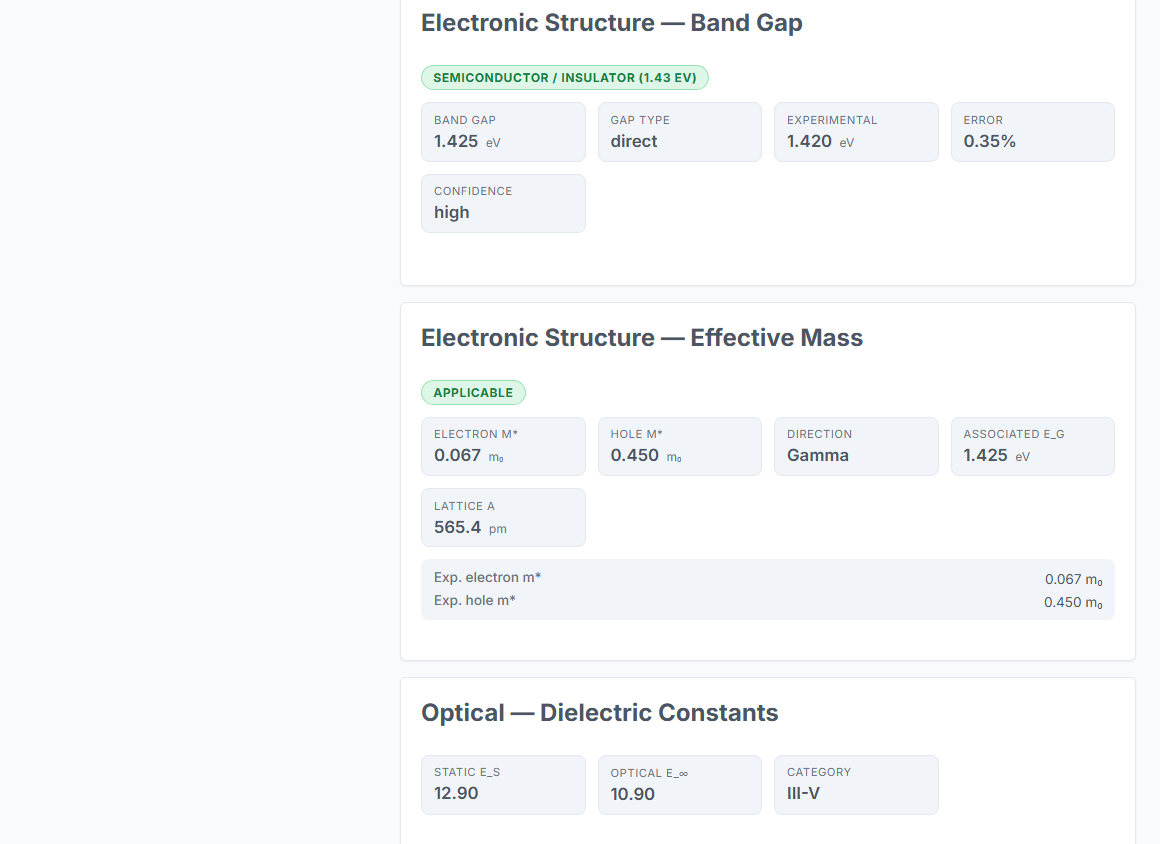
0.237 eV MAE on the 1,048-material public benchmark. 0.9% mean error on the 313-material curated set — DFT-competitive.

Formation energy

0.08 eV / atom MAE — screening-grade accuracy for stability ranking and hull-distance calculations.

📏

Lattice parameters

2.1% MAPE against experimental data, comparable to DFT’s 1–2% range at a tiny fraction of the runtime.

🔗

Crystal bond lengths

1.93% MAPE across 351 truly novel materials and 65 structure categories — from composition alone, sub-millisecond. See benchmark →

🌡️

Thermal conductivity

r2 = 0.87 correlation with experiment. Screening-grade ranking for thermoelectric and heat-management work.

🧲

Curie temperature

7.2% MAPE on 79 ferromagnetic materials across 17 families — ML baselines typically sit at 15–30%.

🎯

Metal vs insulator

100% classification accuracy across the benchmark set. Gap-sign sanity check before any downstream physics.

🔎

Property / elasticity bundle

Bulk modulus, Young’s modulus, sound velocity, Debye temperature — 9 elastic / thermal properties per composition.

🧬

Magnetic order

Ferro / antiferro / paramagnetic classification + saturation magnetisation for the ferromagnetic class — same engine.

How a property is computed

From composition to full property card in sub-millisecond.

1

Composition

Enter formula or pick from the 313-material curated set. The engine parses composition and classifies structural family automatically.

2

Atomic descriptors

Element-level physics primitives (ionisation, electron affinity, polarizability) pulled from the shared atomic-property engine.

3

Property compute

Closed-form expressions evaluate band gap, formation energy, lattice, thermal, magnetic in parallel. Sub-millisecond per property.

4

Classify & bundle

Metal / insulator classification; magnetic order classification; family assignment. The output is a complete property card, not a single scalar.

5

Hand-off

Bundle feeds Battery (electrode screening), Catalyst (surface properties), Semiconductor (mobility / Baliga FoM), Design Studio / Discovery (evolutionary search).

Why you can trust it

Every property validated on a public benchmark with the test-set MAE or MAPE reported.

0.237 eV
Band-gap MAE on the 1,048-material public benchmark. Family-stratified reports on the benchmark page.
0.08 eV/atom
Formation-energy MAE across the 313-material benchmark — screening-grade for stability triage.
2.1%
Lattice-parameter MAPE. Comparable to DFT (1–2%) at sub-millisecond runtime per structure.
7.2%
Curie-temperature MAPE on 79 ferromagnetic materials in 17 families. ML baselines: 15–30%.
r2 = 0.87
Thermal-conductivity correlation with experiment — ranking-grade for thermoelectric and heat-management screens.
0
Fitted parameters. Same composition returns the same property card every run — bit-for-bit.

How FluxMateria compares

Head-to-head against the standard approaches to materials-property prediction.

MetricFluxMateriaDFT (PBE / HSE)ML force fieldMaterials Project lookup
Band-gap MAE0.237 eV0.5–1.0 eVDepends on setReference (exact)
Lattice MAPE2.1%1–2%1–3%Reference (exact)
Curie T MAPE7.2%10–20%15–30%Very limited
Runtime per material< 1 msHours to daysSecondsInstant lookup
Predicts new compositionsYesYes (slow)Within distributionNo
Training dataNoneNoneLarge datasetsData is the tool
Magnetic-order classificationBuilt-inPer-runNot alwaysCatalogue entry
Family-stratified reportPublishedPer-paperUsually missingN/A

The key insight: DFT is the gold standard for materials properties but too slow for library-scale screens. ML force fields are fast within their training distribution and unreliable outside it. Materials Project is exact but only for materials someone already measured. FluxMateria’s engine gives DFT-competitive numbers from composition alone, sub-millisecond per query, with no training set required. See the full materials benchmark →

Where Materials wins

The Materials engine feeds the sub-modules you actually use for design & discovery.

Sub-module

Band gap + full electronic transport

SOTA pure-physics band-gap predictor with the complete electronic-property bundle — 0.237 eV MAE on the 1,048-material public set, ~1 ms per query, zero training data. One call returns band gap, dopant classification, carrier concentration, mobility, conductivity, and heterojunction band-edge alignment. Works ab initio on novel candidates with no measured-property lookups.Open Band Gap →

Sub-module

Battery electrochemistry

Electrode-electrolyte free-energy calculations, phase stability, voltage windows. 0.149 V holdout MAE on voltage prediction.Open Battery →

Sub-module

Catalyst scoring

9-phase readiness scoring, activation barriers, microkinetics, ASF product distribution. 93.4% pairwise-ranking accuracy.Open Catalyst →

Sub-module

Semiconductor design

Live drift-mobility + Baliga / Johnson figures of merit across doping, temperature, alloy. 6.2% μe / 4.4% μh MAPE.Open Semiconductor →

Sub-module

Surface & Contact

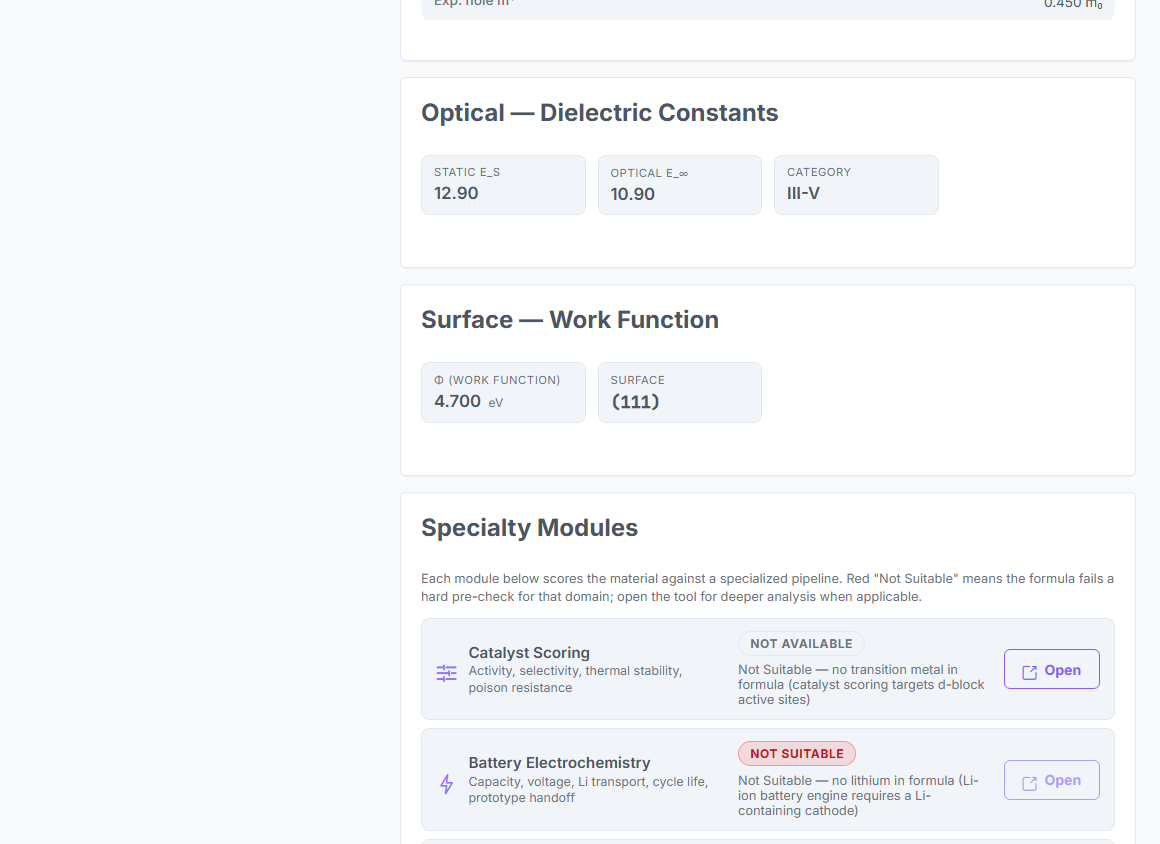
Work function, Schottky barriers, band alignment — 0.063 eV MAE on 35 interface stacks.Open Surface & Contact →

Sub-module

Design Studio

Realtime generative design: spec in, ranked candidates out. 313 curated materials seed every population.Open Design Studio →

Sub-module

Evolutionary Discovery

Round-based evolutionary search toward a spec — superconductor, thermoelectric, battery cathode, custom target.Open Discovery →

Materials in the product

Real captures from the live application. Click any image to zoom.

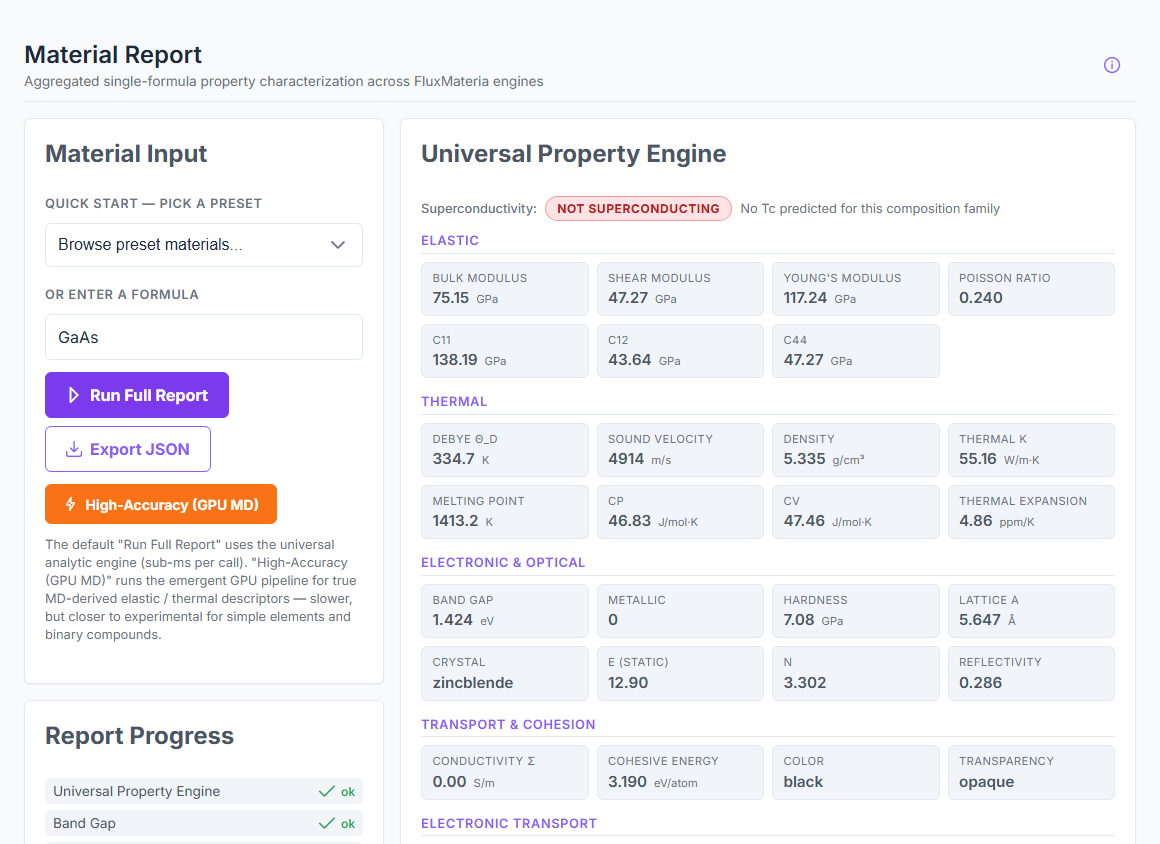
Composition input with structural family classification
Composition inputEnter formula, pick from 313-material curated set. Family is classified automatically.
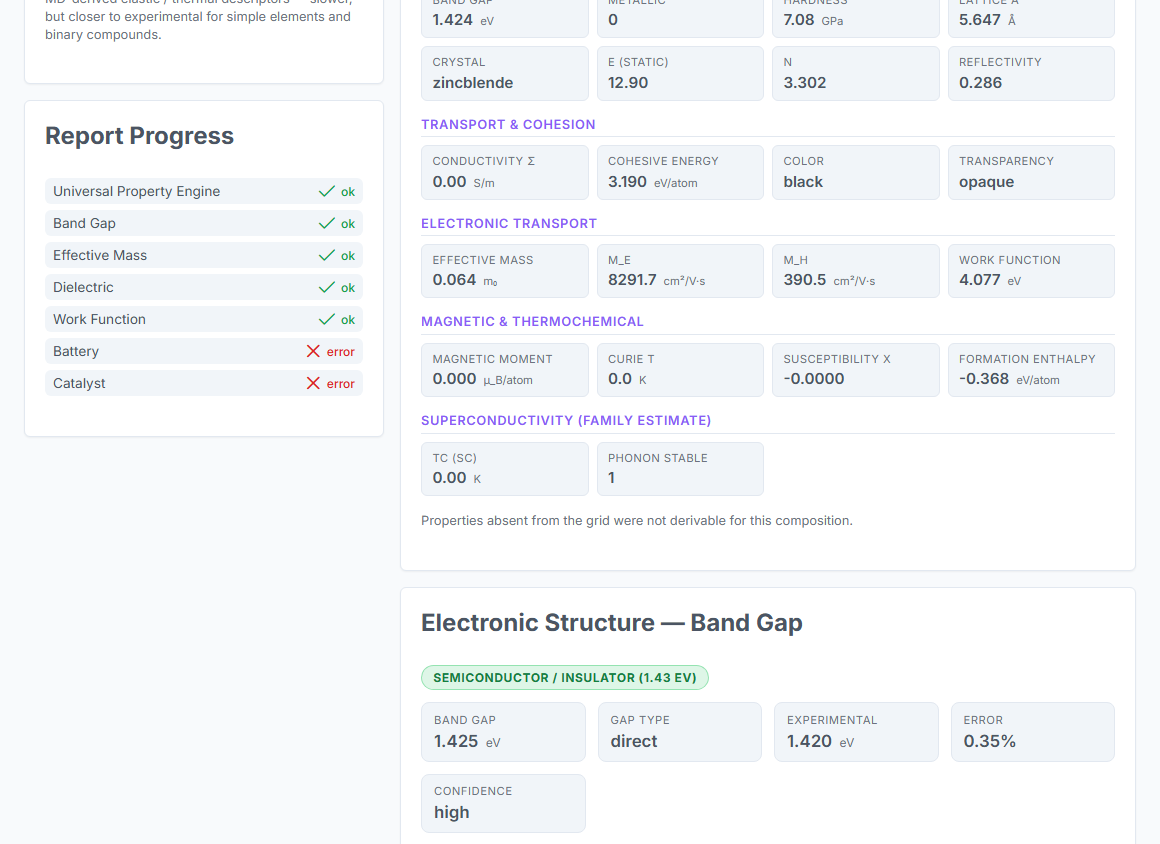
Full property card with band gap, lattice, thermal, magnetic
Property cardBand gap + formation energy + lattice + thermal + magnetic order + elastic bundle — one view.
Per-family benchmark breakdown
Benchmark breakdownFamily-stratified MAE / MAPE for band gap, lattice, Curie, and the thermal-conductivity correlation.
Hand-off to sub-modules (battery, catalyst, semiconductor, discovery)
Hand-offOne-click pipe to the Battery / Catalyst / Semiconductor / Surface / Design Studio / Discovery sub-modules.

Scope & Limitations

Strengths

  • DFT-competitive accuracy on band gap, lattice, formation energy, Curie temperature — at sub-millisecond runtime.
  • 313 curated materials across 14 families, 1,048-material public band-gap benchmark.
  • One composition input returns band gap, formation energy, lattice, thermal, magnetic, and elastic bundle — not a single scalar.
  • Family-stratified benchmarks published — you see where the model is strong and where it drifts.
  • Feeds six specialised sub-modules (Battery, Catalyst, Semiconductor, Surface, Design Studio, Discovery).

Known limitations

  • Strong-correlation systems (heavy 4f lanthanide oxides, some TM oxides) drift wider than the average MAE — flagged in the benchmark.
  • Amorphous solids, organic semiconductors, and most MOFs sit outside the current structure library.
  • Thermal-conductivity is ranking-grade (r2 0.87), not quantitative — use for triage, refine on the top picks.
  • Non-collinear magnetic order is a 2026 roadmap item; today’s engine classifies collinear ferro / antiferro / paramagnetic.

Bring Materials to your program

Pilot access includes the universal Materials engine, all six sub-modules (Battery, Catalyst, Semiconductor, Surface, Design Studio, Discovery), and a Workspace seat for audit-ready runs.

Request Pilot Access →