🔬 FLUXMATERIA — MATERIALS

Evolutionary discovery,
at millisecond evaluations

Define the spec — hard constraints, weighted objectives, preset target profile — and let the engine evolve thousands of candidates per generation. GPU lattice dynamics validates the best for phonon stability; survivors become seeds for the next round.

Constraint DSL Multi-objective GPU phonon validation Round-based iteration No ML
~3 ms
Per-candidate evaluation latency
5,000
Candidates per generation (maximum)
313
Pre-computed materials seed the population
6
Preset target profiles, plus custom specs
0
Trained parameters
The breakthrough

Evolution that actually evaluates the material

Every candidate in every generation is scored on the real properties it would exhibit — band gap, bulk modulus, Debye temperature, superconducting transition, density — at a few milliseconds per evaluation. Constraints reject violators cleanly, objectives steer selection, and a GPU lattice dynamics pass checks that the finalists are actually phonon-stable. You promote the survivors as seeds for the next round and keep going until the spec is hit.

What Evolutionary Discovery does

Every control you need to run a discovery campaign, not just a single generation.

📜

Spec DSL

Hard constraints and soft objectives with standard comparison operators — , , between, in — against any supported property.

🎯

Multi-objective fitness

Maximise, minimise, or target a specific value; each objective carries a weight. Composite fitness drives both elitism and survival for the next generation.

🧭

Preset target profiles

Solar absorber (Shockley–Queisser optimum), thermoelectric, transparent conductor, superconductor candidate, LED emitter, battery cathode — loaded with one click.

🌱

Database seeding

313 pre-computed materials warm the initial population so generation one already has a competitive baseline. User-supplied seed formulas are layered on top.

🧬

Crossover & mutation

Composition mutation, stoichiometry perturbation, and family-aware moves (including superconductor neighbour injection) generate each new generation from the elite pool.

🎛️

Diversity control

A niche-cap filter prevents populations from collapsing onto a single property fingerprint. You explore the space instead of looping on one local optimum.

💎

GPU phonon-stability gate

The top-N candidates are handed to a GPU lattice dynamics pass that flags synthetically implausible structures before you ever ship the list downstream.

🔁

Round-based iteration

Promote survivors as seeds for the next round. Build up a lineage from your starting materials to a ranked short-list — with the generation history preserved.

How a discovery round is built

From spec to a GPU-validated short-list in a single click.

1

Configure

Pick a preset target, write a custom spec, set population / generations / time budget, and paste seed formulas.

2

Initialise

Population is seeded from user formulas, the 313-material database, and random compositions drawn from the allowed element space.

3

Evolve

Each generation: evaluate every candidate, score against objectives, reject constraint violators, apply diversity control, breed from elites.

4

Converge

Best-fitness plateau triggers early stopping; otherwise the run proceeds to the configured generation or time budget.

5

Validate

Top-N candidates go through a GPU lattice dynamics pass that returns phonon stability, refined bulk modulus, and Debye temperature.

6

Promote

Promote survivors as seeds for the next round and iterate. The full generation history is logged for audit and later re-analysis.

Why you can trust it

Numbers from the live engine, not a whitepaper projection.

~3 ms
Per-candidate evaluation (single CPU). 500×10 generation = 5,000 evals in ~15 seconds.
5,000 · 100
Maximum population · maximum generations per single run.
313
Pre-computed materials across 14 families warm every population.
6 presets
Solar / thermoelectric / TCO / superconductor / LED / battery cathode.
GPU gate
Lattice dynamics phonon-stability check on the top-N candidates before hand-off.
0
Trained parameters. Every prediction is deterministic and re-runnable.

How FluxMateria compares

Head-to-head against the usual approaches to materials design.

Metric FluxMateria Random search DFT-based EA ML surrogate
Evaluation latency ~3 ms Not applicable Minutes to hours 1–100 ms
Training data required None None None Thousands per family
Spec DSL Hard + soft No Custom per run Ad-hoc
Phonon-stability gate Built-in Not provided Separate job Not provided
Max population / generation 5,000 Unlimited but blind 10–100 typical Depends on GPU
Out-of-distribution behaviour Degrades gracefully Unchanged Unchanged Confidently wrong
Preset target profiles 6 built-in None None None
Generation history & audit Full log Trace only Usually Opaque

The key insight: Random search is free but blind; DFT-based evolutionary search is honest but slow; ML surrogates are fast but only inside their training distribution. FluxMateria evaluates every candidate with a physics engine in milliseconds, so populations of thousands and generations of dozens fit inside a single run — and the GPU phonon gate weeds out candidates before you look at them. See the spec DSL →

Where Evolutionary Discovery wins

Research workflows where an iterative, phonon-gated search changes what’s tractable.

Use case 1

Superconductor Tc chase

Seed with YBCO or H3S, set the superconductor preset (metallic, θD > 200 K, B > 50 GPa), maximise θD, and push the survivors into the next round.

Use case 2

Solar absorber sweep

Shockley–Queisser preset: band gap 1.1–1.6 eV, target 1.34 eV. Evolves across the III-V / II-VI / chalcogenide families in a single run.

Use case 3

Battery cathode screen

Element-restricted search (Li, Co, Ni, Mn, O, Fe, P), gap < 4 eV, density < 6 g/cm3. Hundreds of stoichiometries evaluated per generation.

Use case 4

Thermoelectric hunt

Narrow gap (0.1–1.0 eV) with low lattice thermal conductivity. The composite objective ranks ZT-relevant candidates without having to compute ZT directly.

Use case 5

Custom target design

Write your own spec — “wide gap > 3 eV AND work function < 4 eV AND element-restricted to earth-abundant” — and the engine runs the search exactly as written.

Use case 6

DFT budget allocation

Run thousands of evolutionary evaluations per target in seconds, Pareto-filter, then spend the DFT budget on the top five GPU-validated candidates only.

Evolutionary Discovery in the product

Real captures from the live application. Click any image to zoom.

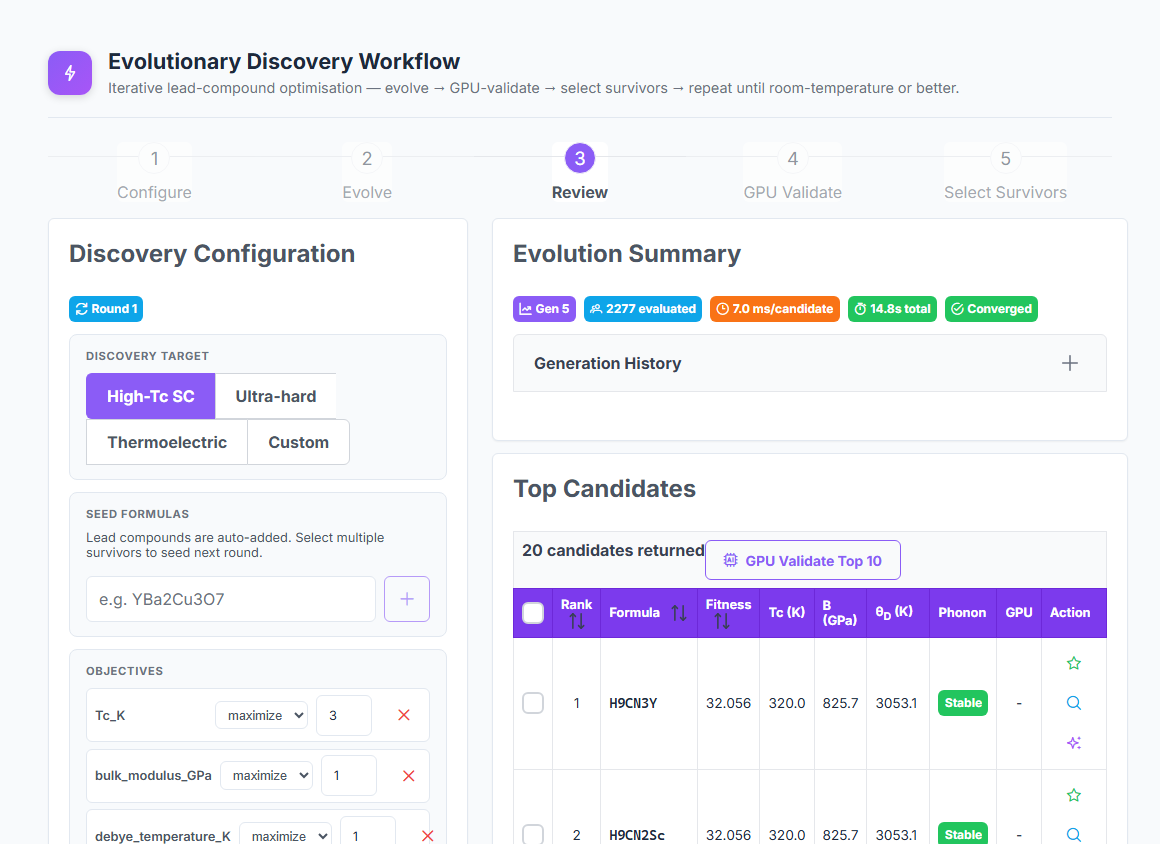
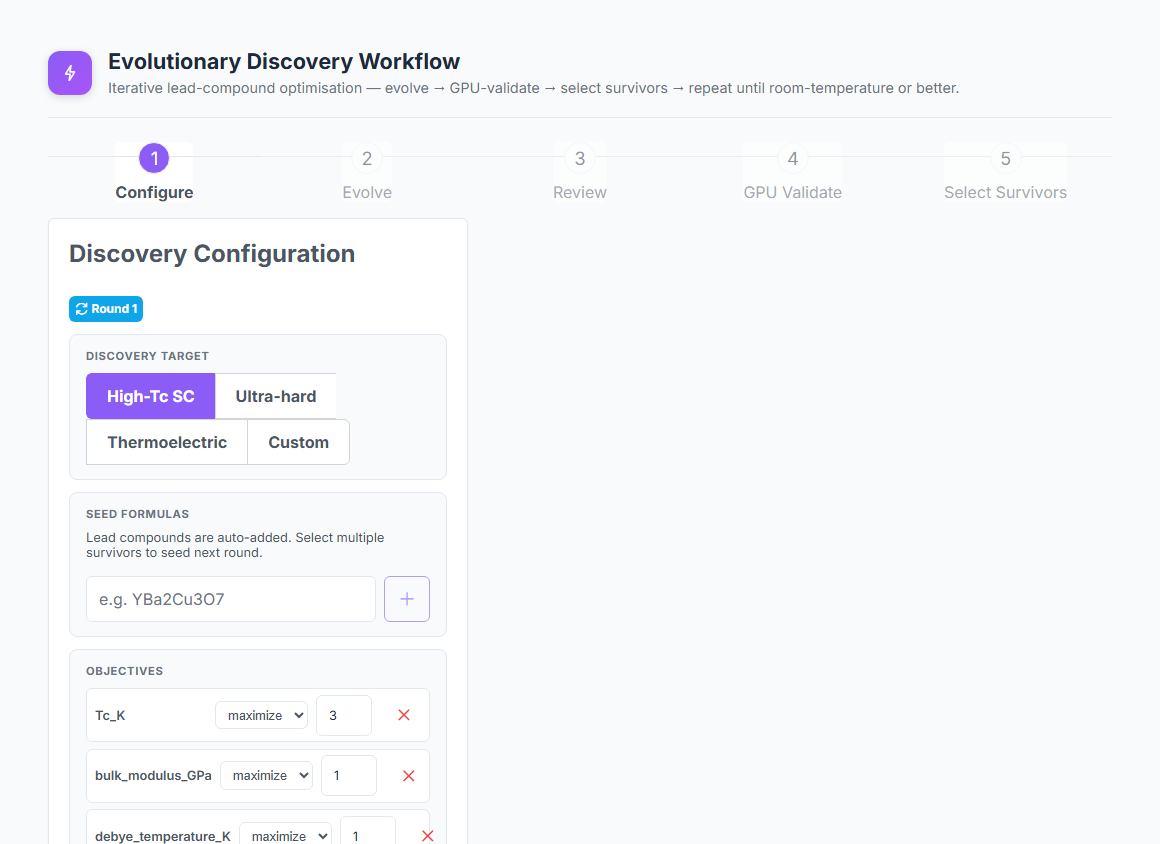
Discovery configuration panel with seed formulas, preset target profile, objectives, and constraint editor
Configuration Seed formulas, preset target, objectives, constraints, and evolution parameters — all on one screen.
Generation history showing fitness progression per generation with best, median, mean, and worst stats
Generation history Per-generation best, median, mean, and worst fitness with elapsed time and unique-formula count.
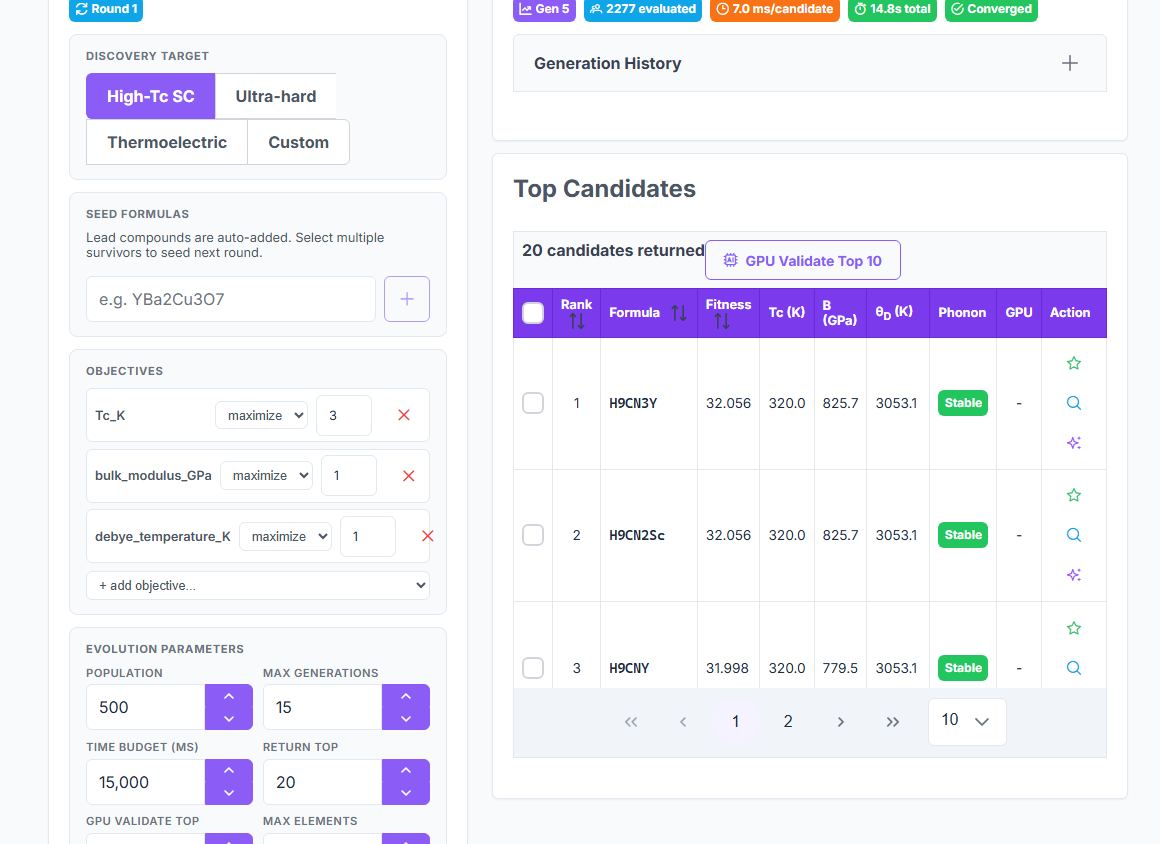
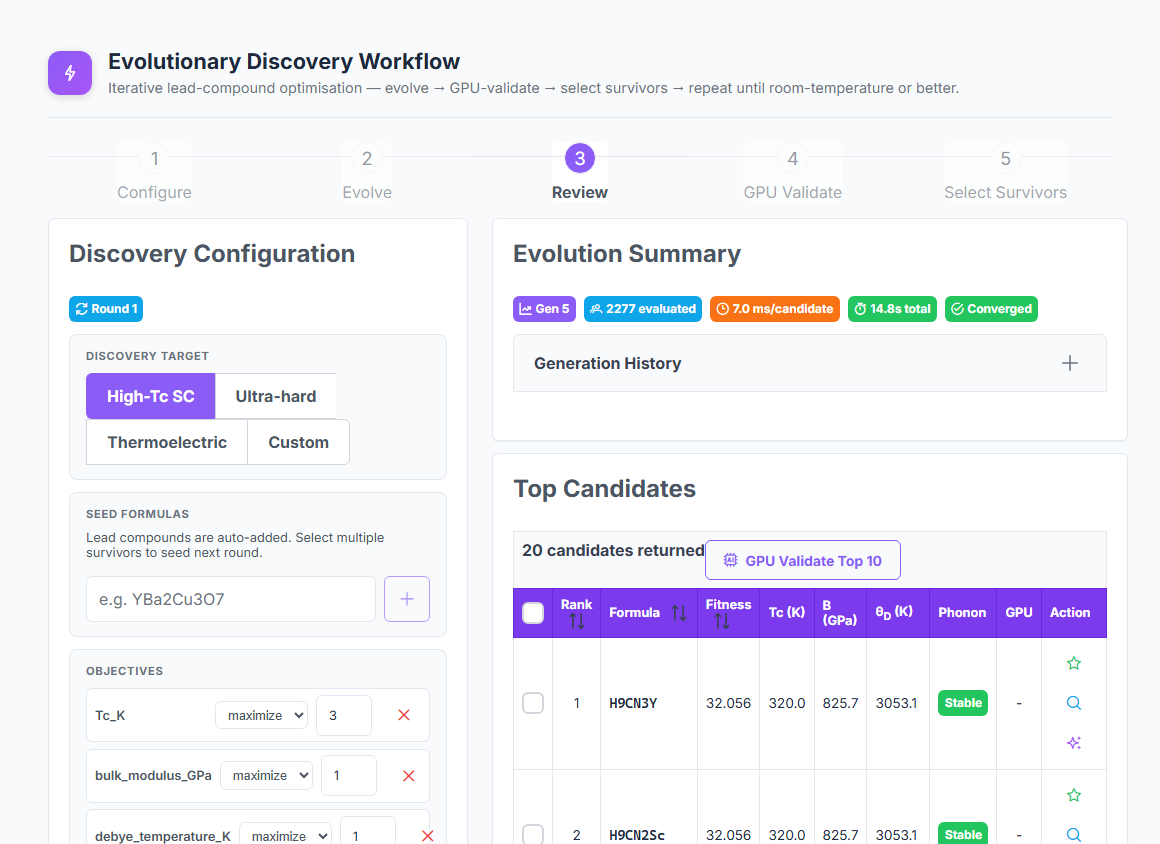
Top candidates table ranked by fitness with formulas, band gap, Debye temperature, bulk modulus, Tc, and phonon-stability flag
Top candidates Ranked shortlist with the headline properties, the phonon-stability flag, and one-click promotion to next-round seed.
Superconductor Tc progress tracker showing reference-material landmarks and the best candidate found so far
Tc progress tracker Reference-material landmarks (YBCO, H3S, room-temperature target) with the best candidate of the run overlaid.

Scope & Limitations

Strengths

  • Up to 5,000 candidates per generation evaluated in seconds — fits inside a single CI run.
  • Hard + soft constraints with standard operators; objectives are multi-weighted, not a single Pareto axis.
  • GPU lattice dynamics filters phonon-unstable candidates before hand-off, so the list you act on is cleaner.
  • Every evaluation is deterministic; re-running the same spec reproduces the same ranked list bit-for-bit.
  • Preset target profiles and the 313-material seed database both shorten the path from blank page to first survivor.

Known limitations

  • Selection is elitist, not true Pareto-front NSGA — if you need a full front you rank the final population yourself.
  • Amorphous materials, MOFs, and most organic semiconductors are outside the current structure library.
  • Charge-neutrality and oxidation-plausibility gates are strict; unusual but real oxidation states can be rejected.
  • GPU phonon validation adds latency; skip it for exploratory rounds and turn it back on for the final shortlist.

Run an evolutionary discovery round

Pilot access includes the full Evolutionary Discovery workflow, the 313-material seed database, GPU phonon validation, and a Workspace seat to keep every round auditable.

Request Pilot Access →