๐Ÿ”ฌ FLUXMATERIA — MATERIALS

Cathode decisions,
made in battery terms

Battery-native screening that goes beyond bulk ranking. Transport, degradation, electrolyte & coating fit, uncertainty, and prototype handoff — in one 26.8 s end-to-end workflow, at 0.149 V calibrated holdout MAE on published voltage data.

Battery-native scoring Interface & electrolyte aware Prototype handoff Uncertainty built-in No ML
0.149 V
Calibrated holdout MAE on published voltage data
26.8 s
End-to-end local workflow per cathode
5 / 5
Scenario alignments passed on the benchmark
4
Decision winners surfaced — bulk, interface, battery-native, build-ready
0
Fitted parameters
The breakthrough

The winner changes when you stop ranking by bulk alone.

Bulk energy ranking tells you which cathode looks best on paper. Interface effects change the winner. Battery-native scoring (transport, degradation, voltage window) changes it again. Electrolyte & coating fit changes it a third time. This module runs all four passes in 26.8 s and returns the prototype-ready winner — with uncertainty bands and the next experiment to run.

What the Battery layer adds

The six passes a cathode decision actually needs.

๐Ÿš€

Transport & fast charge

Topology-aware Li-ion transport, bottleneck screening, anisotropy, defect sensitivity, and rate-capability signals.

๐Ÿ”‹

Degradation & cycle life

Fade-mode breakdown, impedance growth, cracking pressure, voltage-window stress, and cycle-life heuristics.

๐Ÿงช

Electrolyte & coating fit

Interphase risk, oxygen-loss pressure, dissolution risk, and coating recommendations tied to the cathode chemistry.

๐Ÿ’ฐ

Cost & manufacturing

Cost competitiveness + manufacturing-readiness signals folded directly into the battery decision layer.

๐Ÿ“

Uncertainty & active learning

Support-aware confidence, out-of-domain warnings, and experiment recommendations for the next iteration.

๐Ÿ“ฆ

Prototype handoff

Build-facing recommendation package: recommended configuration, validation plan, public / internal disclosure split.

โšก

Voltage prediction

0.149 V calibrated holdout MAE on published cathode voltages — accurate enough for rank-order and absolute screening.

๐Ÿ”—

Feeds the materials stack

Same composition input the universal Materials engine takes. Same output surface feeds Workspace and the Design Studio.

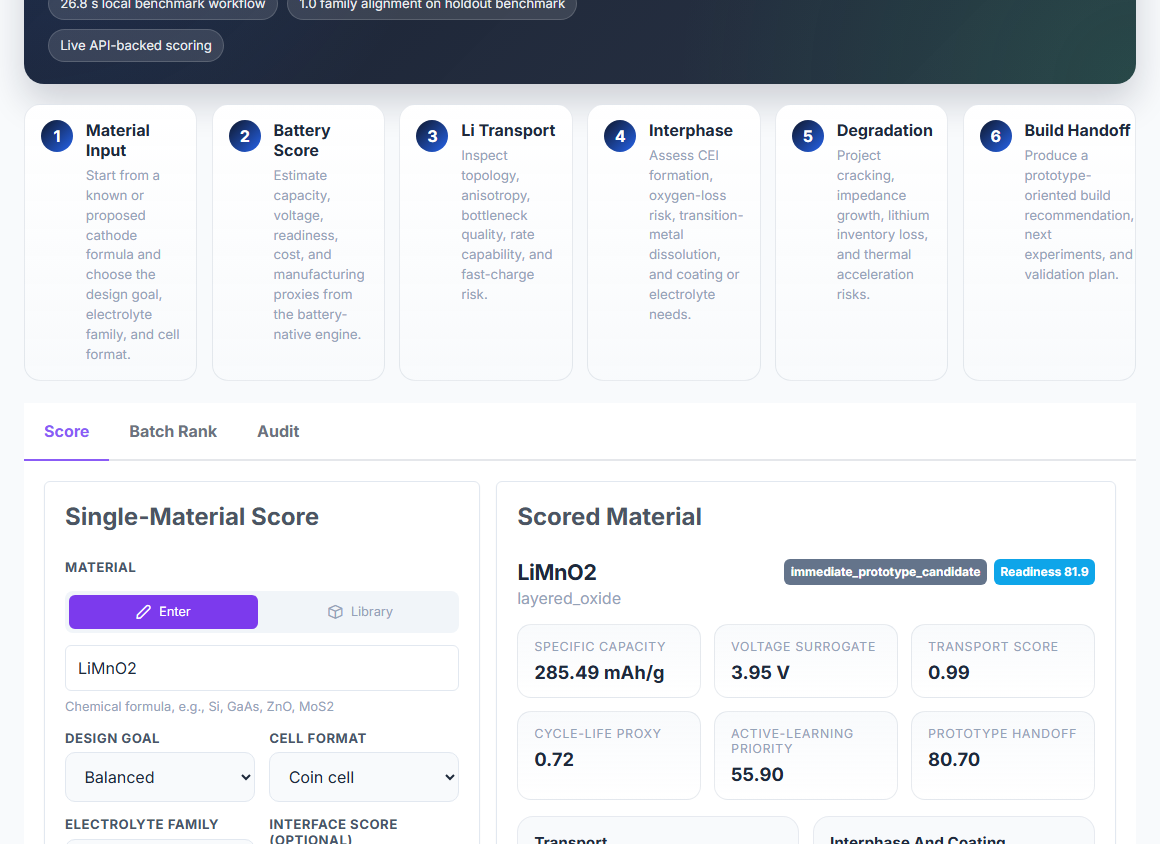
The battery-native pipeline

From composition to prototype handoff in one 26.8 s local workflow.

1

Bulk screen

Classical bulk ranking over candidate cathode compositions from the universal Materials engine.

2

Interface pass

Re-rank for contact, interface, and surface-readiness effects (shared with the Surface & Contact module).

3

Battery-native scoring

Transport, voltage, cycle-life proxies, degradation signals — battery-specific metrics, not bulk analogues.

4

Electrolyte & coating

Interphase risk, mitigation guidance, and chemistry-specific flags attached per cathode candidate.

5

Uncertainty & next step

Support-aware confidence, out-of-domain warnings, and the highest-value next validation experiment.

6

Prototype handoff

Build-facing recommendation package with validation plan and public / internal disclosure split. Ready for the next experimental cycle.

Why you can trust it

Validated against published cathode voltage data with calibrated holdout errors.

0.149 V
Calibrated holdout MAE on the published voltage benchmark — tight enough for absolute voltage calls, not just ranking.
26.8 s
End-to-end local workflow per cathode — bulk + interface + battery-native + electrolyte + uncertainty + handoff.
5 / 5
Scenario alignments passed — the published benchmark’s full scenario-coverage suite.
4
Distinct decision winners across the pipeline passes — proves bulk-alone would have picked the wrong cathode.
Public packet
Case study + benchmark + white paper all published — the numbers are reproducible with public data.
0
Fitted parameters. Same composition + conditions returns the same ranking and uncertainty, every run.

How FluxMateria compares

Head-to-head against the common ways of screening cathodes.

MetricFluxMateriaDFT screeningML voltage modelsMaterials Project lookup
Voltage MAE0.149 V (holdout)0.2–0.4 V0.2–0.5 VReference (exact)
End-to-end runtime26.8 sHours to daysSecondsInstant lookup
Battery-native scoringBuilt-inCustom per paperVoltage onlyNot provided
Electrolyte / coating fitBuilt-inSeparate workflowNot providedNot provided
Uncertainty & next stepPer cathodeManualUsually notN/A
Training dataNoneNoneThousands of cathodesData is the tool
Predicts novel chemistriesYesYes (slow)Within distributionNo
Prototype handoffBuild-facing packageManualNot providedNot provided

The key insight: DFT is honest but too slow to do four passes per cathode. ML voltage models are fast but give you a single number without interface, electrolyte, or uncertainty context. FluxMateria runs the full four-pass pipeline in 26.8 s with 0.149 V holdout MAE — and hands off a build-facing package the wet lab can act on. See the full battery benchmark →

Where Battery wins

Cathode and cell-design workflows where bulk-only ranking gets it wrong.

Use case 1

Early-stage cathode scouting

Generate candidate compositions (via Discovery), score them four ways in 26.8 s, pick prototype-ready winners before committing lab time.

Use case 2

Bulk-vs-battery reality check

Demonstrate that the best bulk ranking is not the best battery-native ranking — with the winner swap documented in the decision trail.

Use case 3

Electrolyte / coating pairing

Given a cathode, surface the electrolyte and coating strategies that reduce interphase risk and oxygen-loss pressure.

Use case 4

Cost-performance trade-off

Fold cost and manufacturing readiness into the ranking. Find the prototype candidate that scales, not just the one with the highest lab voltage.

Use case 5

Active-learning loop

Uncertainty estimates guide the next experiment. Get "which cathode should I measure next?" back as an explicit output.

Use case 6

Audit & disclosure

Every decision, every winner swap, every uncertainty band logged. Public / internal disclosure split included in the handoff package.

Battery in the product

Real captures from the live application. Click any image to zoom.

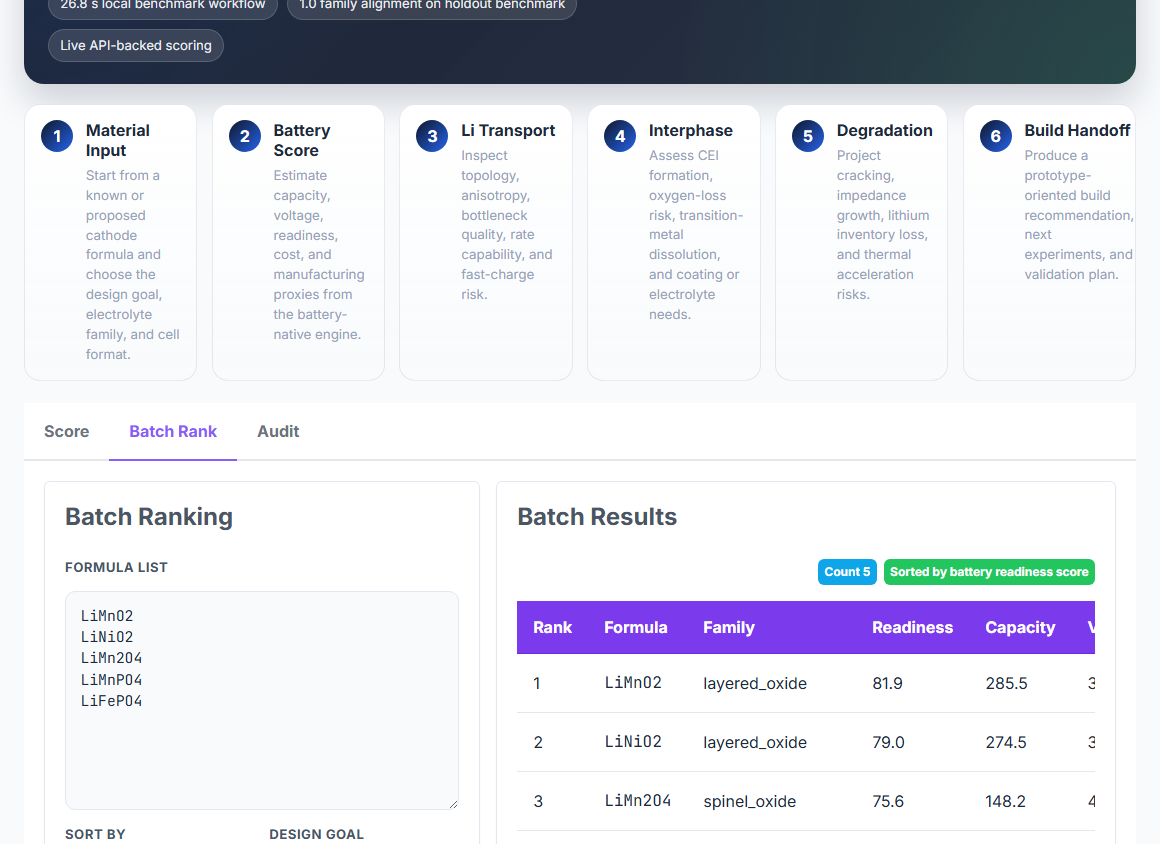
Cathode candidate set with bulk ranking
Candidate setCathode compositions from the universal Materials engine with bulk ranking as the starting point.
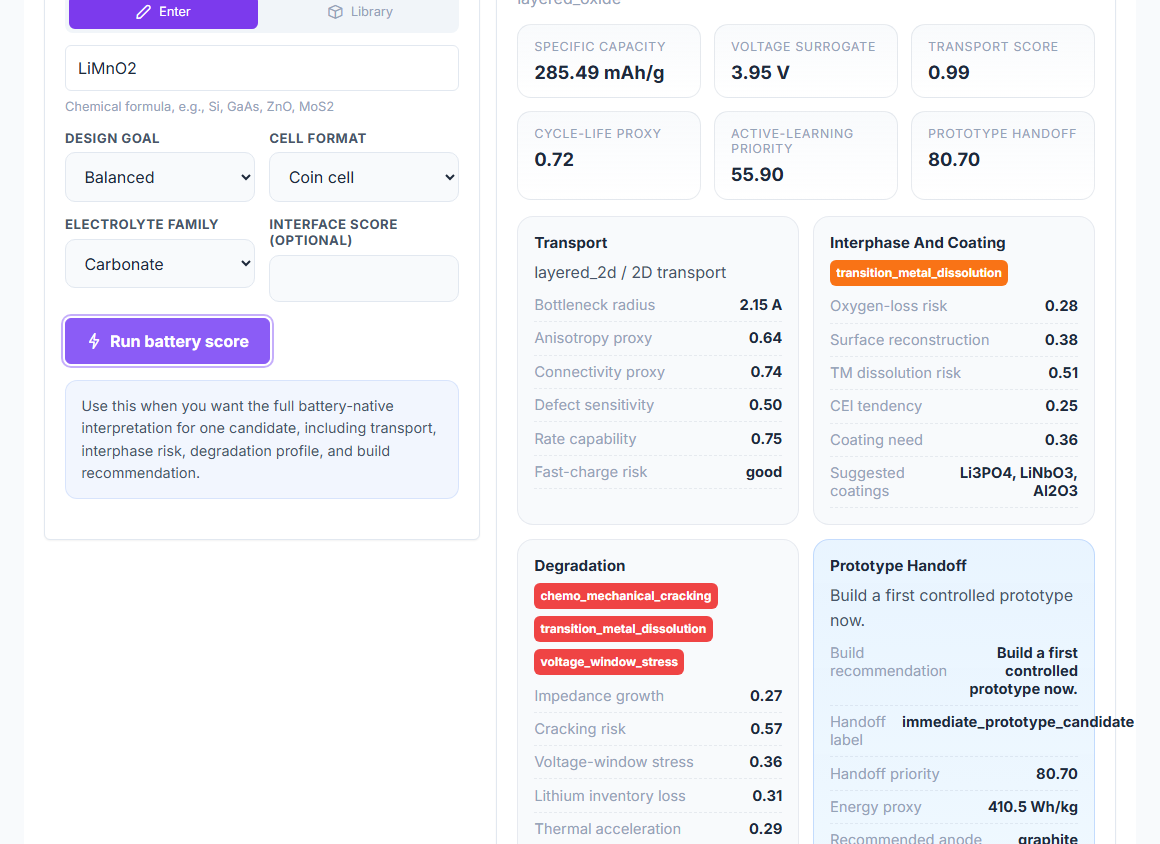
Battery-native scoring with transport, voltage, cycle-life signals
Battery-native scoringTransport, voltage, cycle-life, and degradation signals replace bulk energy as the decision criterion.
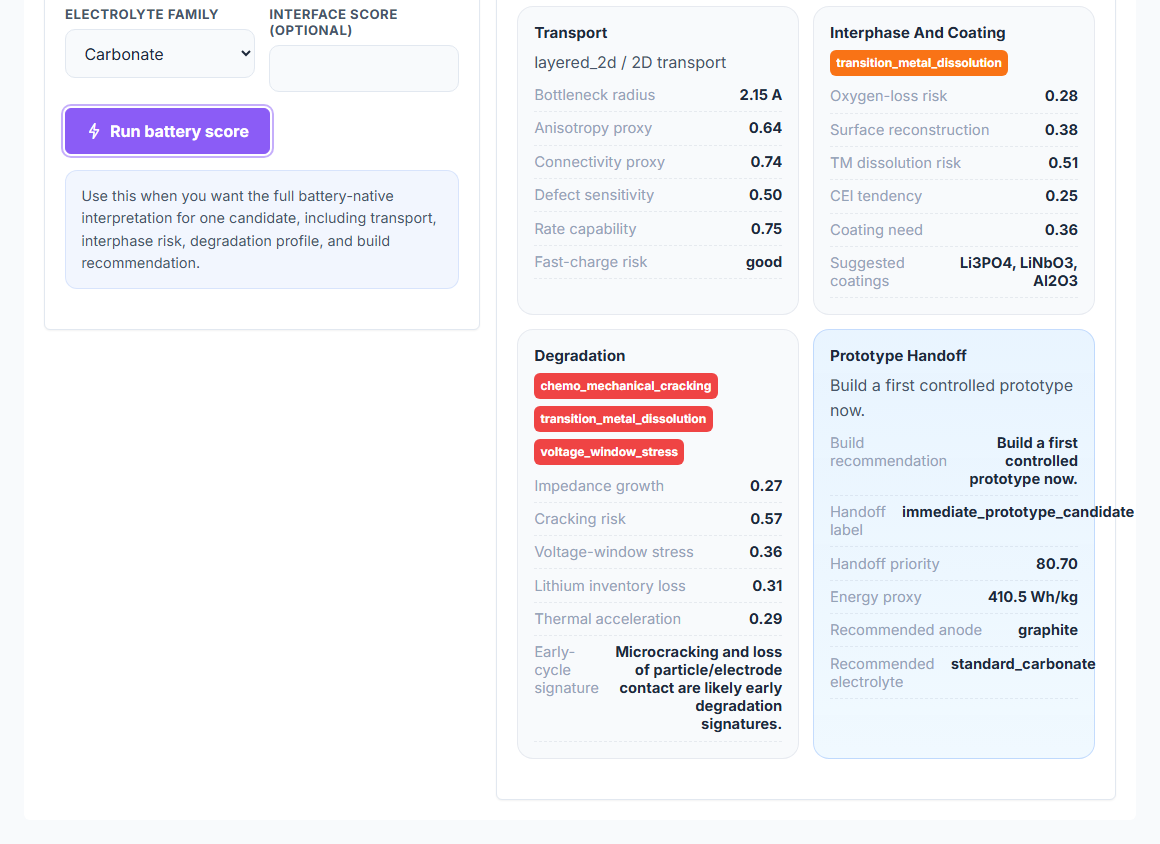
Electrolyte and coating fit panel
Electrolyte & coatingInterphase risk, dissolution risk, oxygen-loss pressure, and coating recommendations per cathode.
Prototype handoff package with validation plan
Prototype handoffBuild-facing package: recommended configuration, validation plan, public / internal disclosure split.

Scope & Limitations

Strengths

  • 0.149 V calibrated holdout MAE — tight enough for absolute voltage calls across Li-ion cathode chemistries.
  • Four-pass decision pipeline (bulk → interface → battery-native → electrolyte / coating) in 26.8 s.
  • Uncertainty and active-learning recommendations per cathode — not a bare ranking.
  • Prototype-handoff package included: validation plan, public / internal disclosure split, ready for the wet lab.
  • Public benchmark + case study + white paper — every number reproducible with public data.

Known limitations

  • Focus today is Li-ion cathode screening; Na / K / multivalent chemistries are on the roadmap but less broadly validated.
  • Rate-capability signal is directional; absolute C-rate limits still need laboratory validation.
  • Solid-electrolyte interphase modelling is risk-aware, not a full kinetic simulation — pair with MD & Free Energy for explicit-SEI work.
  • Full-cell modelling (cathode + anode + electrolyte + separator) sits outside this module; current scope is cathode-centric.

Make your next cathode decision in battery terms

Pilot access includes Battery Electrochemistry, the universal Materials engine, Surface & Contact, Design Studio, Discovery, and a Workspace seat for audit-ready runs.

Request Pilot Access →