FLUXMATERIA — SPECTROSCOPY

Predict spectra before synthesis.

Eight spectroscopy types from one physics engine. UV-Vis, IR, Raman, NMR, CD, EPR, Emission, and X-ray predictions with peak assignments and confidence indicators.

Request Access ← Back to Modules

Capabilities

🌈

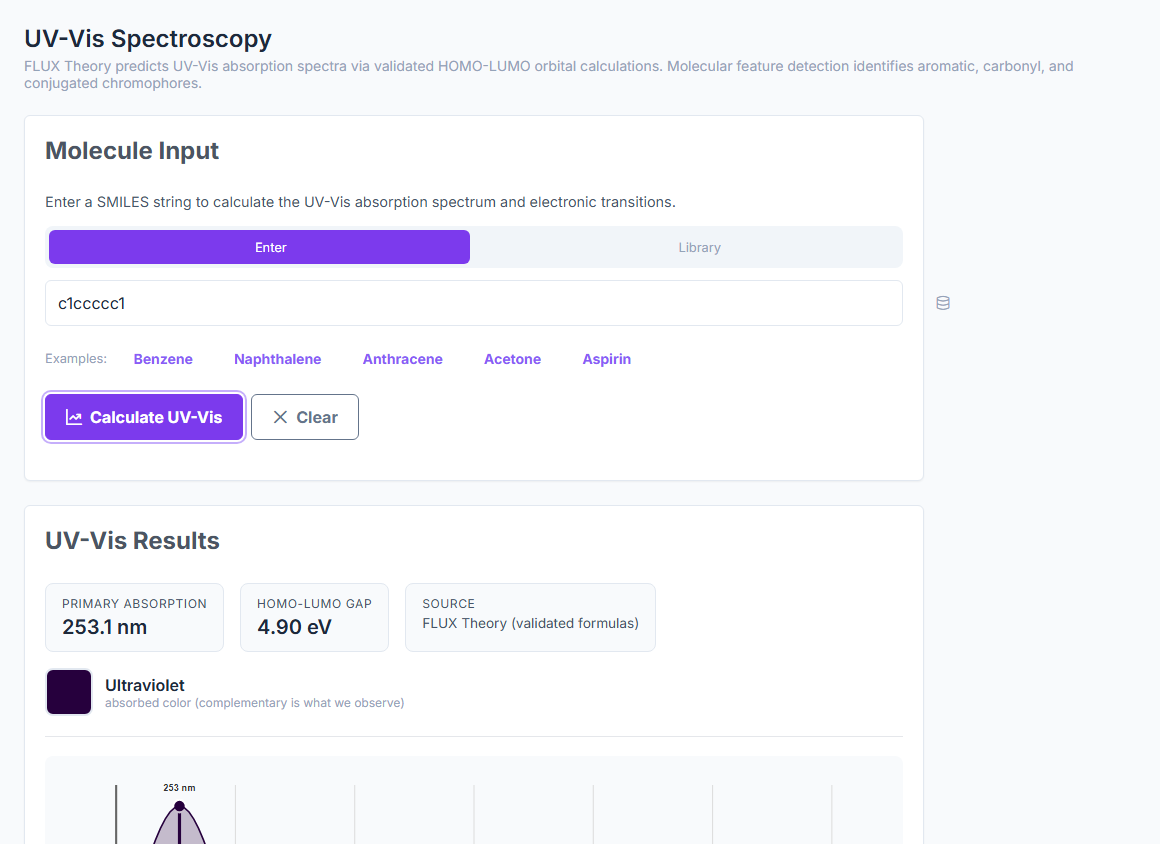
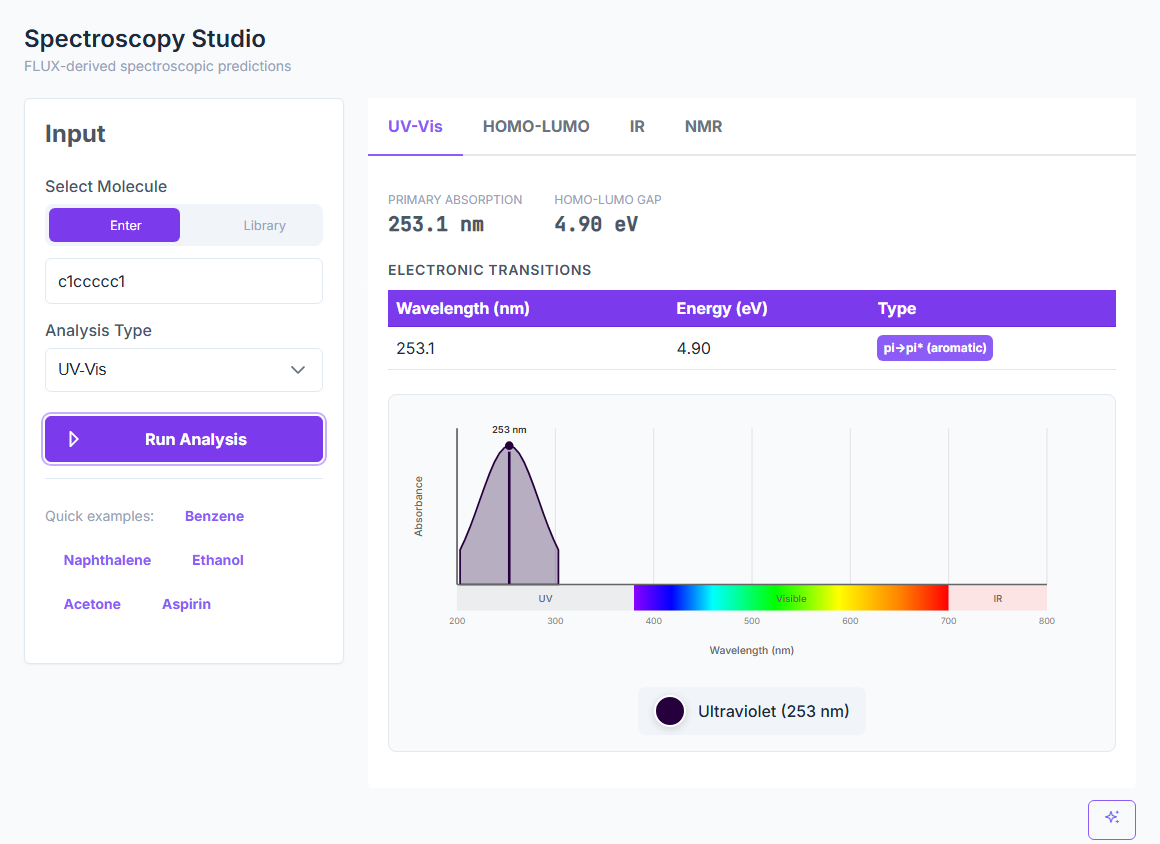
UV-Vis predictions

Electronic transitions, absorption maxima, and extinction coefficients

📊

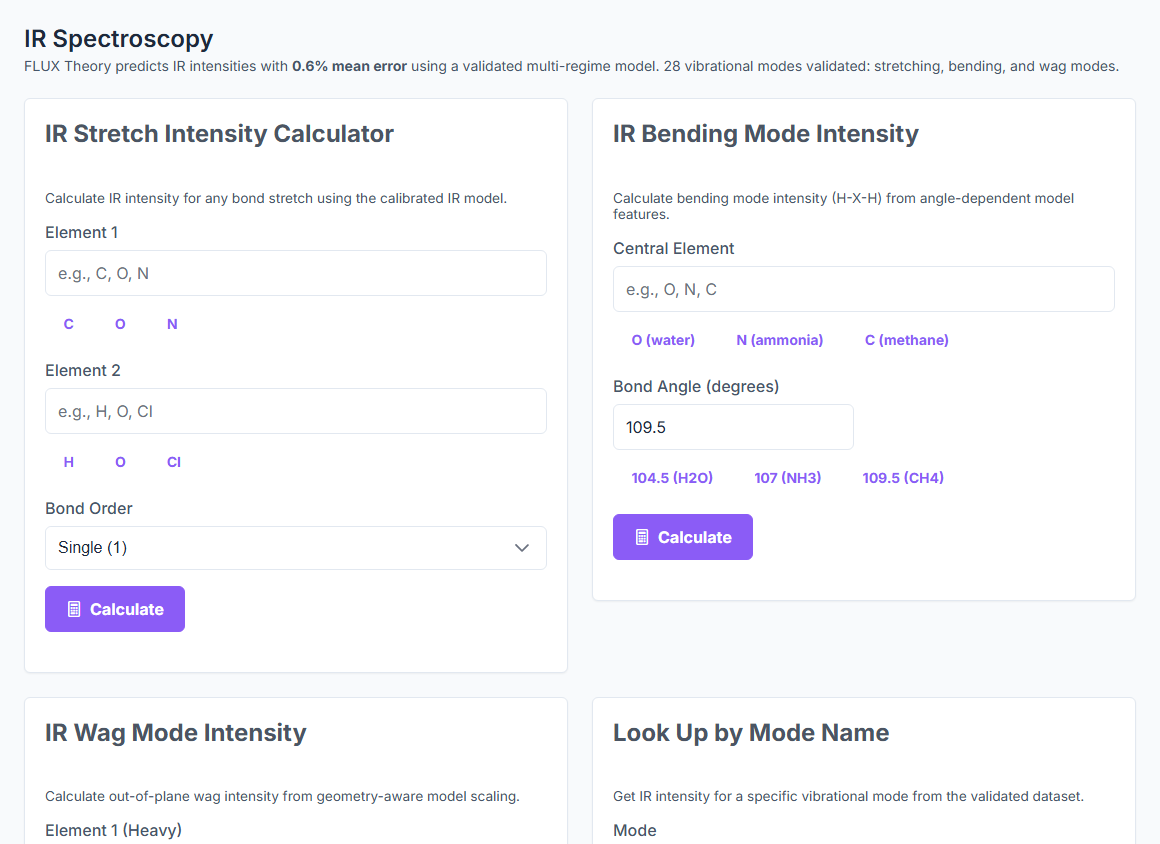
IR spectroscopy

Vibrational modes with peak assignments and functional group identification

🔬

Raman predictions

Raman-active modes, Stokes/anti-Stokes ratios, SERS enhancement factors

HOMO-LUMO analysis

Frontier orbital energies and optical gap predictions

🎯

Peak assignment

Confidence-scored assignments linking peaks to molecular features

📋

Compare spectra

Overlay predicted vs. experimental spectra for validation

🔄

Circular dichroism (CD)

Chiroptical spectra for stereochemistry analysis. Cotton effects and secondary structure signatures

🧲

EPR spectroscopy

Electron paramagnetic resonance for radical and metal center characterization. g-factors and hyperfine coupling

💡

Emission spectroscopy

Fluorescence and phosphorescence predictions. Stokes shifts and quantum yield estimates

☢️

X-ray spectroscopy

XAS and XES predictions for element-specific electronic structure. Edge energies and pre-edge features

The physics advantage

Why first-principles spectroscopy beats ML surrogates for chemical prediction

ML-based approaches

  • Limited to chemical space in training data
  • Unreliable extrapolation for novel structures
  • No physical interpretation of predictions
  • Silent failures on out-of-distribution inputs

FluxMateria Spectroscopy

  • Physics-based: works across chemical space
  • Interpretable peak assignments
  • Confidence indicators for every prediction
  • Generalizes to novel structures reliably

Typical workflow

1

Input

Enter SMILES or upload structure file

2

Select

Choose spectrum types (IR, UV-Vis, Raman)

3

Compute

Physics-based spectral prediction

4

Analyze

Review peaks with assignments

5

Compare

Overlay with experimental data

6

Export

Spectrum files and reports

Typical use cases

Synthesis planning

Predict expected spectra before synthesis to plan characterization strategy and set success criteria.

Structure confirmation

Compare predicted spectra against experimental data to confirm synthesized product identity.

Photophysical screening

Screen candidates for optical properties — absorption ranges, emission characteristics, color prediction.

Impurity identification

Match unknown spectral features to predicted signatures of potential impurities or degradation products.

The Results

Validated benchmark data across UV-Vis, IR, and NMR

6.2%
UV-Vis mean error
<1%
IR mean error
0.3-0.5
NMR MAE (ppm)
50
UV-Vis molecules
~25ms
per prediction
View full benchmark data →

8 Spectroscopy Types

UV-Vis, IR, NMR, and Raman are production-validated. CD, EPR, Emission, and X-ray are working and actively being benchmarked.

Production (benchmarked):

  • UV-Vis absorption predictions (50 molecules validated, 6.2% error)
  • IR vibrational mode analysis (32 NIST molecules, <1% error)
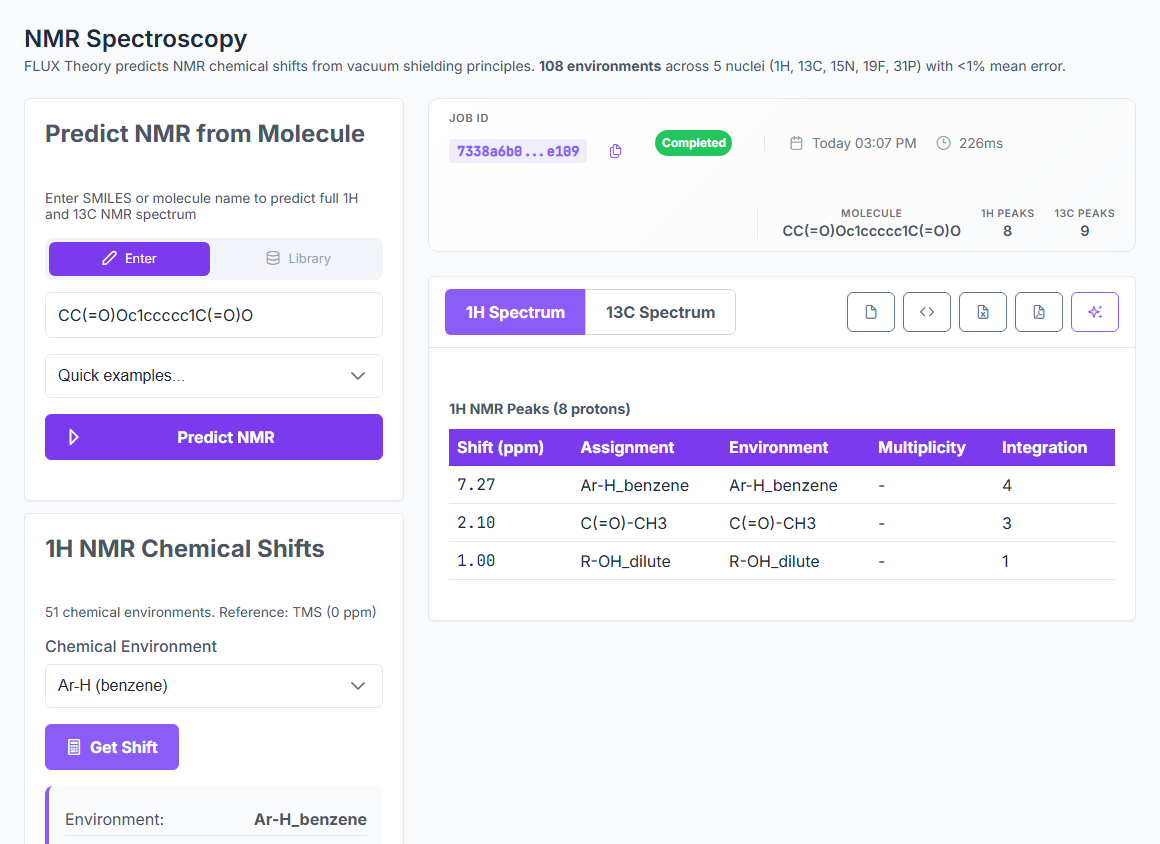
  • NMR shift predictions (10 SDBS molecules, 0.3-0.5 ppm MAE)
  • Raman spectrum predictions
  • HOMO-LUMO frontier orbital energies

Working (validation in progress):

  • CD spectroscopy — chiroptical analysis, Cotton effects
  • EPR spectroscopy — radical/metal characterization, g-factors
  • Emission spectroscopy — fluorescence, phosphorescence, Stokes shifts
  • X-ray spectroscopy — XAS/XES, edge energies

Evaluate Spectroscopy

View the demo

See IR, UV-Vis, and Raman predictions in action with peak assignments and confidence scores.

View Demo →

Join the beta

Tell us about your spectroscopy workflow. We're looking for partners to shape the final product.

Request Beta Access →