FLUXMATERIA — LIFE SCIENCE SAFETY

Drug-induced liver injury risk,
decomposed for safety teams

FluxMateria turns drug-induced liver injury (DILI) prediction into an auditable mechanism circuit: calibrated parent risk, liver exposure, transporter retention, cytochrome P450 (CYP) enzyme context, injury chemistry, optional dose-window behavior, confidence, and the score trace that explains the call.

Mechanism attribution Exposure-aware Dose-window sweep Audit trace Portfolio triage
0.9597
Area under receiver operating characteristic curve (AUROC) on comparable Therapeutics Data Commons (TDC) binary task
0.9275
Hepatotox cross-panel AUROC
12.95 / s
Parent DILI path molecules per second locally
Traceable
Score, class, confidence, mechanisms, and calculation trace
What changed

From a binary toxicity flag to a safety-review packet.

Binary models answer whether a compound resembles historical DILI cases. FluxMateria also answers why: whether the risk is driven by liver entry, impaired hepatobiliary efflux, CYP-mediated metabolic context, reactive injury chemistry, chronic exposure pressure, or a dose range where the risk starts to rise. The result is usable in governance meetings, not just as a screen-ranking column.

DILI mechanism coverage at a glance

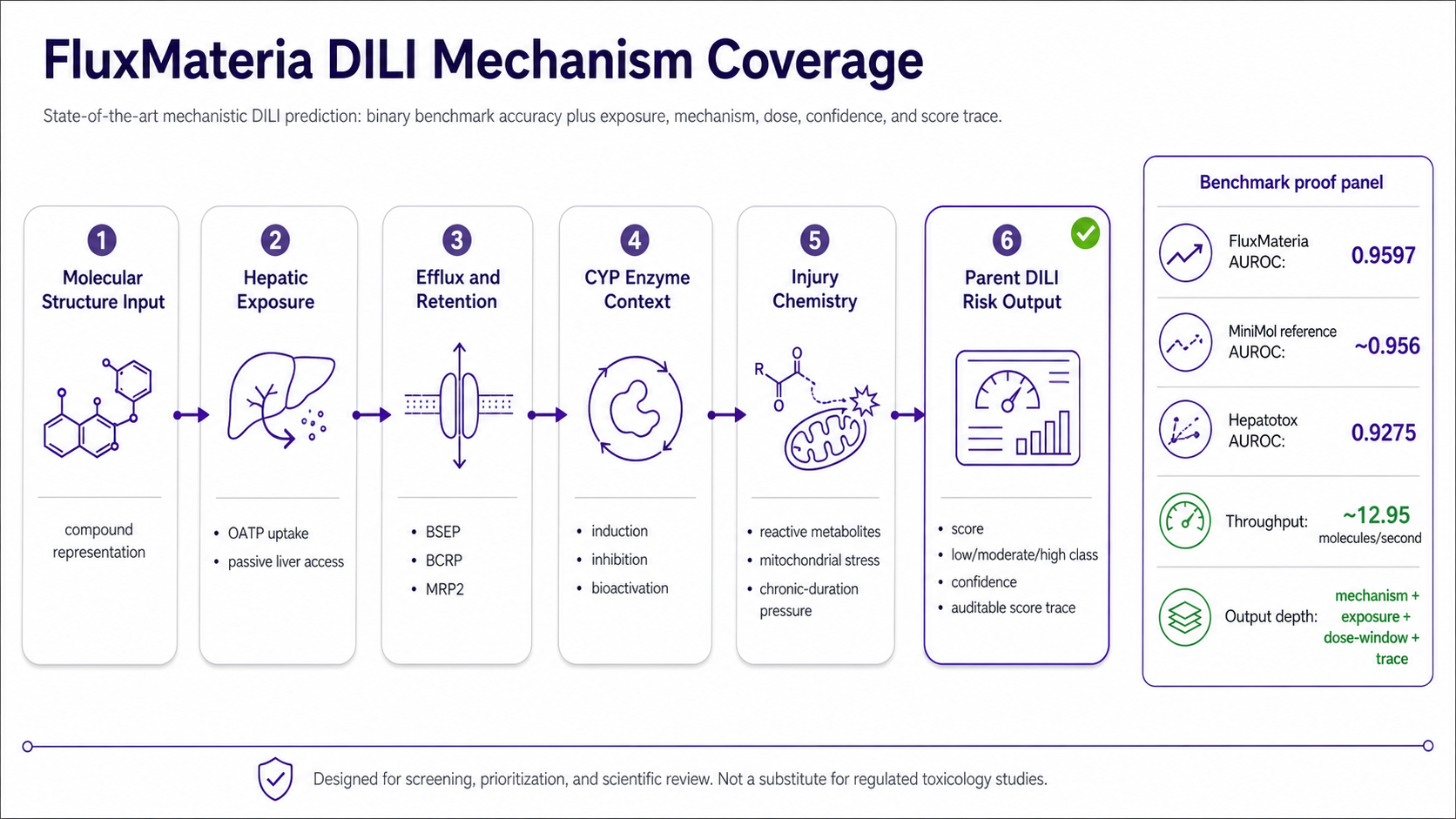
The mechanism map shows how FluxMateria moves from molecular structure to liver exposure, retention, enzyme context, injury chemistry, dose-window behavior, and an auditable parent risk score.

FluxMateria DILI mechanism coverage infographic showing molecular structure input, hepatic exposure, efflux and retention, cytochrome P450 enzyme context, injury chemistry, and parent DILI risk output.
FluxMateria DILI coverage is organized as a reviewable safety circuit: exposure in, clearance out, enzyme context, injury chemistry, dose-window sensitivity, confidence, and score trace.

DILI mechanism coverage

Coverage is organized the same way a translational safety team reviews liver liability: exposure in, clearance out, enzyme context, injury chemistry, and decision trace.

Layer Scientific question Enterprise output Status
Parent DILI score What is the integrated liver-injury risk for this molecule? Numeric score, low/moderate/high class, confidence, and escalation rationale. Production
Liver-entry context Is the molecule likely to reach hepatocytes at meaningful exposure? Organic anion transporting polypeptide (OATP) uptake context and exposure pressure. Production
Hepatobiliary retention Could the compound accumulate through impaired canalicular clearance? Bile salt export pump (BSEP), breast cancer resistance protein (BCRP), and multidrug resistance-associated protein 2 (MRP2) signals. Production
CYP enzyme context Does metabolism, inhibition, induction, or bioactivation change the risk picture? CYP-linked contribution to parent DILI scoring and mechanism explanation. Production
Injury chemistry Does the structure carry chemistry consistent with direct or metabolite-mediated liver injury? Reactive-metabolite, mitochondrial-stress, chronic-duration, and phenotype-specific evidence. Production
Dose-window behavior Where does risk begin to rise as projected exposure increases? Optional dose/concentration sweep for sensitivity review and candidate prioritization. Optional
Audit trace Can reviewers see how the final score was reached? Structured calculation trace with baseline, mechanism deltas, confidence gates, and final class. Production

How the circuit reads a molecule

The engine separates molecular access, persistence, metabolic context, injury chemistry, and confidence before producing the final safety call.

1

Molecular intake

Normalize the structure and compute the core safety profile used across the absorption, distribution, metabolism, excretion, and toxicity (ADMET) panel.

2

Hepatic exposure

Evaluate liver-entry and retention context, then separate transient exposure from sustained hepatocyte pressure.

3

Mechanism attribution

Assess CYP enzyme context, transporter retention, injury chemistry, and dose-window behavior as separate evidence layers.

4

Parent score

Combine the evidence into a calibrated risk class with confidence and a calculation trace suitable for review.

Where enterprise teams use it

The DILI engine is built for screening programs where ranking alone is not enough; reviewers need mechanism, confidence, and provenance.

Portfolio safety triage

Prioritize programs by liver-liability mechanism, not only by a yes/no hepatotoxicity label.

Lead optimization governance

Track whether analog changes reduce the specific exposure, enzyme, transporter, or injury-chemistry driver.

Translational toxicology review

Export an auditable evidence packet for safety review, candidate nomination, and follow-up assay planning.

Dose-window sensitivity

Use optional dose/concentration sweeps to identify the exposure range where risk begins to rise.

Novel-scaffold challenge

Low-confidence calls are surfaced explicitly, so unusual chemistry is flagged for experimental confirmation rather than hidden inside an overconfident score.

Integrated ADMET review

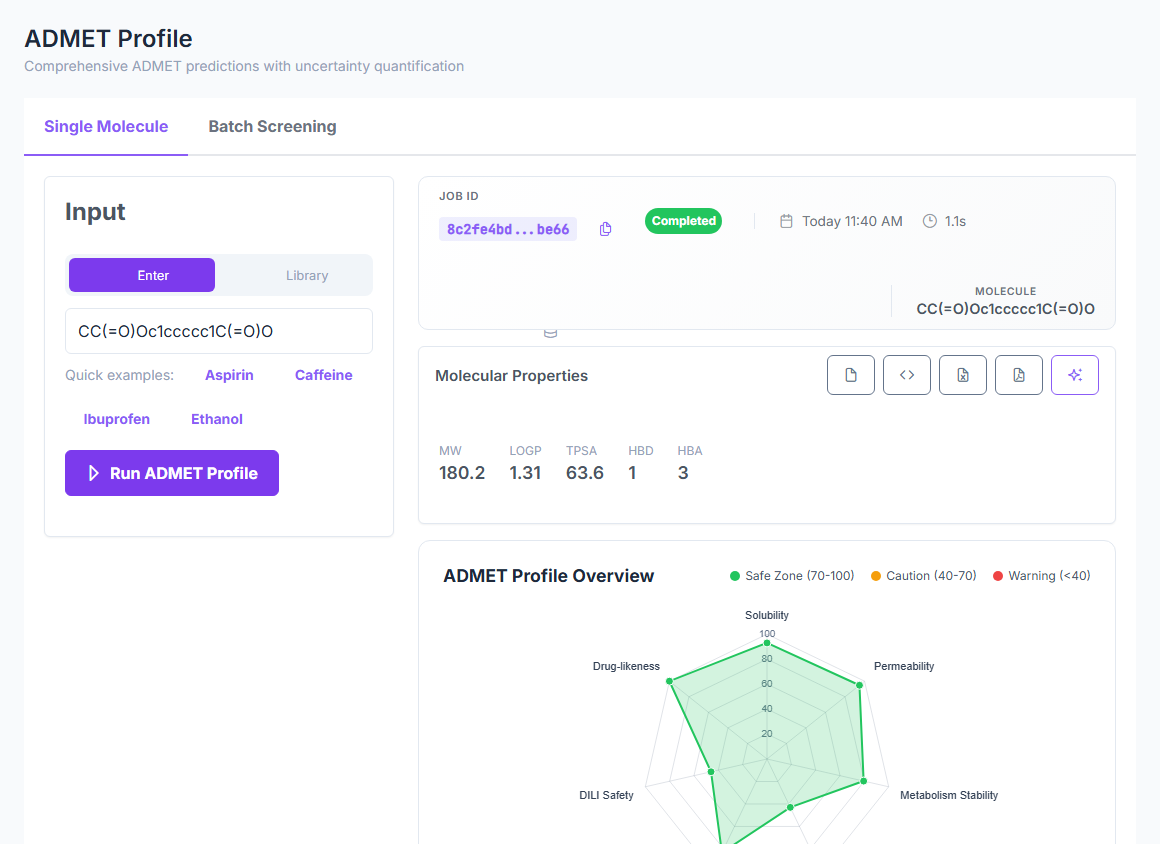
DILI results sit beside solubility, permeability, plasma protein binding, metabolism, human ether-a-go-go-related gene (hERG), and CYP panel outputs.

DILI in the product workflow

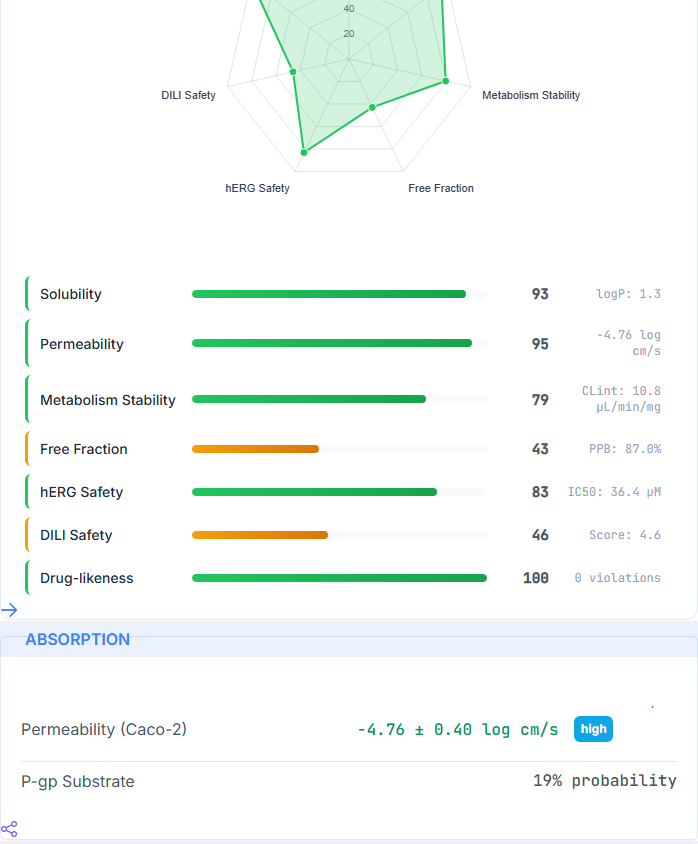
DILI is surfaced inside the same ADMET interface used for full-profile screening, batch review, and decision-packet export.

Single-molecule ADMET profile with DILI risk and confidence displayed alongside other endpoints
Full ADMET profileDILI is interpreted beside absorption, distribution, metabolism, excretion, and toxicity endpoints rather than isolated as a standalone label.
Decision packet with endpoint breakdown, DILI score, and review-ready outputs
Decision packetOutputs are formatted for review: endpoint values, confidence, risk class, and mechanism context in one reproducible packet.

Benchmark position

FluxMateria clears the comparable public binary benchmark reference while delivering the mechanism, exposure, dose-window, confidence, and score-trace outputs safety teams need.

State-of-the-art position

FluxMateria is state-of-the-art for mechanistic DILI prediction.

On the comparable Therapeutics Data Commons (TDC) binary drug-induced liver injury (DILI) task, FluxMateria reaches area under receiver operating characteristic curve (AUROC) 0.9597 versus the MiniMol public reference around AUROC 0.956. The commercial significance is not only the binary accuracy: FluxMateria also returns the mechanism attribution, liver-exposure context, optional dose-window behavior, confidence, and score trace behind the decision.

0.9597 FluxMateria AUROC on the comparable TDC binary DILI task.
~0.956 MiniMol public AUROC reference on the binary benchmark.
Mechanistic Score, class, confidence, exposure, mechanisms, dose-window, and trace.

Comparable public binary task

AUROC 0.9597 on the comparable TDC DILI task, compared with the MiniMol reference around AUROC 0.956.

Cross-panel evidence

DILIRank novel-like AUROC 0.9063 and hepatotox-validated novel-like AUROC 0.9275 support broader clinical-risk transfer.

Throughput

Parent DILI path runs at about 12.95 molecules per second locally. MiniMol speed is not verified from the public leaderboard.

Output depth

FluxMateria returns score, class, confidence, mechanism attribution, exposure context, optional dose-window behavior, and score trace.

Scientific claim: The benchmark comparison is not binary-only apples-to-apples. FluxMateria clears the comparable MiniMol AUROC reference while returning mechanistic and governance outputs that a binary classifier does not attempt to provide. Review the detailed DILI benchmark →

Scope & limitations

Best use

  • Early discovery and lead-optimization safety triage.
  • Mechanism-aware candidate comparison across a series.
  • Compound-review packets where confidence and rationale matter.
  • Prioritizing experimental follow-up for transporter, CYP, and injury-chemistry hypotheses.

Boundaries

  • Designed for screening, prioritization, and review support; not a substitute for regulated toxicology studies.
  • Novel chemistry outside validated space is flagged through confidence rather than hidden behind an overconfident class.
  • Dose-window outputs are optional and should be interpreted with program-specific exposure assumptions.
  • Mechanism attribution is decision support, not a claim of confirmed clinical causality.

Bring DILI into the nomination review

Pilot access includes the DILI engine inside the full ADMET panel, batch mode, decision-packet export, and Workspace lineage for reproducible review.

Request enterprise access → Detailed benchmark Back to ADMET