FLUXMATERIA — ADMET

ADMET screening that tells you what it knows — and what it doesn't.

Run full developability panels on candidate sets. Get predictions with confidence indicators. Export decision packets for downstream review.

Schedule Demo Request Pilot Access

Capabilities

📋

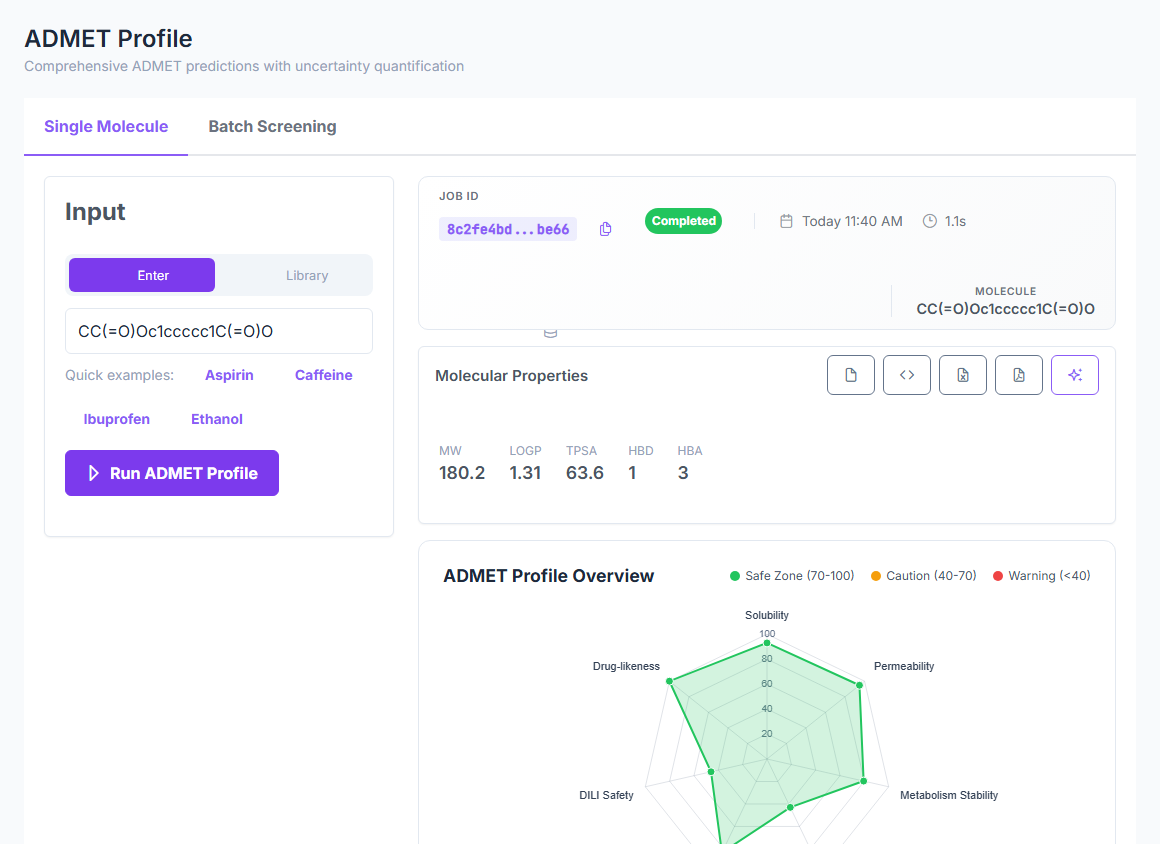
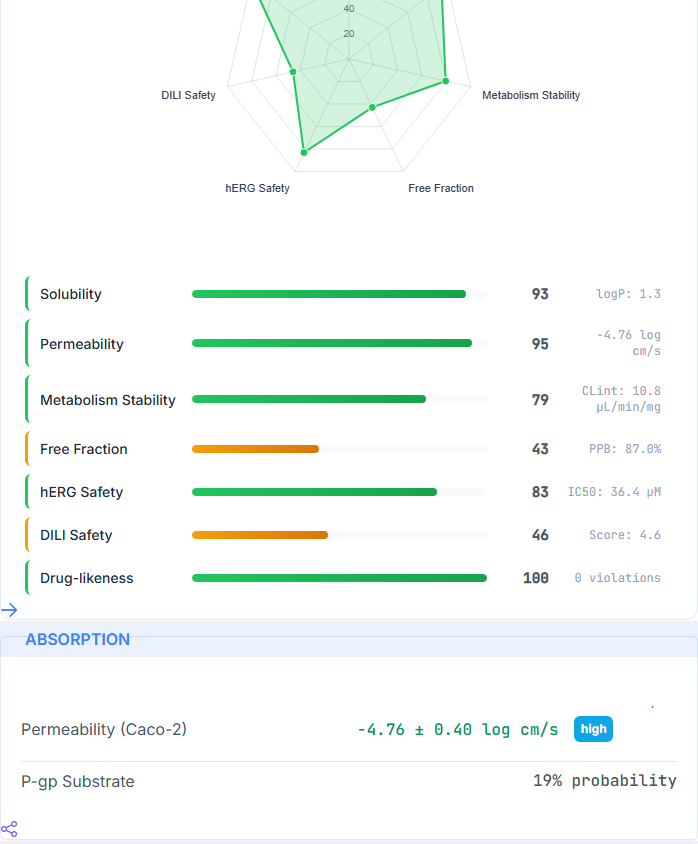
Full ADMET panel

Absorption, distribution, metabolism, excretion, toxicity endpoints

⚛️

Physics-grounded

Deterministic hybrid inference with interpretable, confidence-aware outputs

📊

Confidence indicators

Know how much to trust each prediction

📦

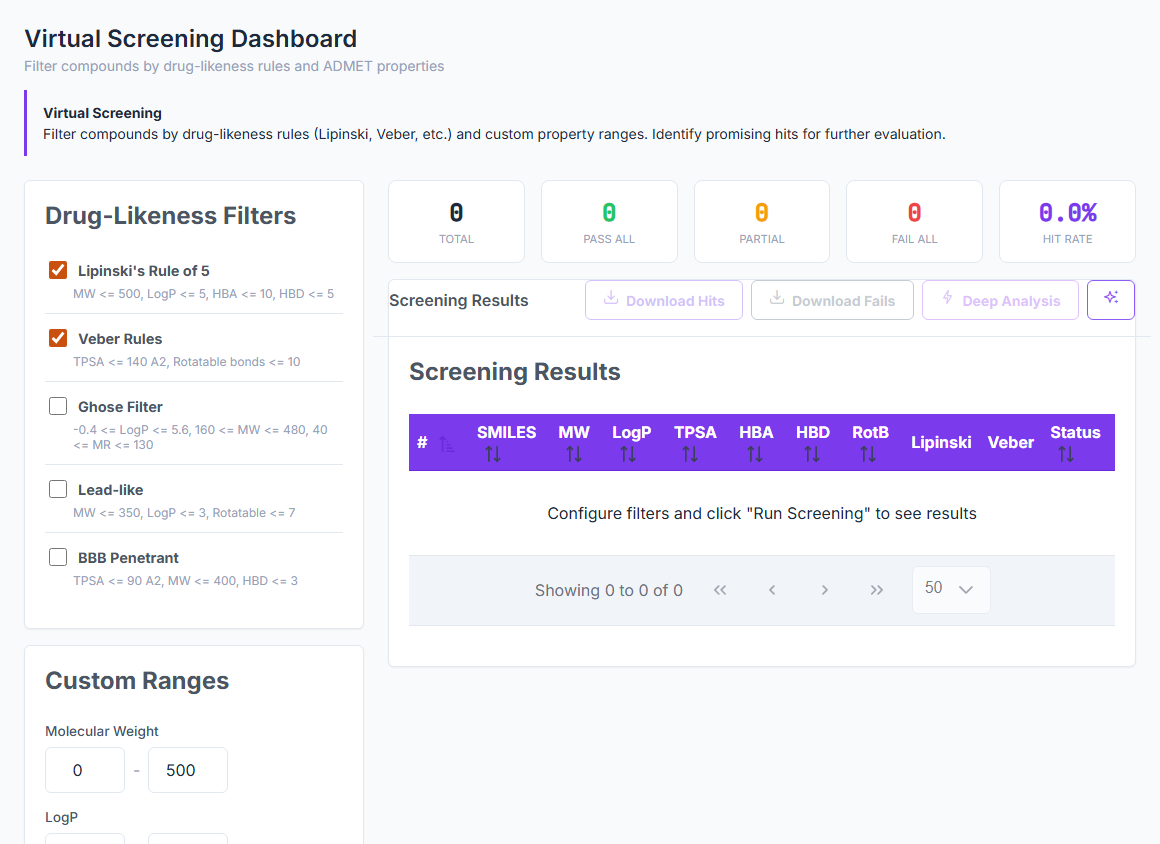
Batch processing

Screen entire candidate sets efficiently

📤

Exportable reports

Decision packets with full provenance

⚖️

Comparison tools

Side-by-side candidate evaluation

SOTA Comparison

Head-to-head against the Therapeutics Data Commons (TDC) ADMET leaderboard — the standard benchmark for ML-based ADMET prediction.

3
#1 SOTA
Solubility, Metabolism, PPB
4
Near-SOTA
BBB, hERG, DILI, CYP
FluxMateria vs TDC Leaderboard #1
Endpoint Metric FluxMateria TDC #1 TDC #1 Method Verdict
Solubility MAE ↓ 0.06 0.741 MiniMol (pretrained GNN) 🏆 #1 SOTA
Metabolism Spearman ↑ 0.692 0.536 CFA (GNN ensemble) 🏆 #1 SOTA
PPB MAE ↓ 2.24% 7.44% MapLight+GNN 🏆 #1 SOTA
BBB AUROC ↑ 93.3% acc 0.924 MiniMol (pretrained GNN) Near-SOTA
hERG AUROC ↑ 0.850 0.880 MapLight+GNN (648 cpds) Near-SOTA
DILI AUROC ↑ 0.878 0.956 MiniMol (binary, 475 cpds) Near-SOTA
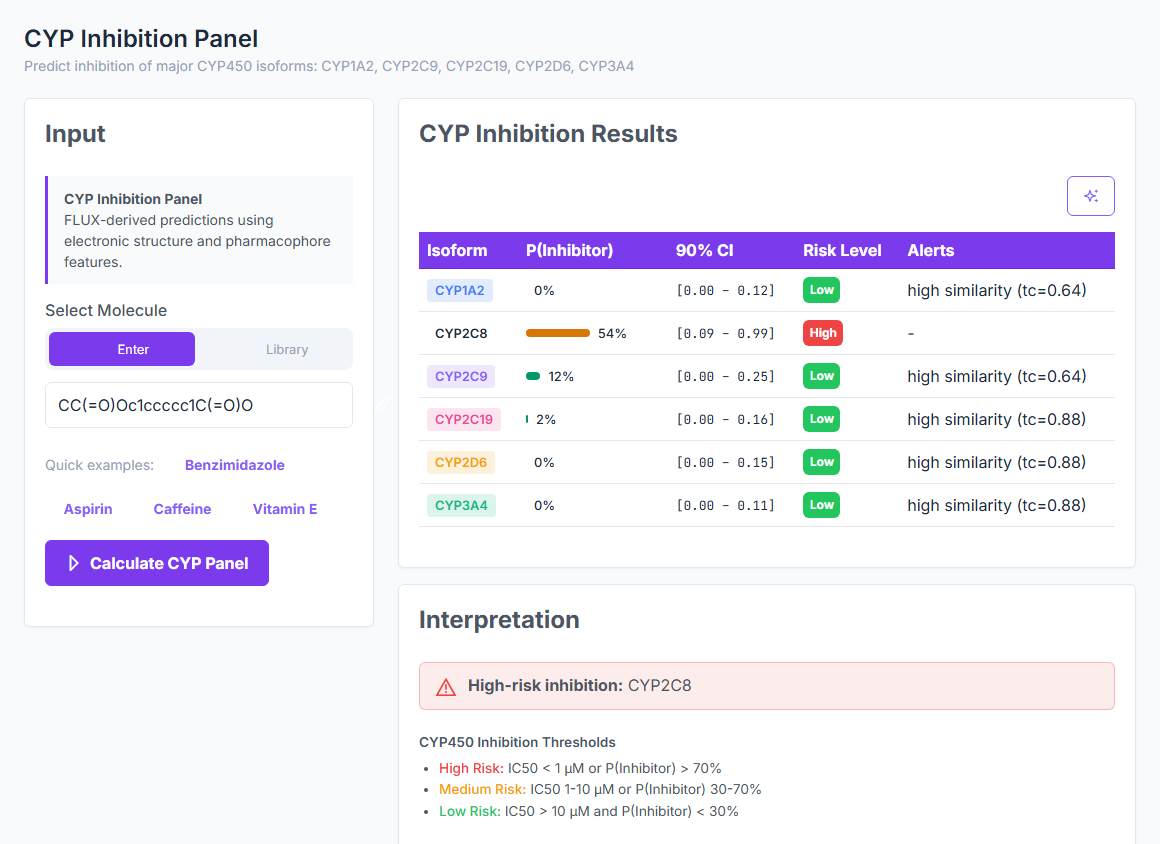
CYP Panel AUPRC ↑ 0.798 ~0.86 MapLight+GNN Near-SOTA
Permeability MAE ↓ 0.502 0.256 CaliciBoost (906 cpds) Competitive
WHY THIS MATTERS

This is not machine learning.

Most competitors on the TDC leaderboard rely on large trained ML models. FluxMateria does not. Predictions come from a deterministic hybrid framework designed to remain interpretable, confidence-aware, and robust on novel chemistry.

0
Fitted parameters
100%
Interpretable
178K
LOO validated compounds

TDC test splits use 200–900 compounds. FluxMateria LOO validations cover 7,800–62,800 per endpoint — exhaustive, not sampled.

Verified Benchmark Results

Validated against curated datasets with verified labels from FDA, peer-reviewed literature, and quality-controlled databases.

93.3%
BBB Accuracy
0.06
Solubility MAE
2.24%
PPB LOO MAE
178K
Compounds Validated
Module Metric FluxMateria Validation Scale Status
BBB Permeability (v8 Hybrid) Accuracy 93.3% 7,807 LOO ✓ Near-SOTA
Solubility (v14) logS MAE 0.06 9,982+ LOO ✓ #1 SOTA
PPB (v49.2 Hybrid) LOO MAE 2.24% 14,288 LOO ✓ #1 SOTA
Permeability (v1 Hybrid) MAE / Acc 0.502 / 73.1% 41,175 LOO ✓ Competitive
Metabolism (v1 Hybrid) Spearman ρ 0.692 38,576 LOO ✓ #1 SOTA
hERG (v1 Hybrid) AUROC 0.850 8,879 LOO ✓ Near-SOTA
DILI Hepatotoxicity (v1 Hybrid) AUROC 0.878 907 LOO ✓ Near-SOTA
CYP Panel (v5 Hybrid) AUPRC / Acc 0.798 / 80.9% 62,794 LOO ✓ Near-SOTA

178K compound-endpoint validations across 8 endpoints. 3 endpoints are #1 SOTA. Full interpretability preserved.

See full methodology →

The confidence difference

Most ADMET tools give you a number. FluxMateria gives you a number and tells you how much to trust it.

WHY WE CAN DO THIS

Physics models know their own limits.

ML models output a number no matter what you feed them — even for molecules nothing like their training data. They can't tell you when they're guessing.

FluxMateria's deterministic inference framework can separate strongly supported predictions from extrapolative ones. When a molecule sits near well-validated chemistry, confidence is higher. When it does not, the system lowers confidence instead of projecting false certainty.

ML black-box
Input → number. Always confident. Can't flag unknowns.
FluxMateria physics
Input → prediction + confidence + explanatory signals. Flags uncertainty automatically.

High confidence

Molecule sits near well-validated chemistry and the model has strong support. Proceed with screening logic.

Strong support

Medium confidence

Prediction is informative but structural novelty introduces uncertainty. Verify experimentally for critical decisions.

Moderate support

Low confidence

Molecule is outside reliable prediction space. Physics flags the gap. Consider alternative assays.

Limited support

Speed advantage

Single-threaded CPU performance. No GPU required.

~350
mol/sec full panel
All 8 endpoints
100%
interpretable
Every prediction traces to molecular properties
Per-Endpoint Throughput
Endpoint Throughput Method
BBB, Solubility ~300 mol/sec Physics descriptors
DILI Hepatotoxicity ~2 mol/sec Deterministic hybrid inference
Permeability (v1 Hybrid) ~500 mol/sec Deterministic hybrid inference
PPB (v49.2 Hybrid) ~153 mol/sec Deterministic hybrid inference
Metabolism (v1 Hybrid) ~8 mol/sec Deterministic hybrid inference
hERG (v1 Hybrid) ~1.3 mol/sec Deterministic hybrid inference
CYP Panel (v5 Hybrid) ~50 mol/sec Deterministic hybrid inference

All measurements single-threaded on CPU. Hybrid endpoints use the same deterministic, confidence-aware inference framework described on the benchmark page.

Typical workflow

1

Input

Paste SMILES, upload a list, or pull from Workspace

2

Configure

Select ADMET endpoints (or use default panel)

3

Run

Batch computation with progress tracking

4

Review

Inspect results with confidence highlighting

5

Compare

Side-by-side candidate evaluation

6

Export

Decision packet with full provenance

Scope notes

  • Novel scaffolds far from validated chemical space may have lower confidence
  • Some toxicity endpoints have limited experimental validation data
  • Predictions are for screening prioritization, not regulatory submission

Evaluate the platform

Interactive demo

No account required. Paste a SMILES string and see the full panel with confidence indicators.

Run Demo →

Batch evaluation

Upload a CSV of molecules and see results across your candidate set.

Request Batch Access →

Patent Pending