โš›๏ธ FLUXMATERIA — CHEMISTRY

Retrosynthetic routes,
with real barriers, in under 50 ms

Synthesis Planning disconnects a target SMILES via 15 strategic SMARTS patterns, scores every step with closed-form FLUX activation barriers, recommends reagents from an 82-compound library, and returns the best route ranked by steps + barriers. 29 reaction-type barriers at 3.1% MAE, 200 specific reactions at < 1% MAE.

15 disconnection patterns 29 reaction types 82 reagents 40 FGI transforms No ML
3.1%
Barrier MAE across 29 reaction types
< 1%
Barrier MAE on 200 specific reactions
82 · 26
Reagents · categories in the library
< 50 ms
Per route plan on a single CPU
0
Fitted parameters
The breakthrough

Retrosynthesis with closed-form barriers, in the time of a page load.

Reaction databases are exact but can’t score unseen disconnections. ML retrosynthesis needs millions of training reactions and still can’t quote a barrier. DFT quotes barriers but takes hours per step. Synthesis Planning gives you retrosynthesis disconnections, closed-form activation barriers at 3.1% MAE, reagent recommendations, and protection-group strategy — all under 50 ms per route plan.

What Synthesis Planning does

Disconnect, score, reagents, protection — one pipeline.

๐Ÿงฉ

Retrosynthetic disconnection

15 strategic SMARTS patterns identify C–heteroatom, C–C activated, and unsaturation disconnections automatically from the target SMILES.

โšก

Closed-form barriers

FLUX activation barriers for 29 reaction types at 3.1% MAE. 200 specific reactions validated at < 1% MAE. Every barrier traceable to a physical expression.

๐Ÿ”

FGI transforms

40 functional-group interconversion pathways across 11 FG classes, integrated into route scoring so group-swaps participate in the plan.

๐Ÿ›ก๏ธ

Protection groups

15 protection groups across 4 orthogonal categories with automatic recommendation when the disconnection requires it.

๐Ÿงช

Reagent database

82 reagents organised into 26 categories. Context-aware recommendations per reaction step — not a generic catch-all list.

๐Ÿ“Š

Multi-step route scoring

Best route picked by composite score (steps + barrier). Compare routes side-by-side with per-step barrier breakdown.

โฑ๏ธ

Evans-Polanyi corrections

Exo / endothermic corrections applied automatically — barriers shift with the reaction enthalpy as they should.

๐Ÿ“ค

Export the whole plan

Routes, barriers, reagents, protection groups, and the reasoning trail — CSV / JSON / PDF export, re-runnable bit-for-bit.

How a plan is built

From target SMILES to ranked routes with barriers in one call.

1

Input

Enter the target SMILES. The planner runs synchronously — no job queue, no wait.

2

Disconnect

15 SMARTS disconnection patterns scan the target; strategic bonds are ranked.

3

Plan routes

Multiple retrosynthetic routes are assembled from the disconnection tree; FGI transforms are inserted where they help.

4

Score barriers

Every step gets a closed-form FLUX activation barrier with Evans-Polanyi correction applied.

5

Pick reagents

Context-aware recommendations drawn from the 82-reagent / 26-category library; protection groups added where needed.

6

Rank & export

Routes ranked by (steps + barriers). Side-by-side comparison, CSV / JSON / PDF export, Workspace logging.

Why you can trust it

29 reaction types validated against experimental barriers — 43 tests passing in the benchmark suite.

3.1%
Barrier MAE across all 29 reaction-type benchmarks — within the DFT accuracy window.
< 1%
Barrier MAE on 200 specific validated reactions. Tight agreement with experiment across SN, E, addition, and cycloaddition families.
15
SMARTS disconnection patterns tested on 12 diverse target molecules — C–heteroatom, C–C activated, unsaturation.
82 · 26
Reagents organised across 26 categories. 40 FGI transforms across 11 functional-group classes.
43
Tests passing across the benchmark suite — disconnection patterns, barrier families, FGI coverage, reagent selection.
0
Fitted parameters. Same target SMILES returns the same route, barriers, and reagents every run.

How FluxMateria compares

Head-to-head against the standard tools for synthesis planning.

MetricFluxMateriaReaction databasesML retrosynthesisDFT barriers
Barrier accuracy3.1% MAEReference (exact)Not provided4–8 kJ/mol
Per-plan runtime< 50 msInstant lookup~1 sHours per step
GeneralisationAny SMILESKnown reactions onlyTraining domainAny (slow)
Training dataNoneData is the toolMillions of reactionsNone
Reagent recommendationContext-aware (82 reagents)Per-entryYesNot provided
Protection-group strategyBuilt-in (15 groups)ManualSometimesManual
Route scoringSteps + barriers compositeDataset pointerRankingNot provided
InterpretabilityClosed-form formulasDatabase entriesOpaqueOrbital trace

The key insight: Reaction databases can’t score unseen disconnections. ML retrosynthesis needs millions of labelled reactions and still doesn’t quote barriers. DFT quotes barriers but is too slow for iterative planning. Synthesis Planning returns routes, barriers, reagents, and protection-group strategy in a single sub-50 ms call — and every barrier is a closed-form expression you can audit. See the full benchmark →

Where Synthesis Planning wins

Process- and med-chem workflows where barrier-aware routes change the decision.

Use case 1

Route scouting

Explore retrosynthetic routes for a new target in seconds, not days. Compare barrier profiles before committing lab resources.

Use case 2

Process-chemistry optimisation

Identify the lowest-barrier pathway for scale-up. Evaluate protection-group strategies for complex targets before committing the synthesis.

Use case 3

CRO handoff

Generate a synthesis plan with closed-form barrier estimates and reagent recommendations. Ship an actionable route, not a wish list.

Use case 4

IP landscaping

Map synthetic accessibility of a compound series. Identify patentable novel routes where the disconnection SMARTS haven’t been claimed.

Use case 5

Teaching & training

Interactive disconnection-and-barrier tool for graduate courses. Students see “why is this route better?” in kJ/mol, not hand-waves.

Use case 6

Audit & reproducibility

Zero fitted parameters — same SMILES returns the same route, barriers, and reagents every time. Reviewers re-run the plan bit-for-bit.

Synthesis Planning in the product

Real captures from the live application. Click any image to zoom.

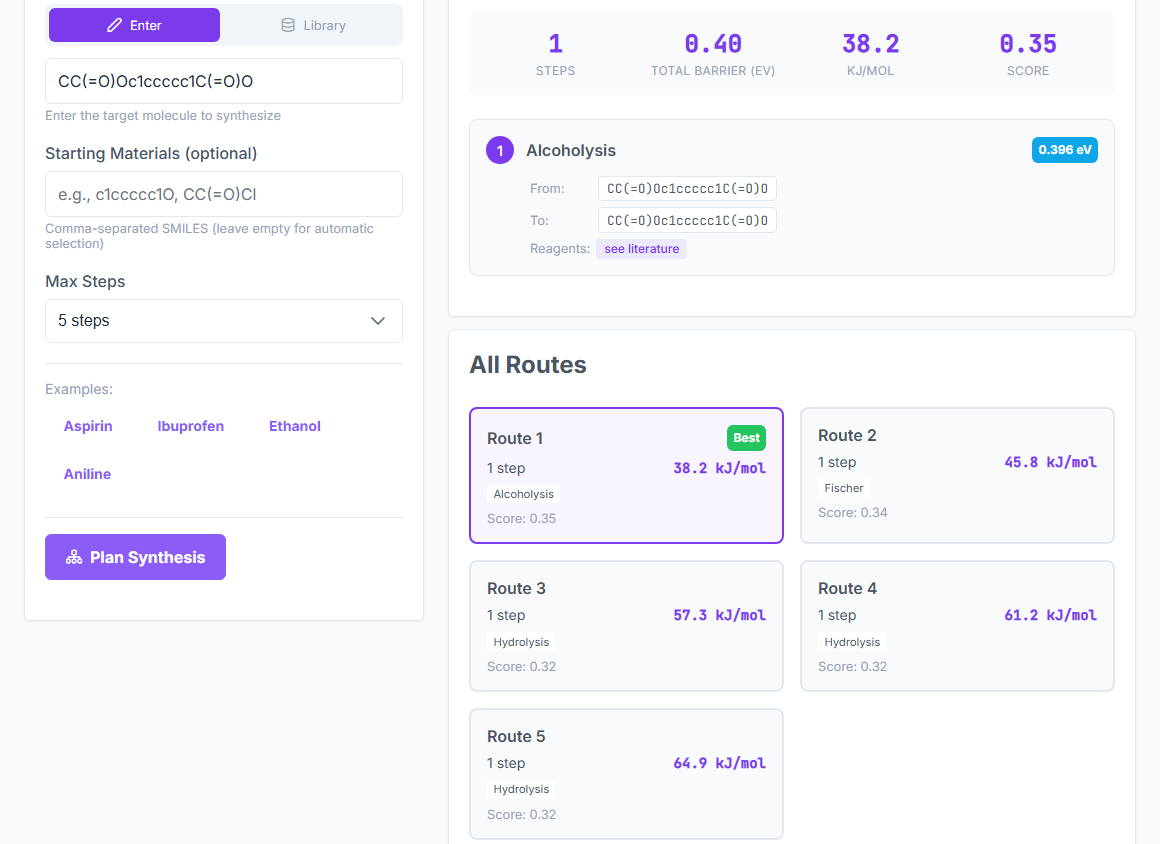
Target SMILES input with retrosynthesis setup
Target inputTarget SMILES + starting-material hints + max-step ceiling. Preset examples for common drugs, or paste your own.
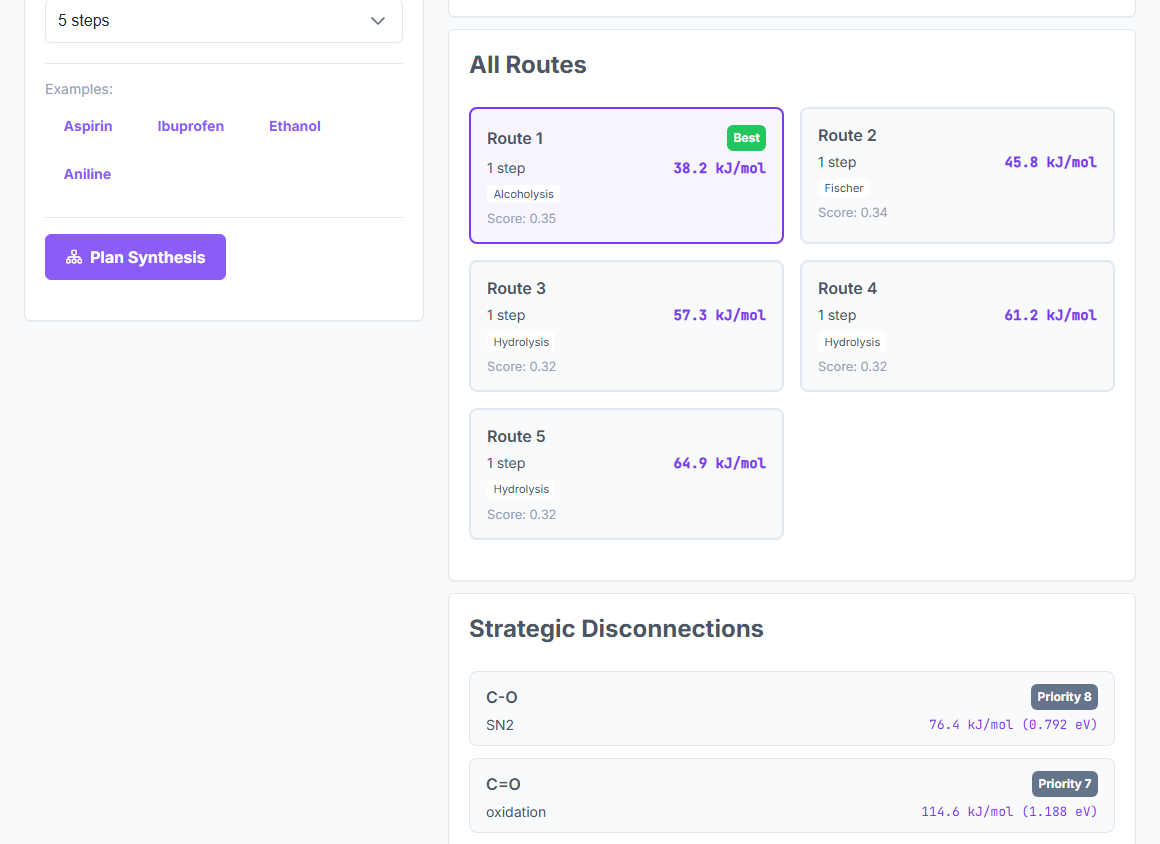
Best route summary with reaction type, barrier, and composite score
Best routeSummary stats (steps / total barrier / score) + step-by-step transformation with reaction type and per-step barrier in eV.
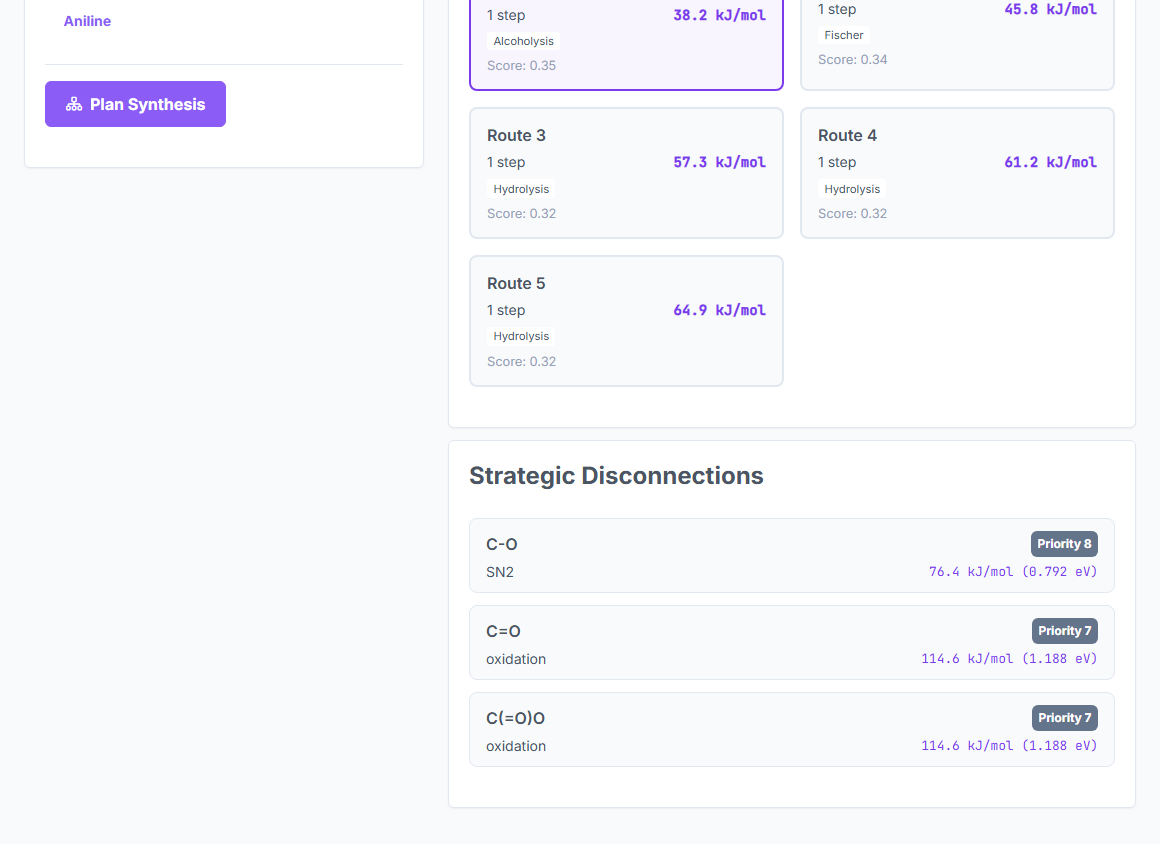
All candidate routes ranked by barrier and score
All routes comparedEvery candidate route with its reaction family, barrier in kJ/mol, and composite score — sort, compare, commit.
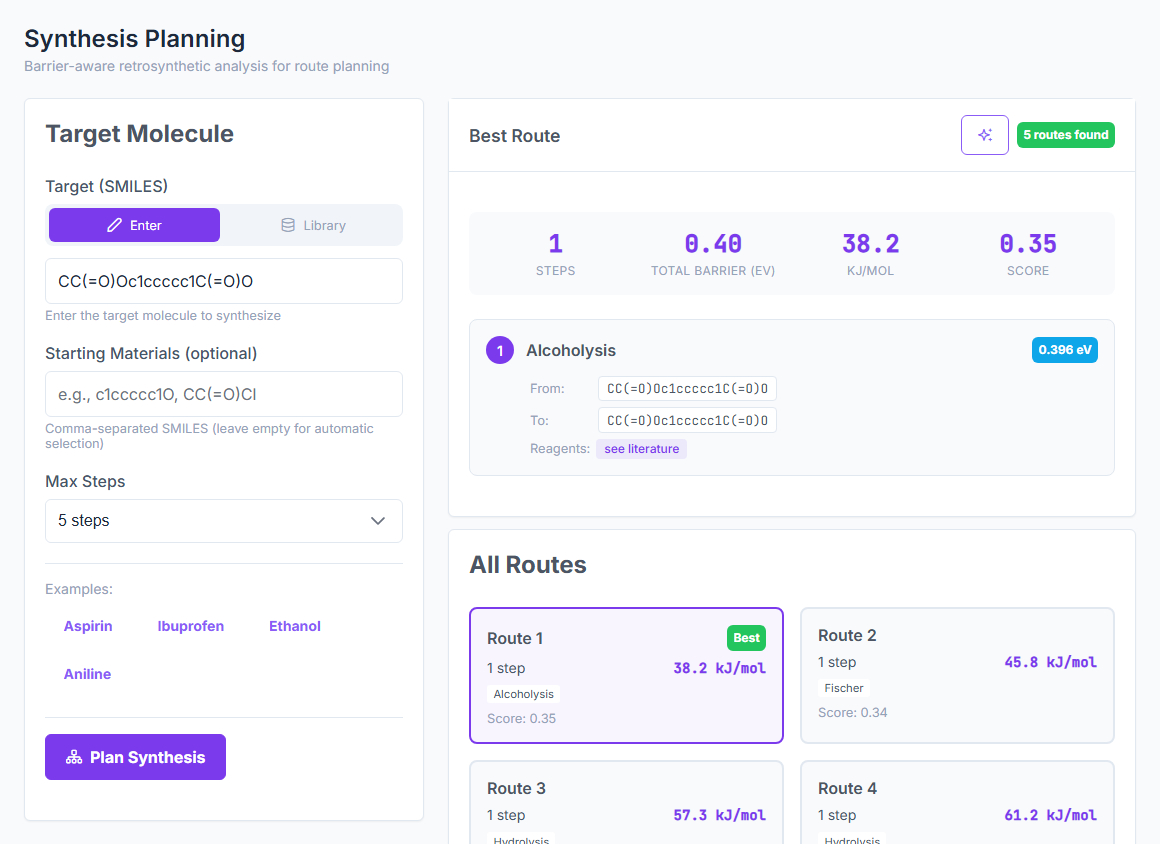
Strategic disconnections ranked by priority and barrier
Strategic disconnectionsStrategic bonds ranked by barrier + reaction family — drives which disconnection the best route commits to.

Scope & Limitations

Strengths

  • 29 reaction-type barriers at 3.1% MAE + 200 specific reactions at < 1% MAE — within the DFT accuracy window at 105–106× the speed.
  • 15 SMARTS disconnection patterns cover the useful retrosynthesis space (C–heteroatom, C–C activated, unsaturation).
  • Reagents + protection groups + FGI are integrated into route scoring, not separate workflows.
  • Every barrier is a closed-form FLUX expression — auditable, not a trained weight.
  • Sub-50 ms per plan keeps iteration interactive.

Known limitations

  • Scope is organic retrosynthesis of small molecules. Peptide coupling, biotransformations, and flow-chemistry-specific steps are planned extensions.
  • Transition-metal catalytic cycles are covered at the reaction-type level, not at individual cycle-state resolution — pair with Catalyst Discovery for cycle detail.
  • Stereochemistry preservation is flagged on the route; the full 3D stereocontrol analysis lives in the 3D Structure module.
  • Novel / patent-unclaimed SMARTS disconnections can be added; the public set is 15 today.

Plan a synthesis route

Pilot access includes Synthesis Planning, Mechanism Discovery, MechanismOS, the Chemistry bond engine, and a Workspace seat for audit-ready runs.

Request Pilot Access →