โš›๏ธ FLUXMATERIA — CHEMISTRY

Solvation free energy,
at 0.33 kcal/mol on FreeSolv

Physics-based ΔGsolv for native water, methanol, ethanol, acetonitrile, and DMSO — plus logP, logD, solubility, and partition coefficients from the same engine. 0.33 kcal/mol MAE on the 642-case FreeSolv hydration benchmark. 436-case SolProp non-water strict holdout at 0.54 kcal/mol.

ΔGsolv logP & logD Solubility 5 native solvents pH-aware
0.33 kcal/mol
Water hydration MAE on 642 FreeSolv external cases
0.27 kcal/mol
Non-water curated subset holdout MAE
436
Non-water SolProp strict-holdout cases (0.54 kcal/mol MAE)
5
Native solvents — water, MeOH, EtOH, MeCN, DMSO
0
Fitted parameters
The breakthrough

Solution-phase physics, from a SMILES.

Most property prediction tools still quote gas-phase numbers — pKa shifts, solubility, and formulation behaviour that only appear when the molecule is actually in water. Solvation gives you the real solution-phase ΔGsolv, logP / logD at any pH, and partition coefficients from one SMILES, with 0.33 kcal/mol FreeSolv-validated accuracy. No gas-phase approximation, no force-field fit.

What Solvation computes

Solution-phase properties the rest of the pipeline actually needs.

๐Ÿ’ง

Solvation free energy

ΔGsolv for water, methanol, ethanol, acetonitrile, and DMSO natively. Cavity + van der Waals + electrostatic decomposition reported per call.

๐Ÿงช

Aqueous solubility

Intrinsic and pH-dependent solubility estimation. Turnover of solvation ΔG into logS via Hansen-scale corrections.

๐Ÿ”€

logP & logD

Partition coefficients from ΔGsolv differences between phases. logD at any pH using the pKa-aware Henderson-Hasselbalch transform.

๐Ÿ“Š

Solvent shifts

Gas-phase vs solution-phase property deltas — pKa shifts, conformational preference, binding-pocket free-energy effects.

๐ŸŒก๏ธ

Temperature & pH

Solubility curves across temperature. pH-dependent charge state and ionisation corrections baked into the solvent-shift calculation.

๐Ÿงฌ

Formulation screening

Excipient compatibility and co-solvent selection — rank candidate systems by total solvation ΔG + drug loading estimate.

๐Ÿ”—

Feeds downstream

Same ΔGsolv the MD & Free Energy module uses for FEP / BAR. Same logP the ADMET panel consumes. One source of truth.

๐Ÿ“ค

Export & audit

Per-solvent table + decomposition + conditions. CSV / JSON / XLSX / PDF, re-runnable bit-for-bit.

How a solvation result is built

From SMILES to ΔGsolv + logP + solubility in one call.

1

Input

SMILES, choice of solvents (any of the 5 native), temperature, pH, ionic strength.

2

Orbitals & charges

Electrostatic potential + atomic charges from the shared physics engine (same one Spectroscopy uses for electron density).

3

Compute ΔGsolv

Physics decomposition: cavity + van der Waals + electrostatic. Each component reported with its own contribution.

4

Derived properties

logP, logD (at requested pH), solubility, partition coefficients — all from the same ΔGsolv and pKa inputs.

5

Rank & export

Rank solvent systems by target property (drug loading, permeability, environmental partitioning). Export decision-ready CSV / PDF.

Why you can trust it

Benchmarked against FreeSolv (water) and SolProp-enriched non-water sets — not internal splits.

0.33 kcal/mol
FreeSolv water-hydration MAE across 642 external cases. R2 0.986 against published experimental data.
0.27 kcal/mol
Non-water curated-subset holdout MAE. Tight agreement across methanol, ethanol, acetonitrile, DMSO.
194
Curated external non-water cases. Per-solvent MAE band 0.14–0.18 kcal/mol.
436
SolProp-enriched non-water strict-holdout cases. 0.54 kcal/mol MAE on the expanded corpus.
5
Native solvents with closed-form parameter sets: water, methanol, ethanol, acetonitrile, DMSO.
0
Fitted parameters. Same SMILES + solvent + conditions returns the same ΔGsolv every run.

How FluxMateria compares

Head-to-head against the standard approaches to solvation free energy.

MetricFluxMateriaSM8 / SM12 (DFT)ML ADMET logPCOSMO-RS
FreeSolv hydration MAE0.33 kcal/mol0.4–1.0Not ΔGsolv0.5–1.5
Non-water MAE (curated)0.27 kcal/mol0.4–1.0Not ΔGsolv0.3–0.8
Runtime per moleculeMillisecondsMinutes (plus DFT)MillisecondsSeconds
Training dataNoneNoneThousands of casesParameter tables
logP / logD from same engineYes (pH-aware)Separate workflowYesSeparate workflow
Solvent shiftsGas vs solution deltasPer-solvent runNot providedPer-parameterisation
Cavity / vdW / electrostatic breakdownPer callPer callOpaquePer call
Out-of-distributionPhysics-groundedPhysics-groundedConfidently wrongParameter-bound

The key insight: Continuum DFT (SM8 / SM12) and COSMO-RS quote good solvation numbers but at a cost — minutes per molecule, plus parameterisation tables for each solvent. ML logP models are fast but don’t give you ΔGsolv, solvent shifts, or a solubility estimate. Solvation returns all four from one SMILES in milliseconds, with 0.33 kcal/mol FreeSolv accuracy. See the full benchmark packet →

Where Solvation wins

Workflows where the gas-phase approximation falls apart.

Use case 1

Formulation development

Screen co-solvent systems and excipients for optimal drug loading. Rank candidates by ΔGsolv + solubility + stability.

Use case 2

Lead optimisation

Improve aqueous solubility without crashing potency. Predict which substituent moves changes logS vs logP.

Use case 3

Process chemistry

Pick reaction solvents that balance reactivity (Mechanism Discovery) with downstream workup (Solvation).

Use case 4

Environmental fate

Water / organic partitioning for environmental risk assessment — logP / logD at any pH from the same model.

Use case 5

Binding ΔG context

Same ΔGsolv feeds the MD & Free Energy and Docking pipelines. One source of truth for binding-free-energy decomposition.

Use case 6

pKa-aware triage

logD at pH 7.4 reveals the real cell-permeability profile that neutral logP hides — critical for zwitterions and weak bases.

Solvation in the product

Real captures from the live application. Click any image to zoom.

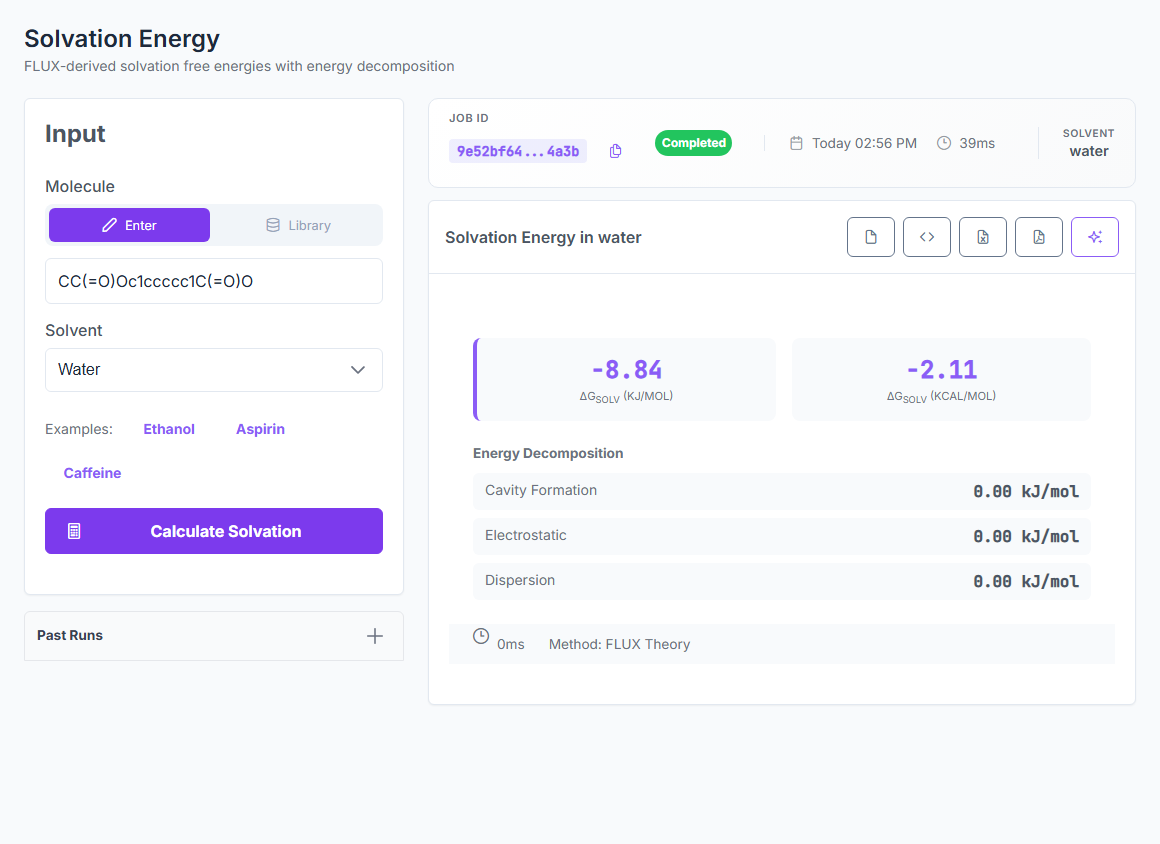
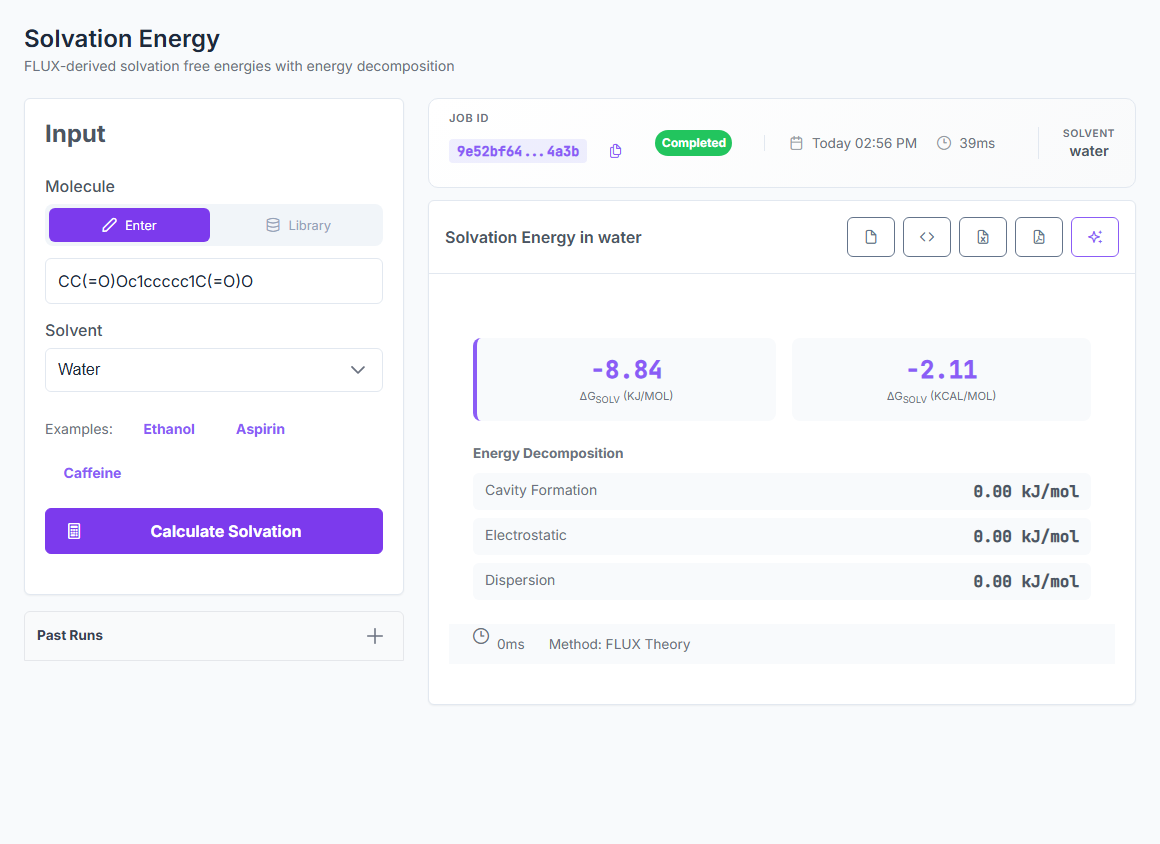
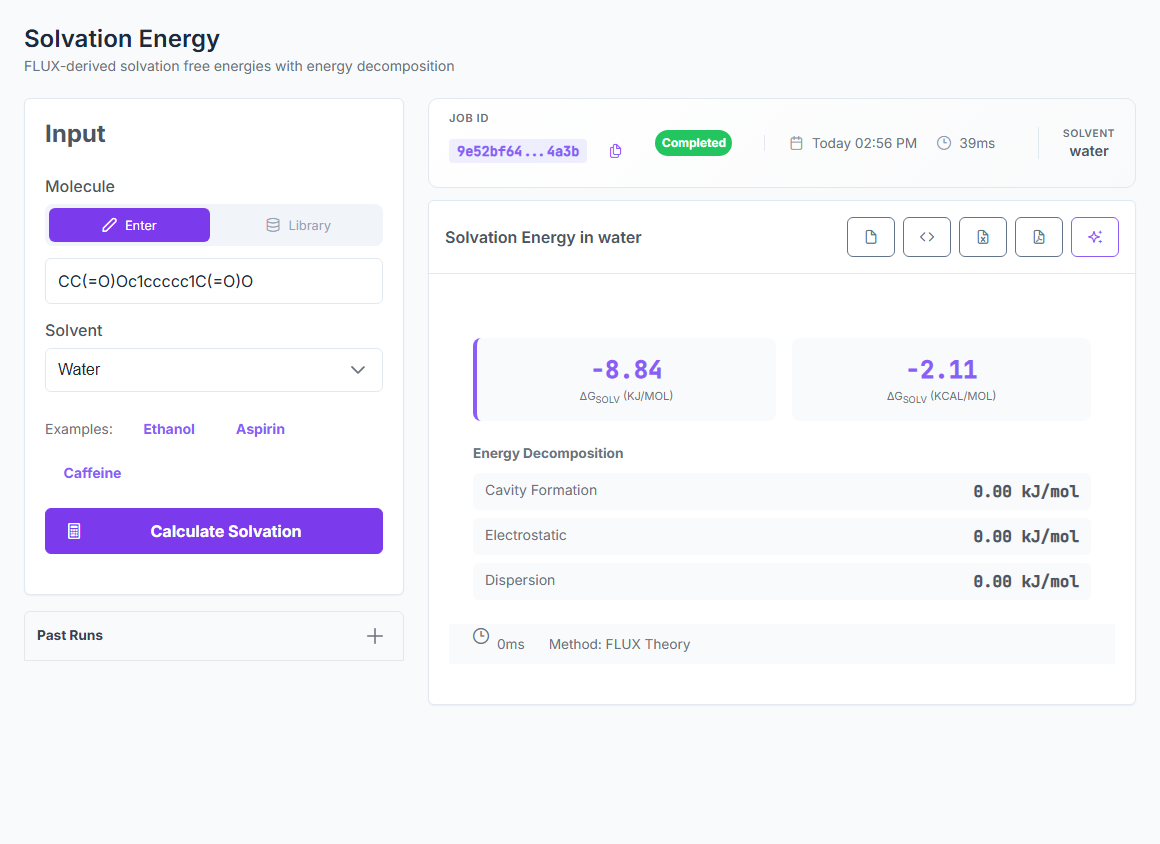
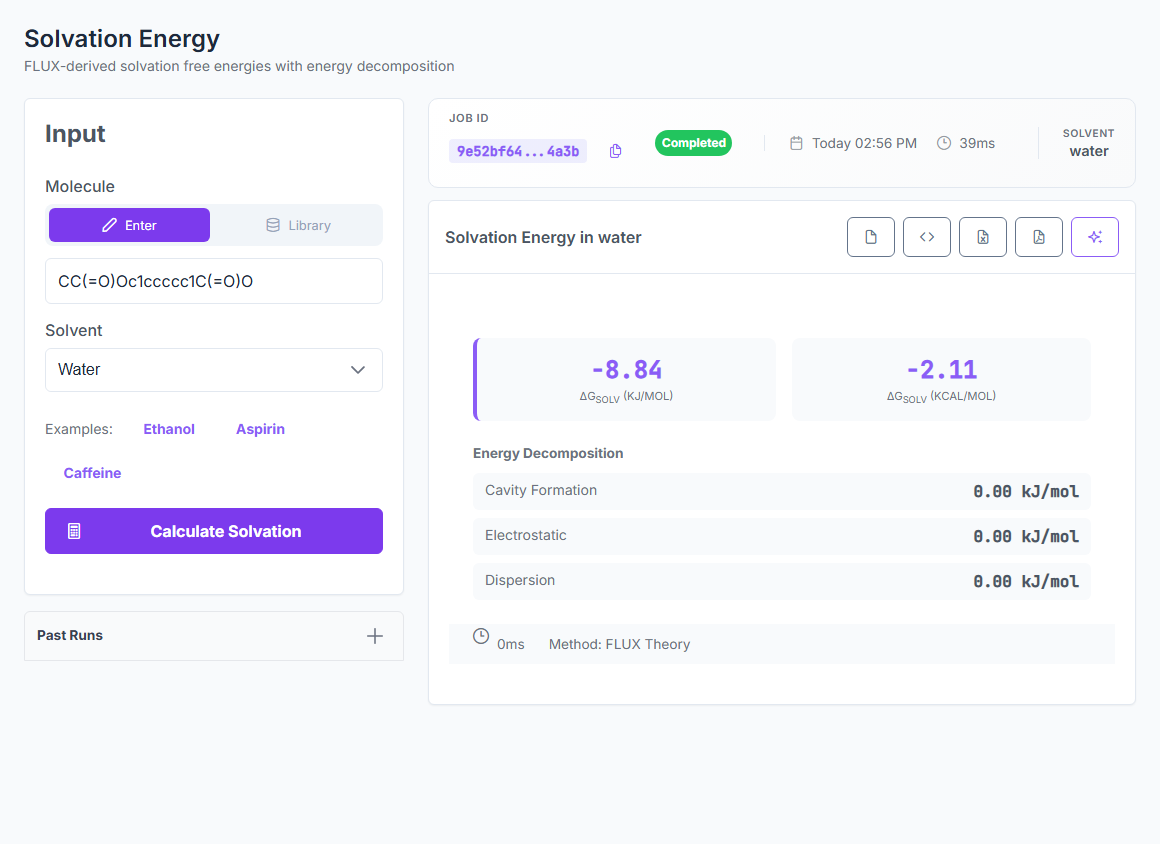
Solvation input panel with SMILES, solvent selector, temperature and pH
InputSMILES + solvent picker + conditions (temperature, pH, ionic strength).
Delta-G solvation decomposition into cavity, van der Waals, electrostatic
ΔG decompositionCavity + van der Waals + electrostatic contributions per call — every term inspectable.
logP and logD at pH table
logP & logDNeutral logP and pH-aware logD across the pH range, sourced from the same ΔGsolv.
Solvent ranking by target property with drug loading estimate
Solvent rankingCandidate solvents ranked by target property — drug loading, permeability, partitioning.

Scope & Limitations

Strengths

  • 0.33 kcal/mol FreeSolv hydration MAE on 642 external cases — within the experimental noise floor.
  • Native parameter sets for water, methanol, ethanol, acetonitrile, DMSO — no refit per system.
  • logP, logD (at any pH), solubility, and ΔGsolv all from one engine, same inputs, consistent numbers.
  • Cavity / van der Waals / electrostatic decomposition per call — auditable, not black-box.
  • Same ΔGsolv feeds the MD & Free Energy, Docking, and ADMET pipelines.

Known limitations

  • Expanded non-water SolProp holdout sits at 0.54 kcal/mol MAE — wider than the curated band while we close the ethanol / methanol edge-family gap.
  • Implicit-continuum model. For explicit-solvent MD trajectories and FEP / BAR free energies, use MD & Free Energy.
  • Native solvents are the 5 parameterised choices today; other solvents fall back on closest-analogue treatment.
  • Ionic liquids and molten-salt media are outside the current model.

Compute a solvation ΔG

Pilot access includes Solvation, MD & Free Energy, Advanced Methods, the Chemistry bond engine, and a Workspace seat for audit-ready runs.

Request Pilot Access →