โš›๏ธ FLUXMATERIA — CHEMISTRY

pKa, polarizability,
and dispersion — deterministic

Per-site pKa across 17+ functional groups. Dominant species at any pH. Polarizability from a 60+ bond-increment model. Dispersion C6 / C8 / C10 with Tang–Toennies damping. All from first-principles physics, all re-runnable bit-for-bit.

Per-site pKa Dominant species Polarizability C6 / C8 / C10 Batch of 100
17+
Ionisable functional groups detected per site
60+
Bond-increment types for polarizability
C6 / C8 / C10
Dispersion terms with Tang–Toennies damping
100
Molecules per batch request
0
Trained parameters
The breakthrough

Ionisation, polarizability, and dispersion — deterministic, every time

The pKa engine detects every ionisable site the molecule actually carries — carboxylic acids, phenols, amines, imidazoles, pyridines, sulfonamides, guanidines, phosphates, tetrazoles — assigns each one a pKa from the same first-principles engine the rest of the platform uses, and returns the dominant species at your chosen pH. Polarizability and dispersion run on the same pass, with C6, C8, and C10 terms plus π–π and CH–π corrections.

What pKa & Dispersion does

One engine for ionisation, polarizability, and dispersion.

๐Ÿงช

Per-site pKa detection

SMARTS-based detection of 17+ ionisable patterns: carboxylic acid, sulfonic acid, phenol, alcohol, thiol, primary / secondary / tertiary amines, imidazole, pyridine, sulfonamide, phosphate, tetrazole, guanidine, and more.

๐Ÿ“Š

pKa values with confidence

Each site reports its pKa, functional-group label, acidic / basic type, and a confidence tag (high / medium / low) with a method stamp.

๐Ÿงฌ

Dominant species

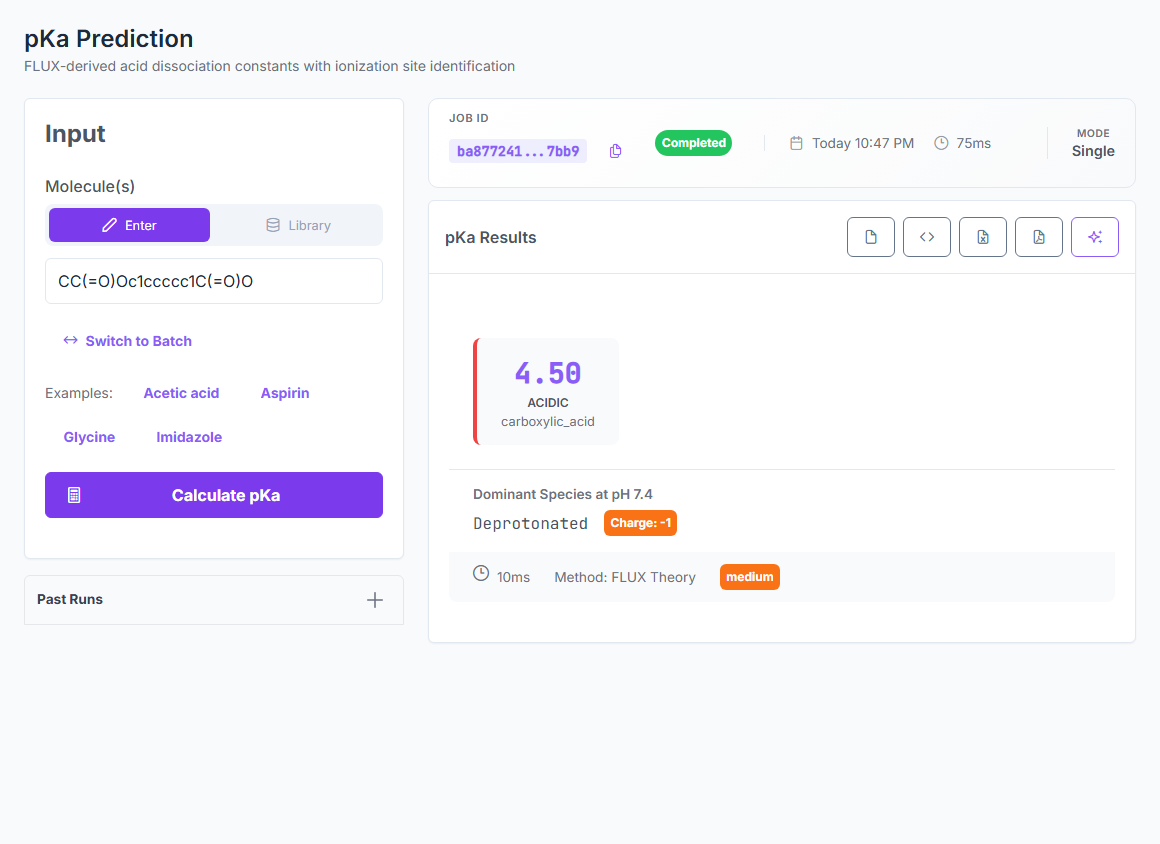
At pH 7.4 by default, or any pH you pass. Reports the dominant species string and the integer net charge.

๐Ÿ“

Polarizability

Bond-increment model with 60+ bond types plus ring, lone-pair, and conjugation corrections. Outputs α in Å3 with the bond breakdown reported.

๐Ÿงฒ

Dispersion C6

London C6 coefficients per atom pair from polarizability and ionisation energy, returned in Hartree·Bohr6 and eV·Å6.

๐ŸŒ€

C8, C10 & damping

Higher-order dispersion plus Tang–Toennies and Fermi damping smooth the r−6 divergence at short range.

๐ŸŽจ

π–π & CH–π

Aromatic stacking and CH–π interaction models against literature reference values — useful for binding and crystal-packing work.

๐Ÿ“ฆ

Batch + export

Up to 100 molecules per request; exports to CSV / Excel / JSON / PDF; AI-interpreted report; Workspace logging for every run.

How a request is handled

From SMILES to ionisation + polarizability + dispersion in one pass.

1

Input

Single SMILES or batch up to 100; canonicalised and validated before anything else runs.

2

Ionisable sites

Detect every ionisable pattern the molecule carries — acid, base, amphoteric — across 17+ functional groups.

3

Assign pKa

Each site gets its pKa from the physics engine plus a confidence tag; uncertainty is propagated through dominant-species selection.

4

Polarizability & dispersion

Bond-increment polarizability, then C6 / C8 / C10 dispersion with damping and the π–π / CH–π corrections.

5

Return

Summary cards (pKa, species, charge), per-atom polarizability and C6 tables, method labels and compute-time stamps; export-ready JSON.

Why you can trust it

Deterministic physics, auditable coverage, and honest scope.

Deterministic
Same SMILES + pH returns the same pKa set, polarizability, and C6 tensor every run.
17+ groups
Ionisable-group coverage includes every common acid / base pattern plus heterocycles (imidazole, pyridine, tetrazole).
60+ bonds
Polarizability bond-increment library — organics, halogens, and key metals — plus ring / lone-pair / conjugation corrections.
Auditable
Every pKa carries its functional-group label and method stamp; polarizability breaks down by bond so reviewers can see where the number came from.
0.079%
Bond-length MAPE on the shared chemistry engine — the ionisation calculator rides on the same engine.
0
Trained parameters. No ionisation training set; no SVM / GBM / NN underneath.

How FluxMateria compares

Head-to-head against the usual sources of pKa, polarizability, and dispersion numbers.

MetricFluxMateriaML pKa modelsDFT (B3LYP)Rules / lookup
Per-site pKaYes — every ionisable groupYesYes (slow)Usually one per molecule
Training data requiredNoneThousands of assayed compoundsNoneData is the tool
Dominant species at any pHYesUsually pH 7.4 onlyCustom workflowNo
PolarizabilityBond-increment, 60+ typesSeparate modelYes (slow)Lookup
Dispersion C6 / C8 / C10Built-in with dampingSeparate modelPost-hoc D3 correctionLookup
DeterministicYesSeed / version dependentYesYes
Predicts unseen scaffoldsYesWithin distributionYes (slow)No
Latency per propertySub-secondMillisecondsMinutes to hoursInstant lookup

The key insight: Trained pKa models are fast but depend on what they were trained on; DFT is honest but too slow to sit behind a UI; rule-based tools are frozen. pKa & Dispersion detects every ionisable site the molecule carries and returns ionisation, polarizability, and dispersion from the same first-principles engine — deterministic, auditable, re-runnable. See the chemistry benchmark →

Where pKa & Dispersion wins

Workflows where ionisation state and polarisability actually move the answer.

Use case 1

logD / logP correction

Apply per-site pKa to the neutral logP and get logD at pH 7.4 — or any pH — with the ionisation-state contribution reported.

Use case 2

Zwitterion detection

Acids and bases in the same molecule? The dominant-species string reports the zwitterion explicitly, with the correct net charge.

Use case 3

Tautomer & protomer triage

Multiple sites near physiological pH? Flip pH and watch the dominant species change; rank tautomers by species free energy.

Use case 4

Dispersion-aware docking prep

C6 / C8 / C10 with damping for any pair — feed directly into docking grid construction or post-scoring.

Use case 5

Crystal packing sanity check

π–π stacking and CH–π interaction estimates against literature reference values — useful for polymorph screening.

Use case 6

Audit-grade ionisation reporting

Every pKa carries its functional-group label, method, and confidence. Reviewers re-run the same call and get the same ionisation map.

pKa & Dispersion in the product

Real captures from the live application. Click any image to zoom.

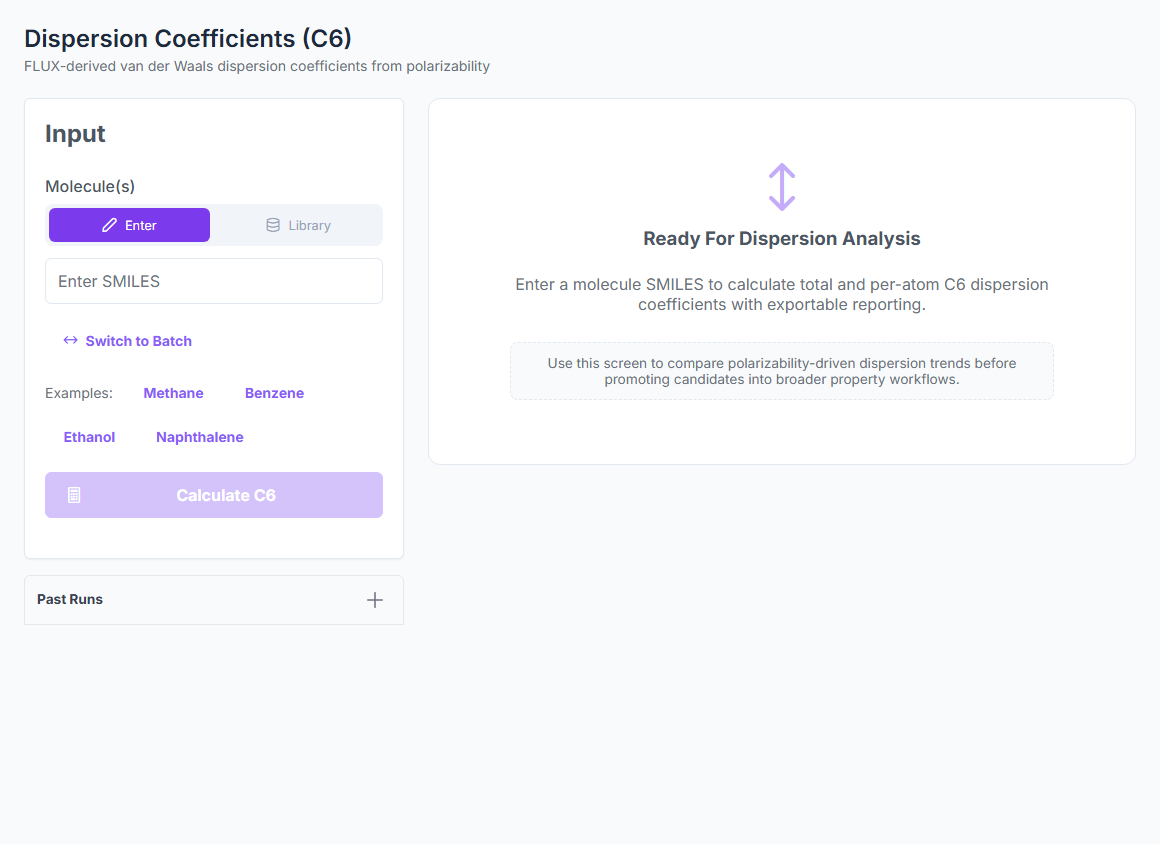
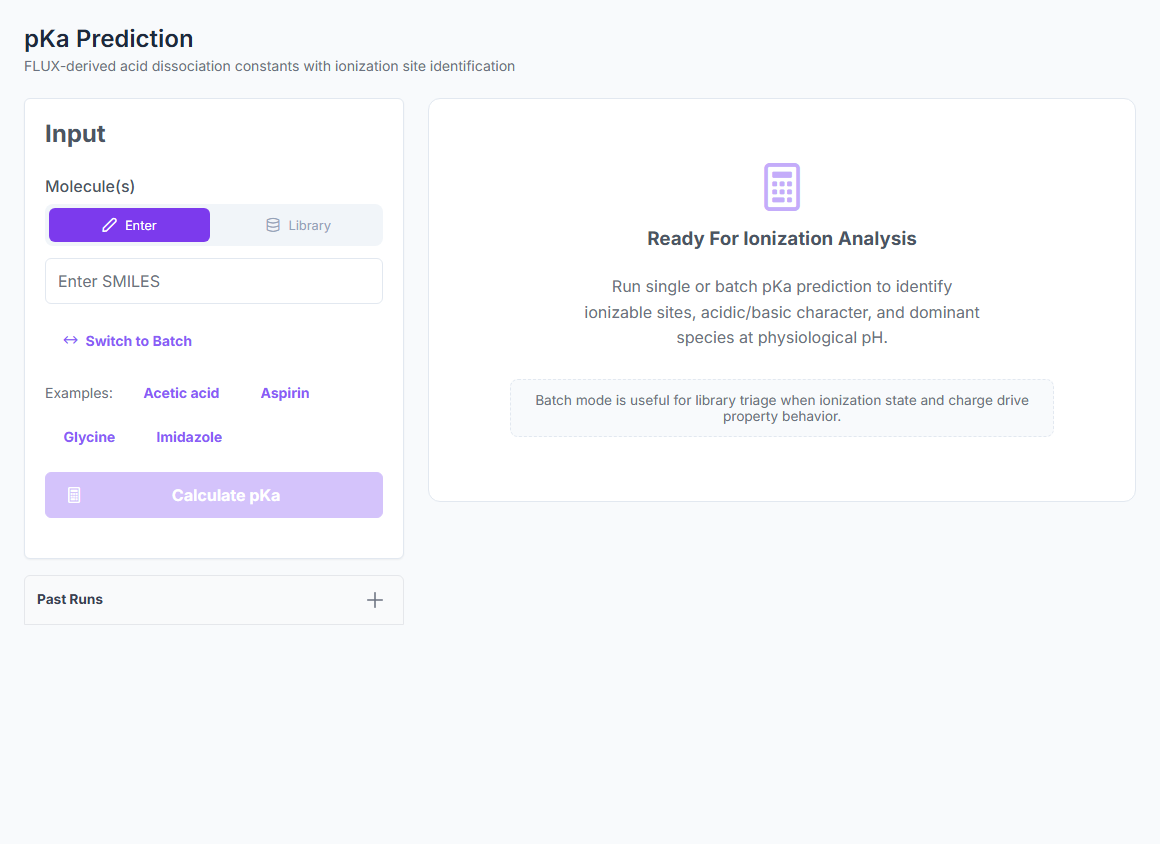
pKa input panel with SMILES, batch toggle, and pH selector
InputSMILES entry, batch toggle, and the pH at which to report dominant species and charge.
pKa result panel with per-site values color-coded by acid / base and dominant species section
Per-site pKaEach site with its pKa, functional-group label, acid / base colour, and the dominant-species summary.
Polarizability result panel with bond breakdown table
Polarizabilityα in Å3 with the bond-increment breakdown so the number is traceable.
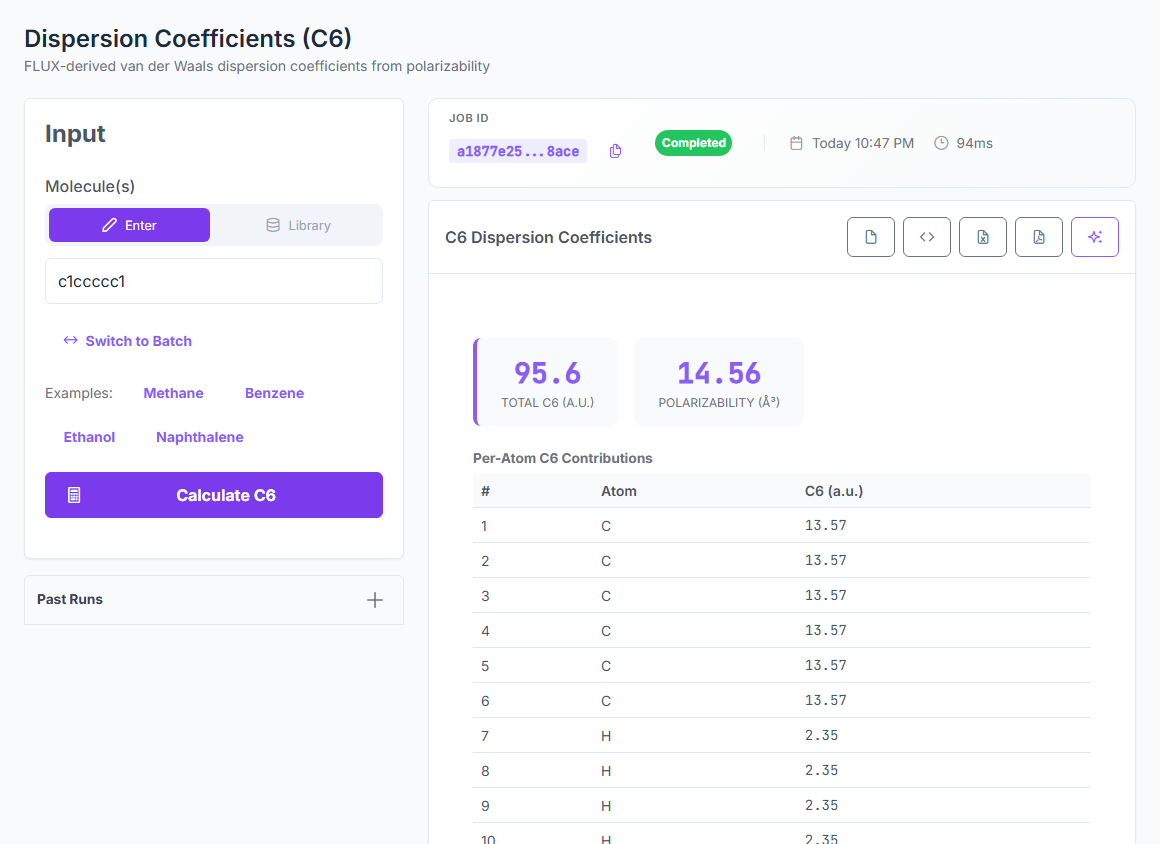
Dispersion result panel with total and per-atom C6 table
DispersionTotal C6, per-atom C6, and the damping parameters used for the request.

Scope & Limitations

Strengths

  • Detects every ionisable site the molecule carries — not just the “most important” one.
  • Deterministic: same input, same pKa set, every run.
  • Polarizability decomposition + C6 / C8 / C10 dispersion with damping in the same pass.
  • π–π and CH–π interaction models against literature reference values.
  • Batch mode + export + Workspace logging for audit-ready runs.

Known limitations

  • Coverage is deep on small-molecule drug-like scaffolds; large peptides and biologics are the province of dedicated tools.
  • External MAE benchmarks (against large experimental pKa sets) are scheduled — current validation is geometric and reference-bond-anchored.
  • Solvent other than water requires the MD / Solvation module for free-energy-grounded predictions.
  • Organometallics and actinide coordination chemistry may require the Advanced Methods relativistic pass first.

Profile ionisation, polarizability, and dispersion

Pilot access includes pKa & Dispersion, the peer Advanced calculators (MD, solvation, universal props), and a Workspace seat for audit.

Request Pilot Access →