πŸŽ›οΈ FLUXMATERIA — CHEMISTRY

SOTA real-time reaction steering,
not just prediction

MechanismOS turns kinetics into an interactive cockpit. See the operating window, watch selectivity flip across boundaries, optimize toward a target outcome under real constraints — and export a signed evidence pack when you’re done.

Control surfaces Boundary + uncertainty overlays Constraint optimizer Evidence pack export SN1 / SN2 / E1 / E2 / E1cb
5
SN1 / SN2 / E1 / E2 / E1cb pathways scored on one surface
Real-time
Interactive recompute as you change solvent, temperature, or strength
Boundary-aware
Ambiguous regions flagged; recommendations steer to robust windows
Signed packs
Every surface, pin, and optimization run is versioned + exportable
Flux Decision Engine
Runtime steering built from Flux Physics scoring
The breakthrough

Prediction → control.

A single-point mechanism classifier gives you a label. MechanismOS maps where outcomes flip — then helps you steer toward robust windows under real constraints. The same engine that prints “SN2” also tells you how wide the SN2 window is, which conditions collapse it, and where the nearest optimization-safe plateau sits.

What MechanismOS adds

Everything required to move from a prediction to an enterprise-grade operating decision.

πŸ—ΊοΈ

Control surfaces

Heatmaps + contours across condition space — dominance, selectivity, rate. Click any point to pin it.

⚑

Real-time steering

Live recompute as you change solvent, temperature, nucleophile strength — no batch job, no spinner.

🎯

Constraint optimizer

Goal-seek under hard constraints (temperature caps, solvent policy, selectivity bounds, cost ceilings).

🚧

Boundary awareness

Ambiguous regions where pathways compete are surfaced explicitly. Recommendations default to robust windows.

πŸ“Š

Branching fractions

Selectivity across all competing pathways — not a single winner label, the whole distribution.

🧭

Pareto preview

Top-N conditions and minimal-change suggestions across rate-vs-selectivity frontiers.

🧾

Audit trail

Every surface, pin, and optimization run is versioned with model-hash provenance for review + handoff.

πŸ“¦

Evidence pack export

One-click export: surface config + pins + optimizer run + model versions — a reproducible decision packet.

The steering pipeline

From a fresh substrate to a signed operating window in one interactive session.

1

Frame the reaction

Substrate, nucleophile / base, leaving group, solvent axes, condition ranges — set the window.

2

Slice the surface

Choose axes + overlays. Control surfaces render in real time across the chosen region.

3

Read branching

Dominance + branching fractions per pathway. Boundaries and ambiguous zones are flagged.

4

Pin and compare

Pin candidate conditions. Pin/compare generates explicit “what changed” deltas for review.

5

Optimize

Goal-seek under hard constraints. Constraint-safe optimization reports infeasibility rather than violating.

6

Export pack

Signed evidence pack: surface config, pins, optimizer run, model versions — ready for handoff.

Why you can trust it

Built to stay honest where chemistry is genuinely ambiguous.

Boundary-first
Zones where competing pathways are close are flagged, not hidden. Small condition changes that flip outcomes are visible before you run.
Conservative
Confidence is reduced in ambiguous or weak-support regions. The optimizer defaults toward robust windows, not knife-edge optima.
Deterministic
Same substrate + same conditions return the same surface bit-for-bit. No stochastic sampling, no random seeds to track.
Explainable
Pin/compare produces clear per-axis deltas. Optimizer output cites the active constraints and binding variables.
Flux Decision Engine
Mechanism selection, barriers, and condition steering are computed from Flux Physics terms. Benchmark rows are validation references, not exact-reaction lookup tables.
Signed packs
Every evidence pack carries a model-version hash. A reviewer re-running the pack gets identical outputs months later.

How FluxMateria compares

Mechanism tools vs real reaction steering.

CapabilityMechanismOSML mechanism classifiersDFT barrier scansLiterature rules
OutputFull control surfaceSingle labelPoint barriersText heuristics
Interactive recomputeReal-timeBatch onlyHours per pointN/A
Boundary awarenessFlagged + conservativeRarelyManualAbsent
Constraint optimizerBuilt-inNot providedManual sweepNot provided
Branching fractionsAll pathwaysWinner onlyOne at a timeQualitative
Training dataNoneLarge labeled setNoneLiterature corpus
Evidence packVersioned exportNot providedManual assemblyNot provided
DeterminismBit-for-bitModel-dependentConvergence-dependentReviewer-dependent

The key insight: A label tells you what probably happens. A surface tells you where it happens, how wide the window is, and what nearby condition change breaks it. Single-label classifiers are fine for retrosynthesis triage; MechanismOS is what you bring when the decision has to survive a CMC review.

Where MechanismOS wins

Decisions where the question is the window, not the label.

Use case 1

Process development / CMC

Find operating windows that survive variance. Reduce late-stage surprises, impurity drift, and off-label selectivity.

Use case 2

Troubleshooting

Explain why a solvent or temperature change flips SN2→E2 (or SN1→E1) — and how to steer back without losing rate.

Use case 3

Flow & automation

Low-latency evaluation + constraint mode make MechanismOS a closed-loop condition optimizer for flow reactors.

Use case 4

Robustness screening

Which proposed route has the widest selectivity plateau? Pin multiple candidates, compare their windows side-by-side.

Use case 5

Audit & handoff

Evidence packs are signed, versioned, re-runnable. Exactly what reviewers and regulators need to reproduce the decision.

Use case 6

Teaching & onboarding

Interactive surfaces make mechanism competition legible. Great for mentoring process chemists on boundary behavior.

MechanismOS in the product

Real captures from the live application. Click any image to zoom.

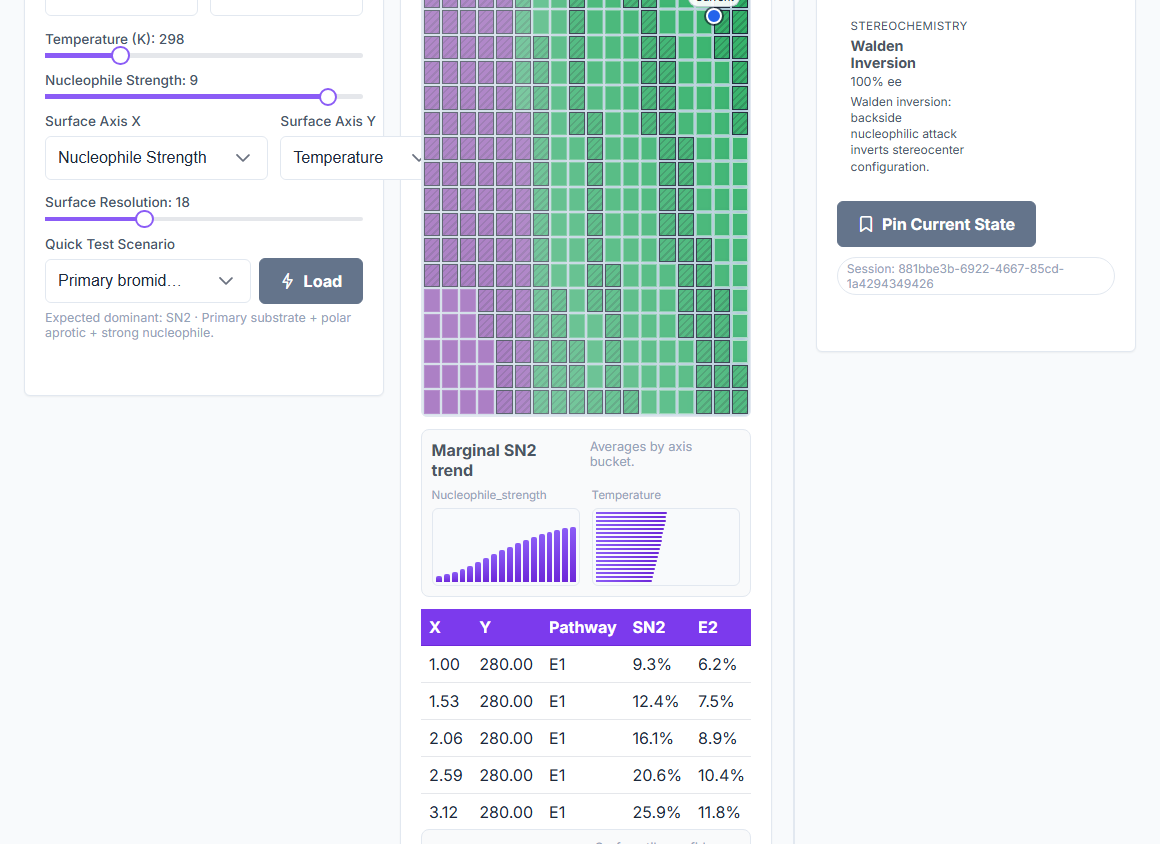
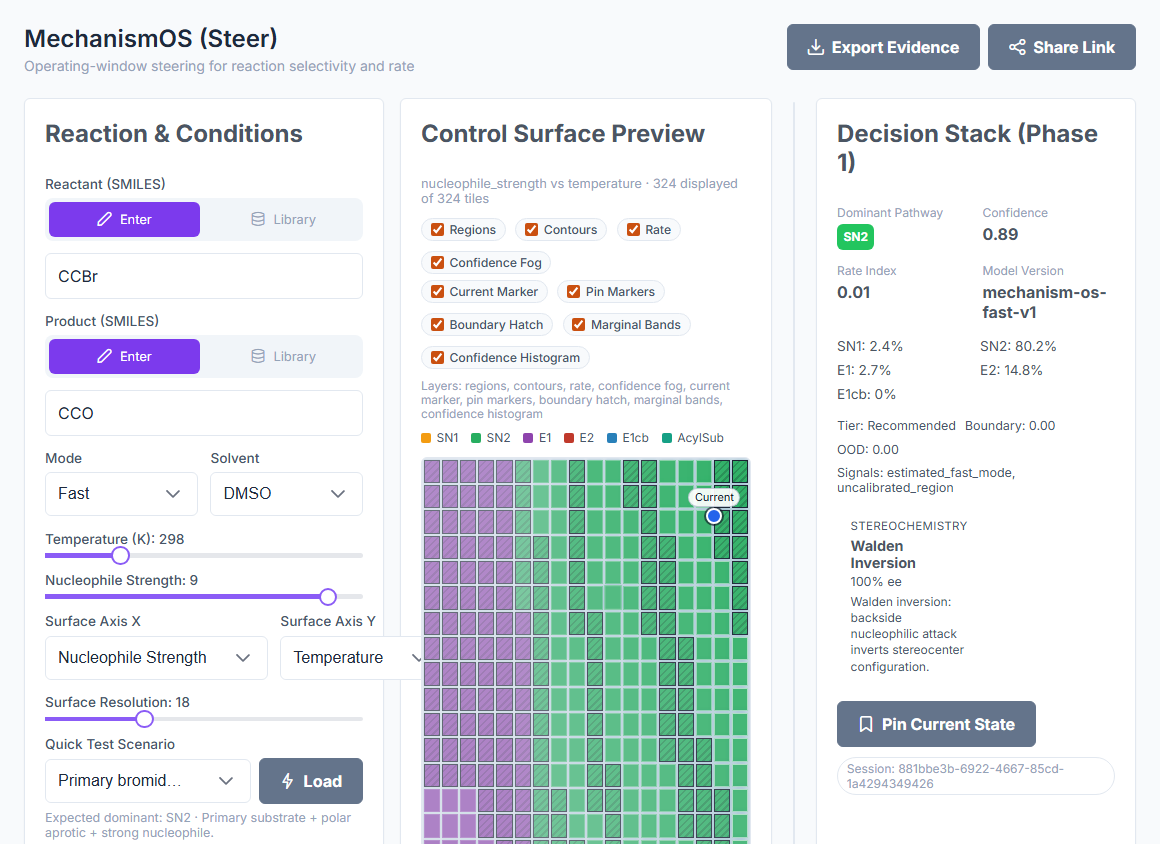
MechanismOS reactant / conditions input panel with live decision stack
Frame the reactionSubstrate, nucleophile, leaving group, solvent, temperature sliders, surface axes — plus a live decision stack on the right.
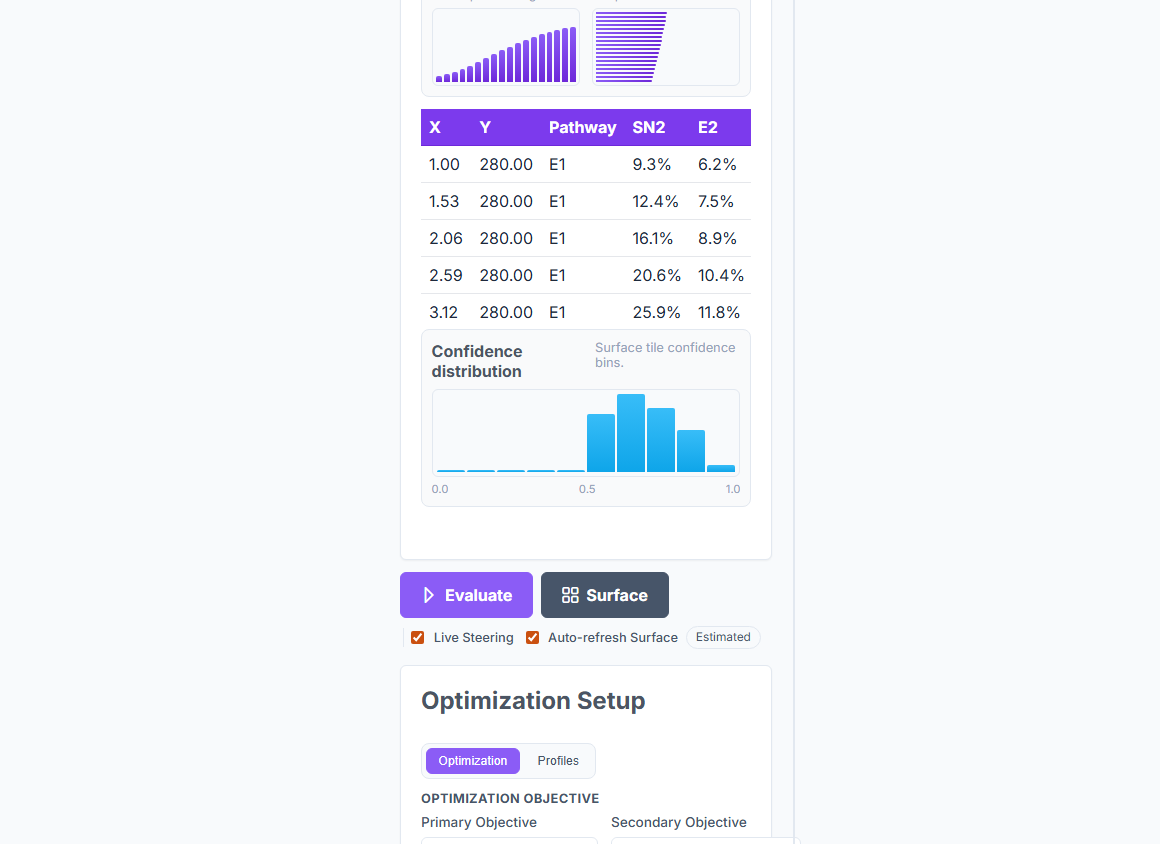
MechanismOS dominant pathway and branching fractions
Dominant pathway + branchingPer-pathway dominance (SN1 / SN2 / E1 / E2 / E1cb) with confidence, tier, and boundary signals next to the stereochemistry call.
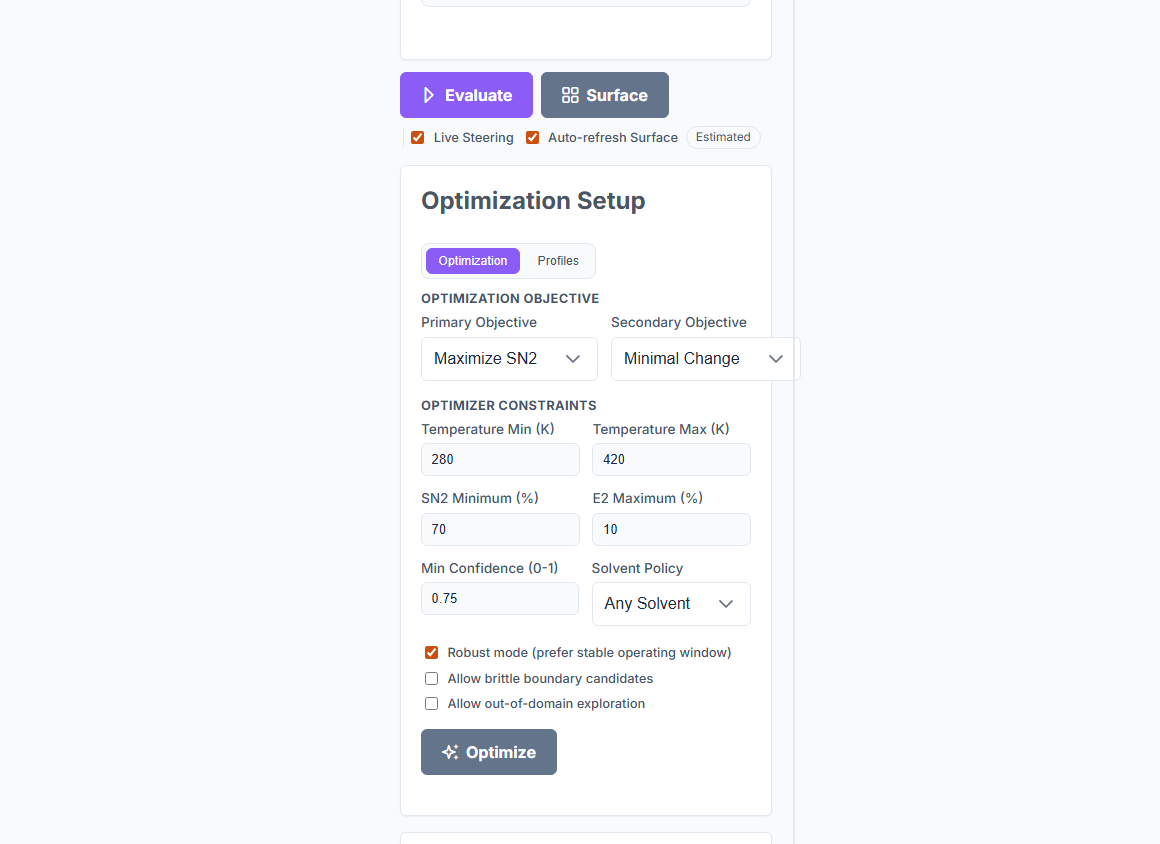
MechanismOS optimization panel with objectives and constraints
Optimization setupPrimary and secondary objectives + hard constraints. Goal-seek reports infeasibility rather than silently violating the bounds.
MechanismOS factor attribution for the activation barrier
Factor attributionEvery kJ/mol of the barrier attributed to nucleophilicity, sterics, solvent, and leaving group — the audit-grade “why” behind the call.

Scope & Limitations

Strengths

  • SN1 / SN2 / E1 / E2 / E1cb coverage with full branching fractions, not winner-only labels.
  • Real-time interactive surfaces across solvent, temperature, and strength axes.
  • Constraint-safe optimizer reports infeasibility honestly rather than silently violating bounds.
  • Boundary-aware: ambiguous regions flagged, robust windows preferred by default.
  • Evidence packs are versioned and reproducible bit-for-bit for audit, handoff, and regulatory review.

Known limitations

  • v1 scope covers SN1 / SN2 / E1 / E2 / E1cb chemistry; additives and catalysts are on the roadmap but not exposed yet.
  • Concentration regime is discrete in v1; continuous-concentration sweeps land in the next phase.
  • MechanismOS is an interactive decision system, not a full quantum-chemistry simulator — pair with Advanced Methods for explicit TS work.
  • ELN / LIMS connectors and standardized audit reports ship in the enterprise tier; public pilot is decision-pack-first.

Steer reactions. Stop guessing conditions.

Pilot access includes MechanismOS, the Kinetics predictor, Synthesis Planning, and a Workspace seat for audit-ready runs.

Request Pilot Access →