FLUXMATERIA — MECHANISMOS (STEER)

Reaction steering with mechanistic control surfaces.

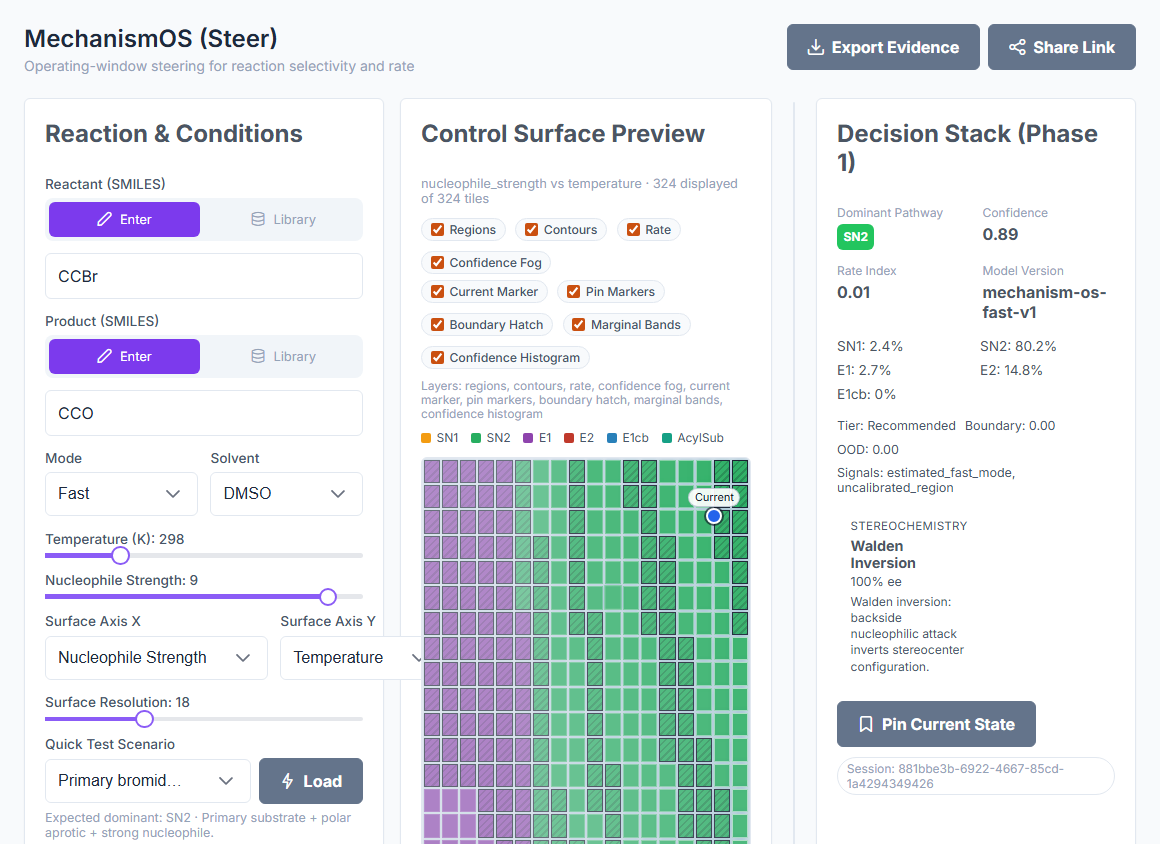
MechanismOS turns kinetics into an interactive cockpit: see the operating window, watch selectivity flip across boundaries, and optimize toward a target outcome under real constraints — with audit-grade traceability.

Request Pilot Access Schedule Demo See Benchmarks
Near real-time feedback Boundary + uncertainty overlays Constraint optimizer Evidence pack export

The breakthrough: prediction → control

MechanismOS is not a single-point classifier. It maps where outcomes flip — then helps you steer toward robust windows with constraints and traceability.

Control surfaces
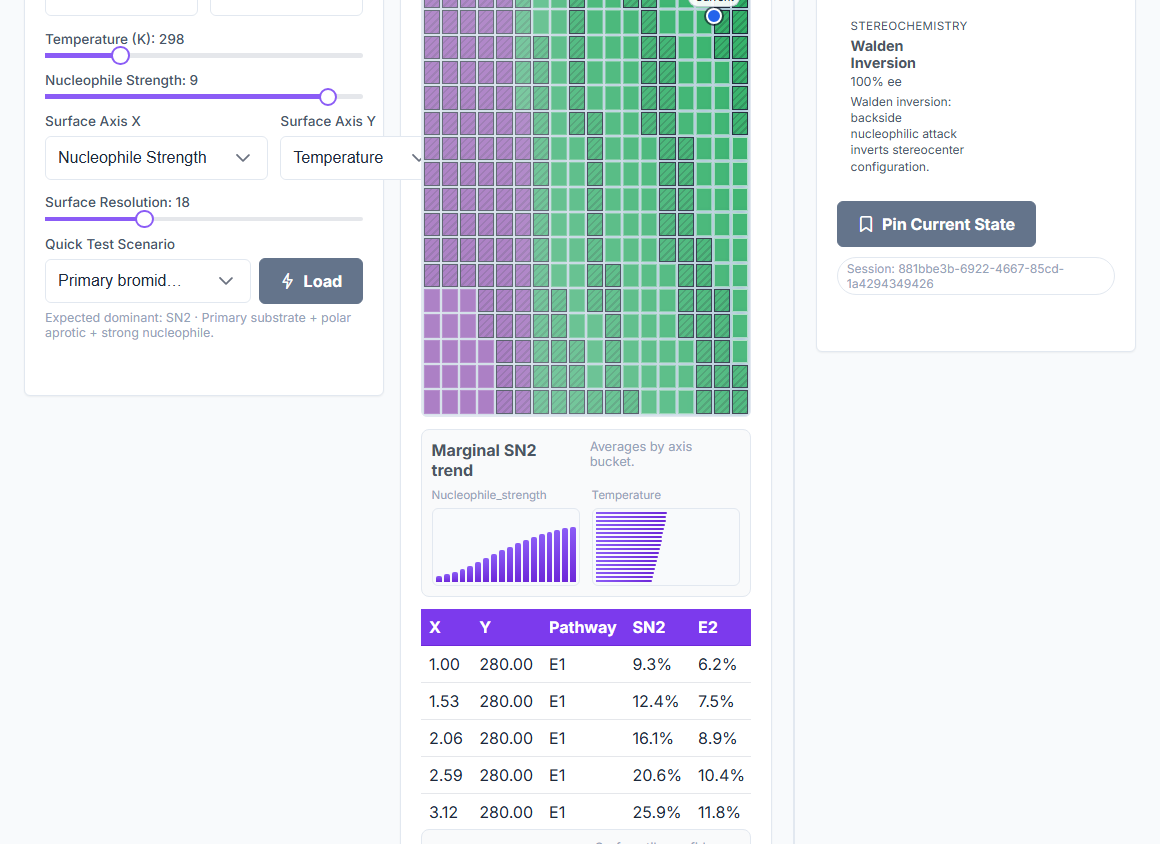
Heatmaps + contours across condition space (dominance, selectivity, rate).
Real-time steering
Live estimate→refined updates as you change solvent, temperature, and strength.
Constraint optimizer
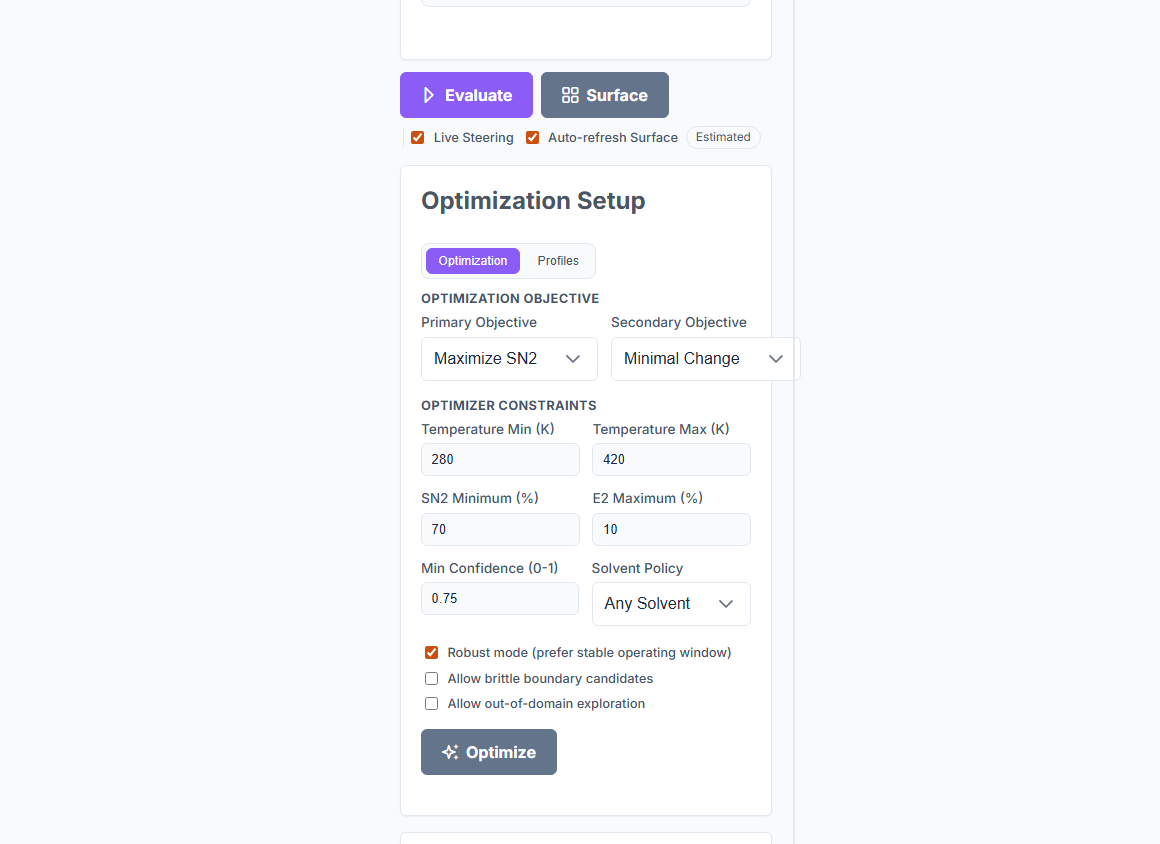
Goal-seek under hard constraints (temp caps, solvent policy, selectivity bounds).
Audit trail
Pin/compare + evidence pack export with version hashes and reproducibility.

Why MechanismOS is different

Most tools stop at “predict the mechanism.” MechanismOS is built for steering — and for staying honest when chemistry is genuinely ambiguous. Under the hood, it uses a deterministic physics kernel to generate per-pathway barrier proxies and decision surfaces in near real time, then wraps that engine with enterprise-grade uncertainty handling, constraints, and traceability.

Deterministic barrier engine

MechanismOS computes per-pathway barrier proxies from a compact, closed-form kernel (no iterative quantum loops, no trajectory simulation). This is what enables interactive control surfaces — not just point predictions.

Physics-informed corrections

Barrier terms are adjusted using structured effects (solvent stabilization, leaving group quality, steric/substitution regime, resonance flags, and temperature dependence), producing smooth, interpretable transitions across condition space.

Fast estimate → refined pins

The UI stays responsive with fast estimates while you steer. When you pin a state (or run optimization), the system evaluates a refined model path and records the full evidence trail.

Boundary-first trust layer

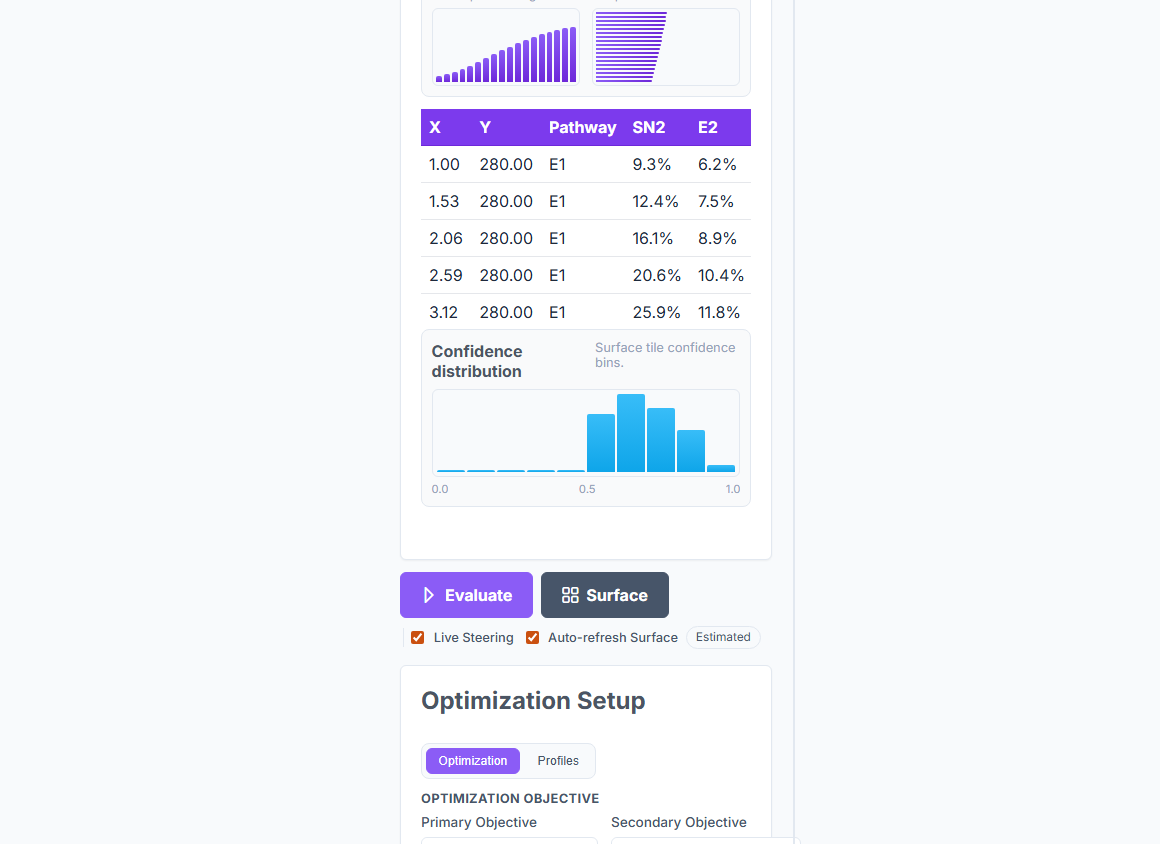
The hardest regions are boundaries where mechanisms compete. MechanismOS explicitly surfaces these zones (hatching + fog + reason codes) and defaults recommendations to robust, high-margin operating windows.

Constraint-safe optimization

Goal seeking is performed under hard constraints (temperature caps, solvent policy, selectivity/impurity bounds, confidence minima). If constraints are infeasible, MechanismOS returns “no feasible solution” with suggested relaxations — never silent violations.

Audit-grade evidence export

Every surface, pin, and optimization run is versioned with model hashes and exported as an evidence pack for review, handoff, and reproducibility.

Website-safe note: MechanismOS is designed as an interactive decision system. It is not positioned as a full quantum-chemistry simulator. It provides fast, interpretable steering surfaces with calibrated uncertainty behavior near boundaries and outside the calibration envelope.

Designed for boundary regions (honest uncertainty)

Mechanism flips are where chemists lose time — and where tools often overclaim. MechanismOS is built to expose these zones, not hide them.

Boundary hatching

Boundary-adjacent tiles are flagged when competing pathways are close. These regions are brittle: small condition changes can flip outcomes.

Confidence fog

Confidence overlays downgrade regions that are boundary-adjacent or outside calibration support. Recommendations default to robust zones.

Explainable deltas

Pin/compare generates “what changed” summaries and reason codes (near boundary, OOD, uncalibrated) for review and handoff.

Capabilities

Everything required to move from “prediction” to enterprise decisioning.

Surface slices

Choose axes, resolution, overlays. Click to inspect and pin states.

Branching fractions

Selectivity across competing pathways (not just a winner label).

Goal seeking

Top-N conditions + minimal-change suggestions + Pareto preview.

Evidence export

Share link + export pack with surface config, pins, and model versions.

Enterprise use cases

MechanismOS is built for process chemistry and development teams where constraints, robustness, and traceability matter.

Process development / CMC

Find operating windows that survive variance. Reduce late-stage surprises and impurity drift.

Troubleshooting

Explain why a solvent or temperature change flips SN2→E2 (or SN1→E1) and how to steer back.

Flow & automation

Low-latency evaluation + constraint mode for closed-loop condition optimization.

Scope and roadmap

Start with high-signal reaction families; expand systematically with validated gates.

v1 scope

  • SN1 / SN2 / E1 / E2 families
  • Surface maps with boundary + confidence overlays
  • Pin/compare + share links + evidence export
  • Constraint-aware optimizer (robust windows by default)

Next

  • Continuous concentration regime
  • Additives and catalyst toggles
  • Additional reaction families
  • ELN/LIMS connectors + standardized reports

Want to steer reactions instead of guessing conditions?

Bring 10–30 representative reactions. We’ll deploy a pilot workspace and deliver operating windows, optimizer recommendations, and traceable exports aligned to your constraints.

Request Pilot Access See Benchmarks