⚛️ FLUXMATERIA — CHEMISTRY

Trajectories and free energy,
without a force field to fit

Molecular dynamics, thermodynamic integration, free-energy perturbation, BAR, solvation free energy, replica exchange, metadynamics — all driven by the same first-principles physics. No force-field parameterisation. The FreeSolv hydration benchmark comes in at 0.33 kcal/mol MAE.

NVT / NPT / NVE TI · FEP · BAR Solvation ΔG Replica exchange Metadynamics
0.33 kcal/mol
MAE on FreeSolv hydration free energy (642 cases)
R² 0.986
Against external FreeSolv water data
8 solvents
Water, methanol, ethanol, acetone, DMSO, chloroform, hexane, benzene
3 ensembles
NVT, NPT, NVE with Berendsen thermostat / barostat
0
Force-field parameters fit
The breakthrough

Dynamics that ride on a first-principles potential

Bond lengths, bond energies, force constants, and angles all come from the same physics engine that the rest of the platform uses. The MD integrator uses that potential directly — so the trajectory is honest about the chemistry, energy conservation is built-in, and free-energy methods (TI / FEP / BAR) stack on top without needing a separate calibration step.

What MD & Free Energy does

One engine for trajectories, ensembles, and every major free-energy method.

🔁

NVT / NPT / NVE

Velocity-Verlet integrator with Berendsen thermostat / barostat. Temperature 1–1,000 K, pressure 0.1–1,000 bar, timestep 0.5–4 fs, run 1–1,000 ps.

📉

Trajectory analysis

Per-frame potential, kinetic, and total energy; temperature curves; diffusion coefficient from MSD; RMSD; radius of gyration — all logged per run.

🪜

Thermodynamic integration

11+ λ windows, adaptive sampling, converged ΔG with uncertainty. Log-sum-exp stability for numerically awkward endpoints.

🎲

Free-energy perturbation

Zwanzig-equation FEP with forward / reverse cycles, hysteresis reporting, and soft-core handling for vanishing endpoints.

⚖️

BAR

Bennett acceptance ratio with self-consistent iteration — uses both forward and reverse work distributions to cancel endpoint bias.

💧

Solvation free energy

Physics decomposition into cavity + van der Waals + electrostatic contributions for 8 solvents: water, methanol, ethanol, acetone, DMSO, chloroform, hexane, benzene.

🌡️

Replica exchange

8+ replicas on a geometric temperature ladder, exchange attempts every N steps, acceptance-rate tracking per swap.

🏔️

Metadynamics + CVs

Well-tempered Gaussian hills on 1D or 2D collective variables (distance, angle, dihedral, coordination number) with free-energy surface recovery.

How an MD run is built

From SMILES to trajectory and free energy in one pipeline.

1

Build the system

Parse SMILES, construct 3D geometry, and assign FLUX-derived bond lengths, energies, force constants, and angles directly from the physics engine.

2

Configure the run

Pick ensemble (NVT / NPT / NVE), temperature, pressure (for NPT), timestep, simulation time, and thermostat. Enable CVs or replicas if needed.

3

Integrate

Velocity-Verlet integrator advances the trajectory; Berendsen thermostat / barostat couple to the target ensemble; energy conservation logged per frame.

4

Free energy (optional)

Turn on TI / FEP / BAR for absolute or relative ΔG. Solvation free energy runs the decomposition over the chosen solvent.

5

Analyse

Summary, energy plot, temperature curve, trajectory table. Diffusion, RMSD, Rg reported automatically; export CSV / XLSX / JSON / PDF.

Why you can trust it

Benchmarked against FreeSolv and the bond engine, not internal metrics.

0.33 kcal/mol
MAE on FreeSolv hydration free energy — 642 molecules, R2 0.986 against published data.
0.079%
Bond-length MAPE on 453 validated bonds — the geometry the MD engine integrates on.
0.289%
Bond-energy MAPE on 908 validated BDEs — the energies the MD engine uses.
0.84%
Force-constant error (Morse potential) — the curvatures the MD integrator depends on.
0.09°
Bond-angle error — the geometric backbone of the potential.
0
Force-field parameters fit. Re-run the same input, get the same trajectory.

How FluxMateria compares

Head-to-head against the usual MD and free-energy toolchains.

MetricFluxMateriaGROMACS + force fieldAMBER / OPLS-AAQM/MM
Force-field parameterisationNoneRequiredRequiredPartial
FreeSolv hydration MAE (kcal/mol)0.330.4–1.00.4–1.00.2–0.5
Ensembles built-inNVT / NPT / NVEAllAllAll
TI / FEP / BAR built-inYesYesYesCustom
Solvation FE (built-in solvents)8 solventsCustom setupCustom setupCustom
Replica exchange & metadynamicsBuilt-inPLUMED plug-inPlug-inCustom
Deterministic per inputYesSeed-dependentSeed-dependentYes
Runtime per psInteractiveFastFastMinutes to hours

The key insight: Classical MD is fast but only as good as its force field; QM/MM is accurate but too slow for free-energy ensembles. MD & Free Energy keeps the trajectory interactive while the potential comes from first principles — and the FreeSolv benchmark ships in at 0.33 kcal/mol MAE without a force-field fit. See the solvation benchmark →

Where MD & Free Energy wins

Chemistry workflows where the ensemble and the free energy both matter.

Use case 1

Solvation free energy

One call returns ΔGsolv in any of eight solvents, plus the cavity / vdW / electrostatic decomposition. Drives logP and transfer-free-energy programmes.

Use case 2

Relative binding FE

Pair FEP or BAR on a common scaffold to rank substituents by ΔΔGbind — without re-parameterising the force field between analogues.

Use case 3

Conformational landscape

Metadynamics on a dihedral or distance CV recovers the free-energy surface. Compare protomers and tautomers on the same axis.

Use case 4

Slow process sampling

Replica exchange on a geometric temperature ladder improves sampling of conformations the NVT ensemble rarely visits.

Use case 5

Transfer properties

logP, logD, partition coefficients from solvation FE in water and octanol — or any of the eight solvents — with the decomposition reported.

Use case 6

Audit & reproducibility

Every run is deterministic. Reviewers can re-run the exact same command and get the same trajectory, frame-for-frame.

MD & Free Energy in the product

Real captures from the live application. Click any image to zoom.

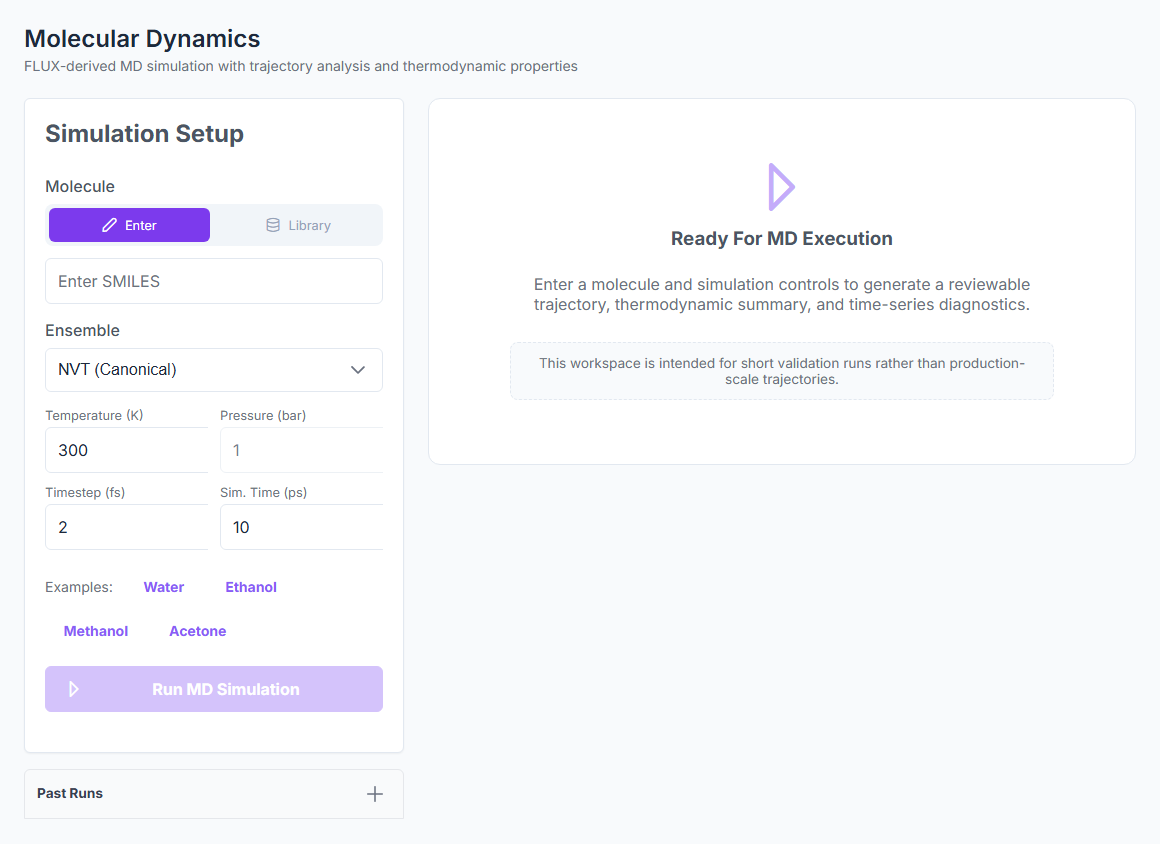
MD run configuration panel with ensemble, temperature, pressure, timestep, simulation time
Run configurationEnsemble, temperature, pressure, timestep, simulation time, and thermostat choice in one panel.
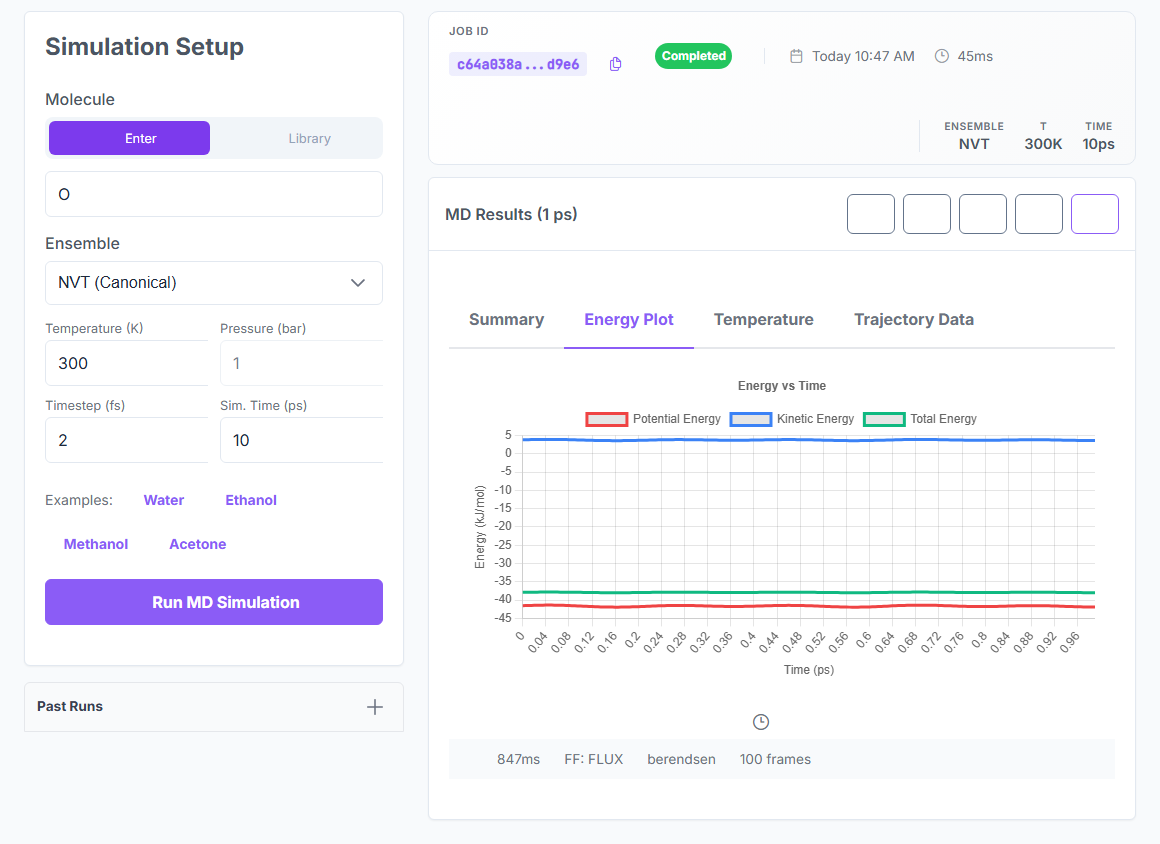
Energy plot tab showing potential, kinetic, and total energy vs time
Energy plotPotential, kinetic, and total energy versus time — the energy-conservation signature of an honest integration.
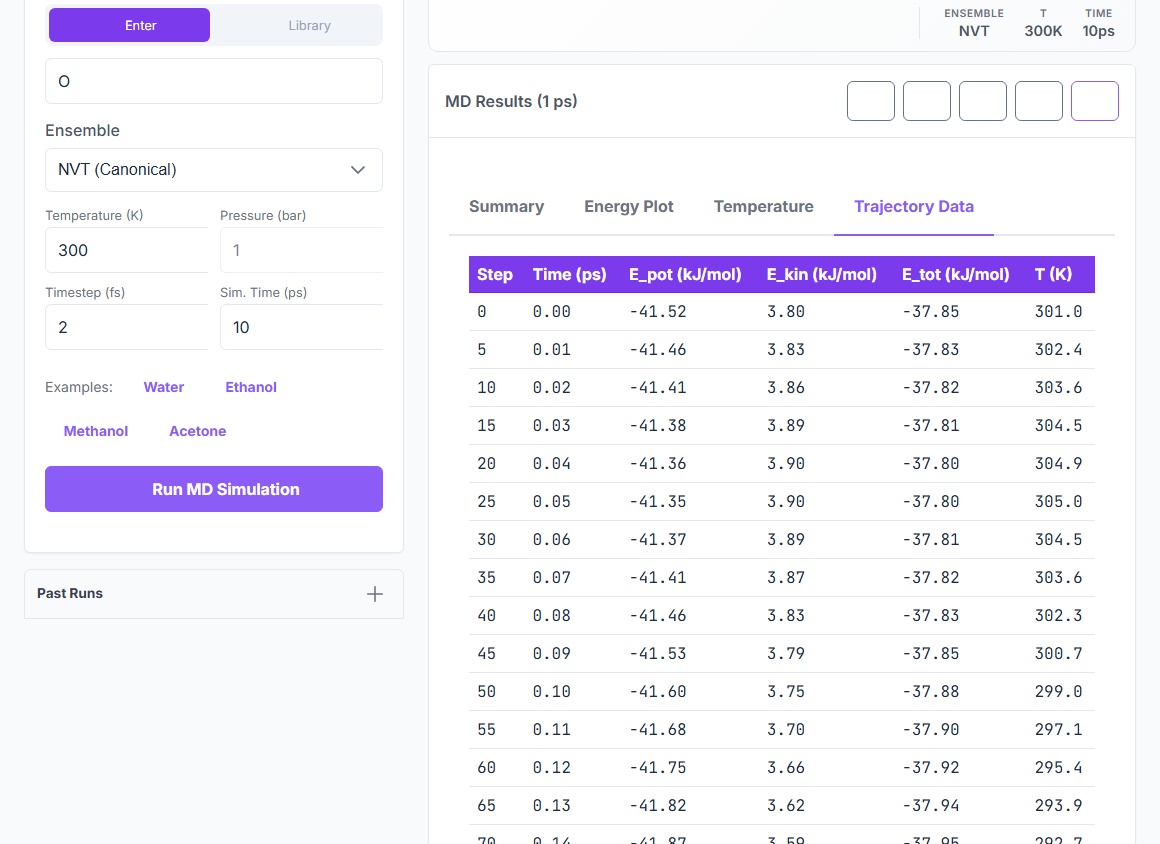
Trajectory data table with step, time, energies, temperature per frame
Trajectory dataPaginated per-frame table: step, time, potential / kinetic / total energy, temperature.
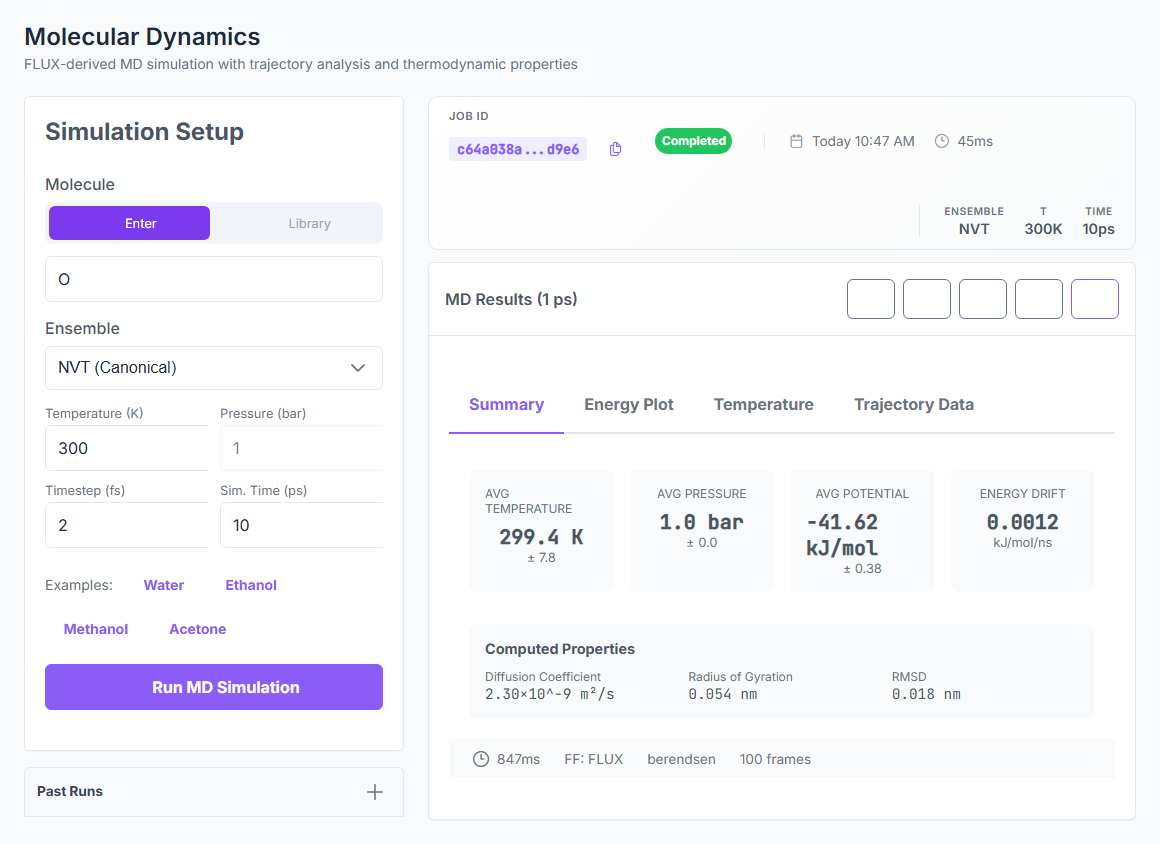
MD results summary card with averages, energy drift, diffusion, radius of gyration, RMSD
Simulation summaryAverages (T, P, potential), energy drift, diffusion coefficient, radius of gyration, and RMSD from the finished trajectory.

Scope & Limitations

Strengths

  • 0.33 kcal/mol MAE on the FreeSolv hydration benchmark (642 molecules, R2 0.986) — no fitting.
  • Solvation free energy for 8 built-in solvents with cavity / vdW / electrostatic decomposition.
  • TI / FEP / BAR / replica exchange / metadynamics all shipped in the same engine; no plug-ins required.
  • Potential comes from the same bond-engine numbers the Chemistry module is benchmarked on.
  • Deterministic; every run is reproducible bit-for-bit from the input command.

Known limitations

  • Long-timescale simulations (> 100 ns) and very large systems belong on a dedicated HPC pipeline, not the interactive UI.
  • Reactive bond-breaking / bond-forming is the MechanismOS domain, not this one — MD is for non-reactive dynamics.
  • Explicit membranes, crystals, and periodic interfaces need the materials MD pipeline (separate module).
  • Outside the 8 built-in solvents, solvation falls back on implicit continuum — explicit-solvent custom boxes are a workspace pipeline task.

Run your next MD / free-energy ensemble

Pilot access includes MD & Free Energy, peer Advanced calculators (pKa, dispersion, universal props), and a Workspace seat for audit.

Request Pilot Access →