FLUXMATERIA — MATERIALS

Screen materials at the speed of ideas.

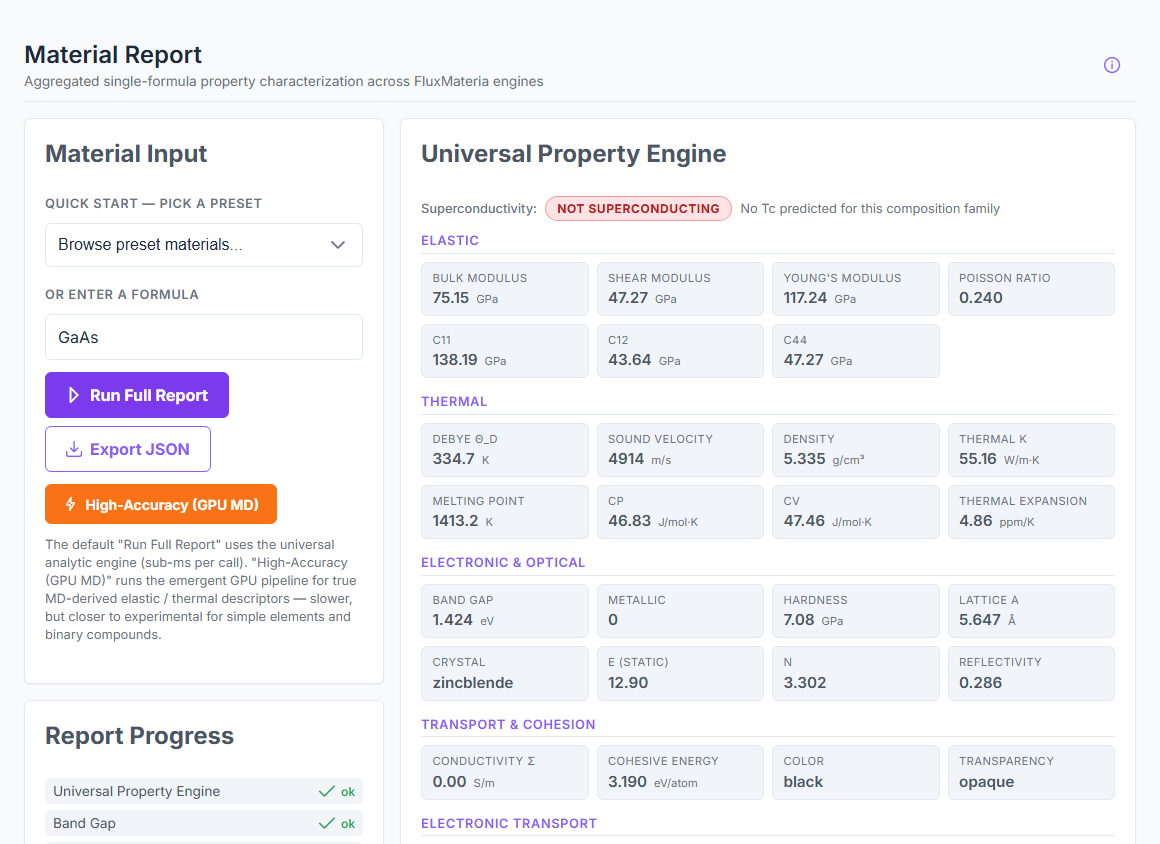
Input compositions. Get electronic, thermal, and structural property predictions. Shortlist candidates without waiting for DFT queues.

View Demo Request Pilot Access

Capabilities

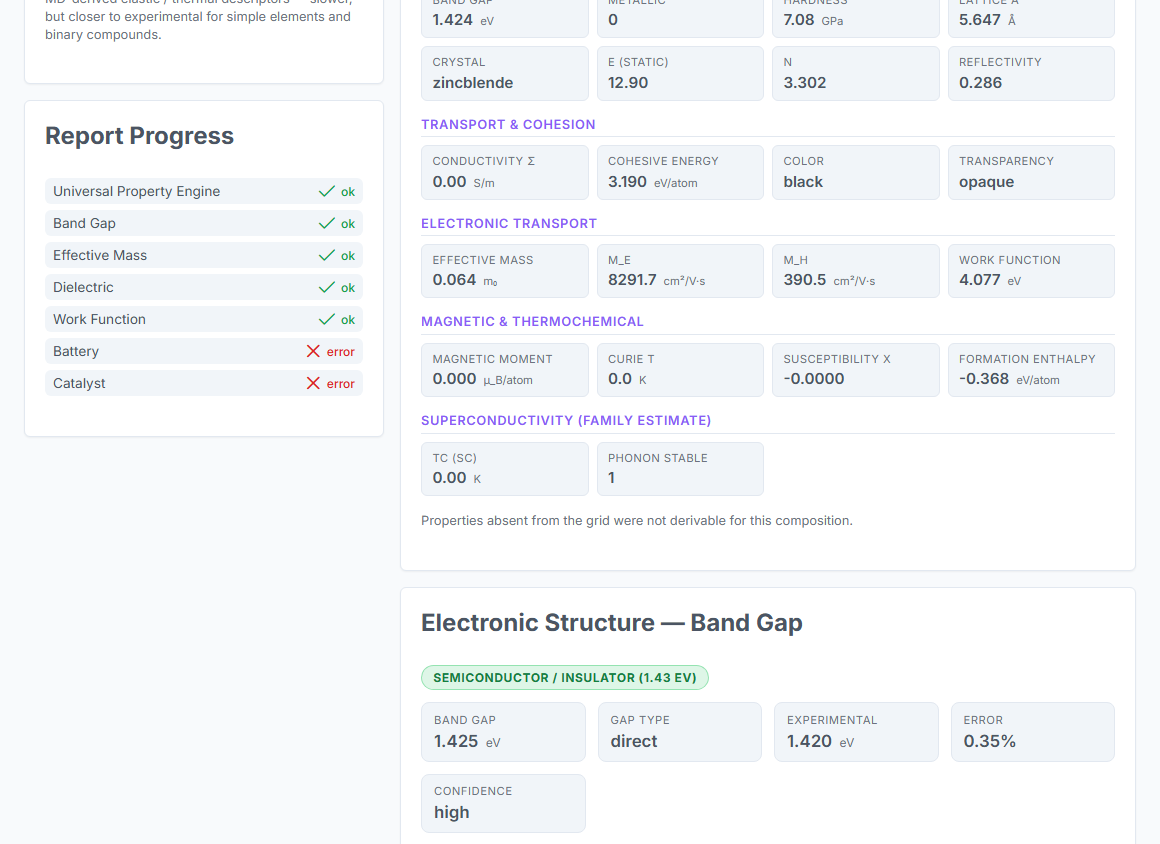
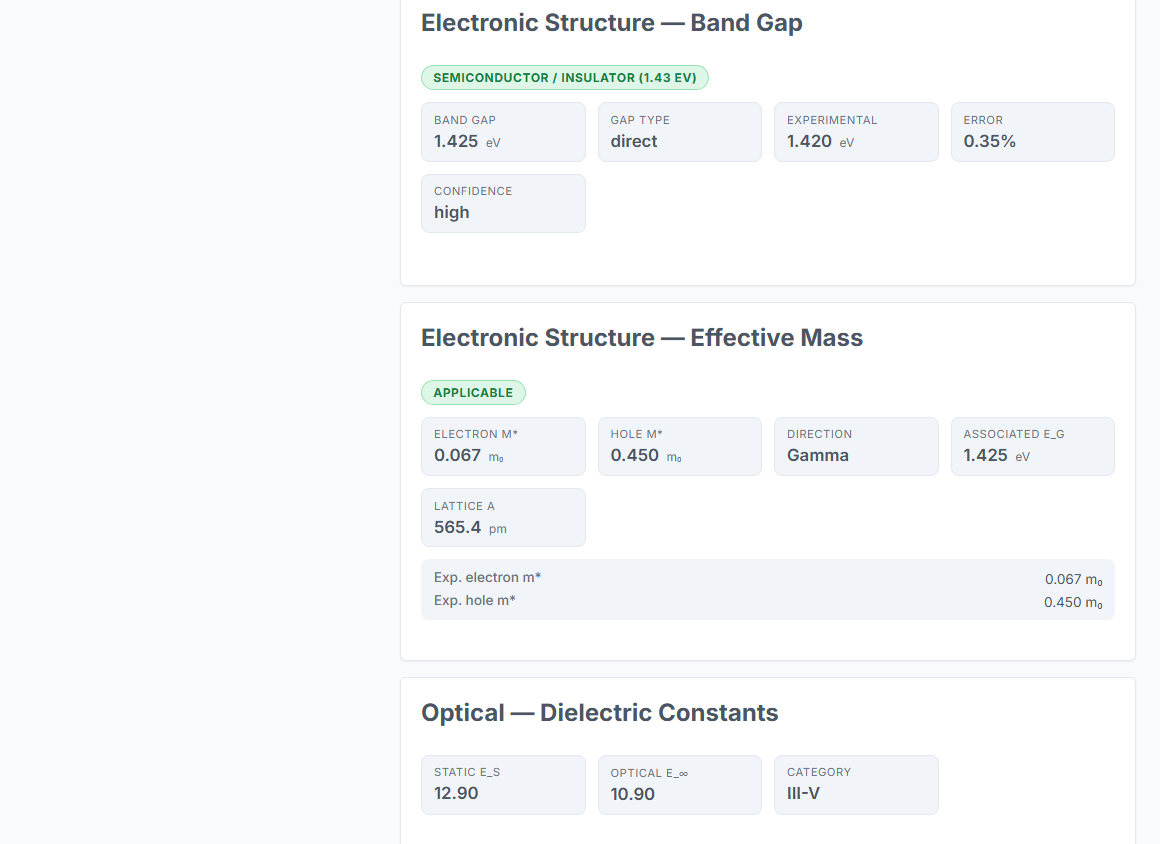
Band gap predictions

Electronic structure and band gap calculations from composition

🌡️

Thermal properties

Thermal conductivity and stability estimates

🔷

Structural properties

Lattice parameters and structural stability

🔄

Composition mapping

Direct composition-to-property predictions

📦

Batch screening

Screen entire material libraries efficiently

🎯

Threshold filtering

Apply property constraints to shortlist candidates

🧲

Magnetic properties

Curie temperature predictions from composition — 7.2% MAPE on 79 materials

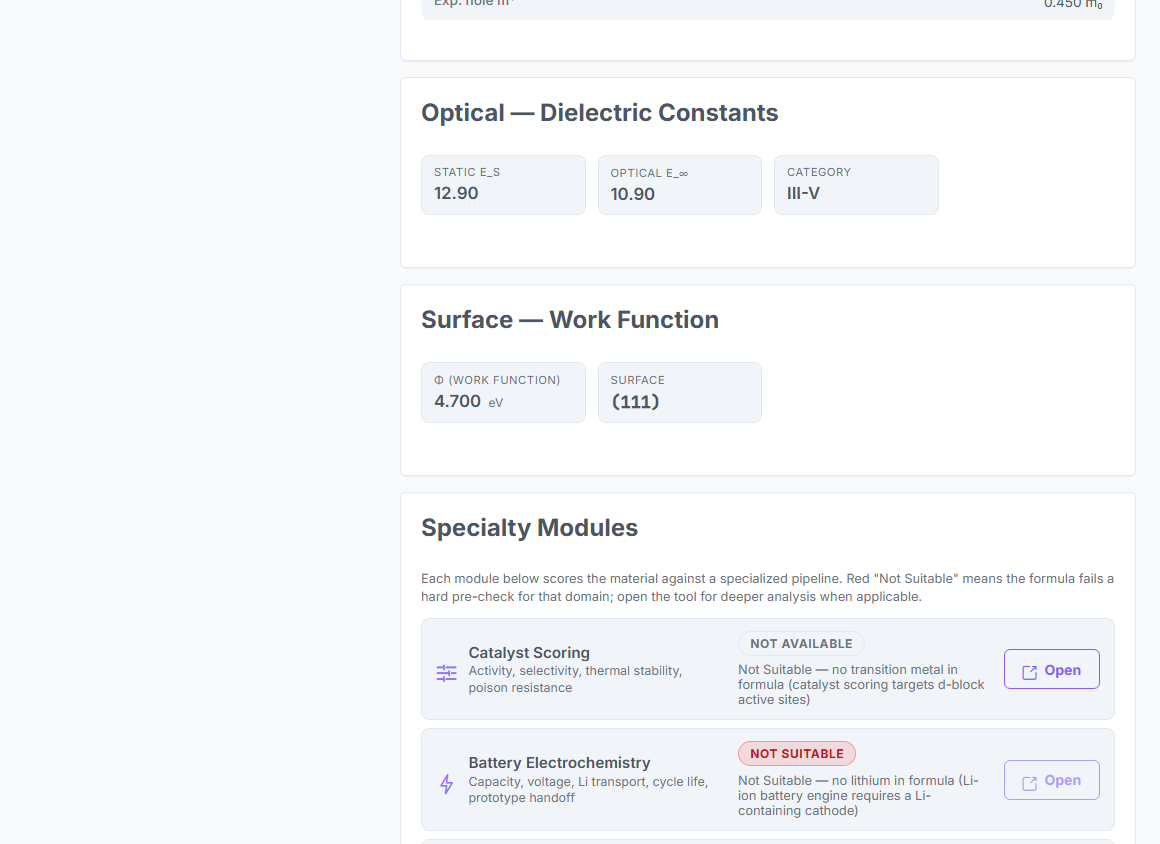
Battery electrochemistry

A dedicated battery-native decision layer for cathodes and build-ready battery screening. FluxMateria now combines bulk properties, transport, degradation, electrolyte and coating fit, uncertainty, and prototype handoff in one local workflow.

26.8s
Full local battery workflow
0.149 V
Calibrated holdout voltage MAE
5 / 5
Scenario benchmark alignments
4
Distinct decision winners
Pipeline outcome
The winner changed as the question changed.
Bulk: LiNiO2 Interface: LiMnPO4 Battery-native: LiMnO2 Build: Li4Ti5O12
Pipeline
01
Bulk screen
Start with classical bulk ranking.
02
Interface pass
Re-rank for contact and surface readiness.
03
Battery-native layer
Score transport, voltage, cycle life, and degradation.
04
Electrolyte and coating
Attach interphase risk and mitigation guidance.
05
Confidence and experiments
Estimate uncertainty and recommend next tests.
06
Prototype handoff
Produce a build-ready recommendation package.
B1

Transport and fast charge

Topology-aware transport, bottleneck screening, anisotropy, defect sensitivity, and rate-capability signals.

B2

Degradation and cycle life

Fade-mode breakdown, impedance growth, cracking pressure, voltage-window stress, and cycle-life heuristics.

B3

Electrolyte and coating fit

Interphase risk, oxygen-loss pressure, dissolution risk, and coating recommendations tied to the chemistry.

B4

Cost and manufacturing

Cost competitiveness and manufacturing readiness folded directly into the battery decision layer.

B5

Uncertainty and active learning

Support-aware confidence, out-of-domain warnings, and experiment recommendations for the next iteration.

B6

Prototype package

Build-facing handoff with recommended configuration, validation plan, and public/internal disclosure split.

Latest case study

Better battery cathodes through interface-aware and build-ready screening

See how the module changed the answer from bulk winner to interface winner to build winner in one local run.

Read case study

White paper

Download the public writeup of the battery workflow, results, and literature context.

Open white paper

Benchmark summary

Review holdout accuracy and the multi-scenario stress test for the battery layer.

Open benchmark

Speed comparison

Approach Time per material Practical for screening?
Full DFT Hours to days No
ML surrogates Seconds Yes, but limited extrapolation
FluxMateria Seconds Yes, physics-based

This table is a positioning summary. Measured throughput and accuracy are reported on the Benchmarks page.

Typical workflow

1

Input

Enter composition or upload material library

2

Select

Choose property predictions (electronic, thermal, structural)

3

Run

Fast batch computation

4

Filter

Apply property thresholds

5

Shortlist

Review ranked candidates meeting criteria

6

Export

Decision packet for DFT follow-up

Verified Benchmark Results

Validated against DFT reference calculations and experimental measurements across material families.

0.9%
Band Gap MAE
100%
Pass Rate
313
Materials Validated
73
Elements Supported
Property Metric FluxMateria DFT Reference Status
Band Gap MAE 0.9% MAE ✓ DFT-competitive
Metal vs Insulator Accuracy 100% ~95% ✓ Pass
Formation Energy MAE 0.08 eV/atom ✓ Screening-grade
Lattice Parameters MAPE 2.1% 1-2% ✓ Competitive
Thermal Conductivity Correlation r² = 0.87 r² ~ 0.9 ✓ Screening-grade
Curie Temperature MAPE 7.2% 15–30% ✓ 79 materials, 17 families

All predictions are physics-based. No ML black boxes. 100% interpretable.

See full methodology →

Speed & cost advantage

~1s
per material
vs hours for DFT
0
fitted parameters
First-principles physics
100%
interpretable
Every prediction explained

Scope notes

  • Currently optimized for binary and ternary compounds; complex quaternary+ systems may have lower accuracy
  • 73 elements supported (H through Bi, excluding lanthanides)
  • Best suited for screening and shortlisting; final candidates should be verified with DFT or experiment
  • Thermal properties require stable crystal structure prediction first

Evaluate the platform

Interactive demo

No account required. Enter a composition and see property predictions with full interpretability.

Run Demo →

Batch evaluation

Upload a material library and screen the full composition space.

Request Pilot Access →

Patent Pending