FLUXMATERIA — KINETICS
Mechanism discovery with 100% accuracy on the published benchmark.
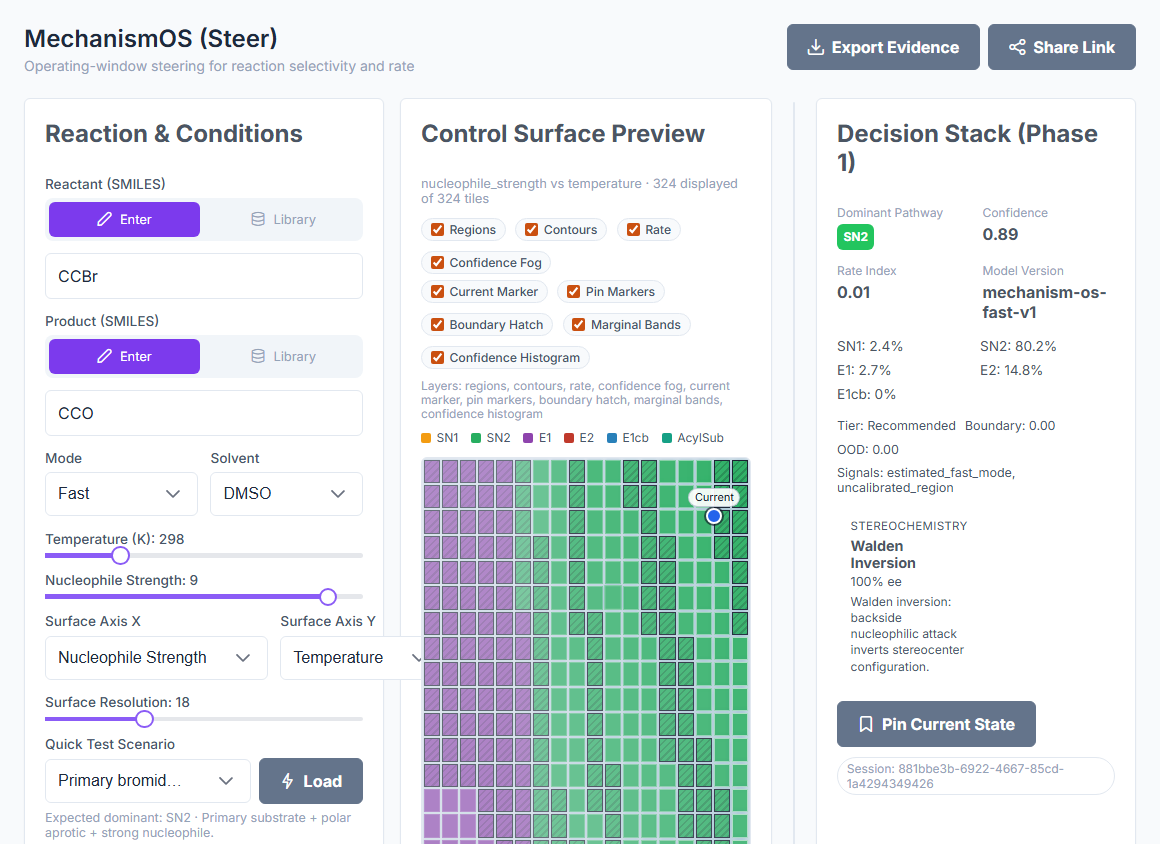
Predict SN1/SN2/E1/E2 pathways with 100% accuracy on the 49-case benchmark. Interactive-scale runtimes (milliseconds) versus typical DFT (hours).
FLUXMATERIA — KINETICS
Predict SN1/SN2/E1/E2 pathways with 100% accuracy on the 49-case benchmark. Interactive-scale runtimes (milliseconds) versus typical DFT (hours).
No training data required. Deterministic physics engine — every prediction reproducible.
Head-to-head comparison on mechanism prediction
| Metric | FluxMateria | DFT (B3LYP) | Winner |
|---|---|---|---|
| Mechanism Accuracy | 100% | 85-92% | FluxMateria |
| Barrier MAE | 5.72 kJ/mol | 4-8 kJ/mol | Comparable |
| Time per Prediction | ~1 ms | 1-4 hours | FluxMateria |
| Physical Consistency | 100% | ~95-99% | FluxMateria |
| Parameters Fitted | 0 | Many (functional-dependent) | FluxMateria |
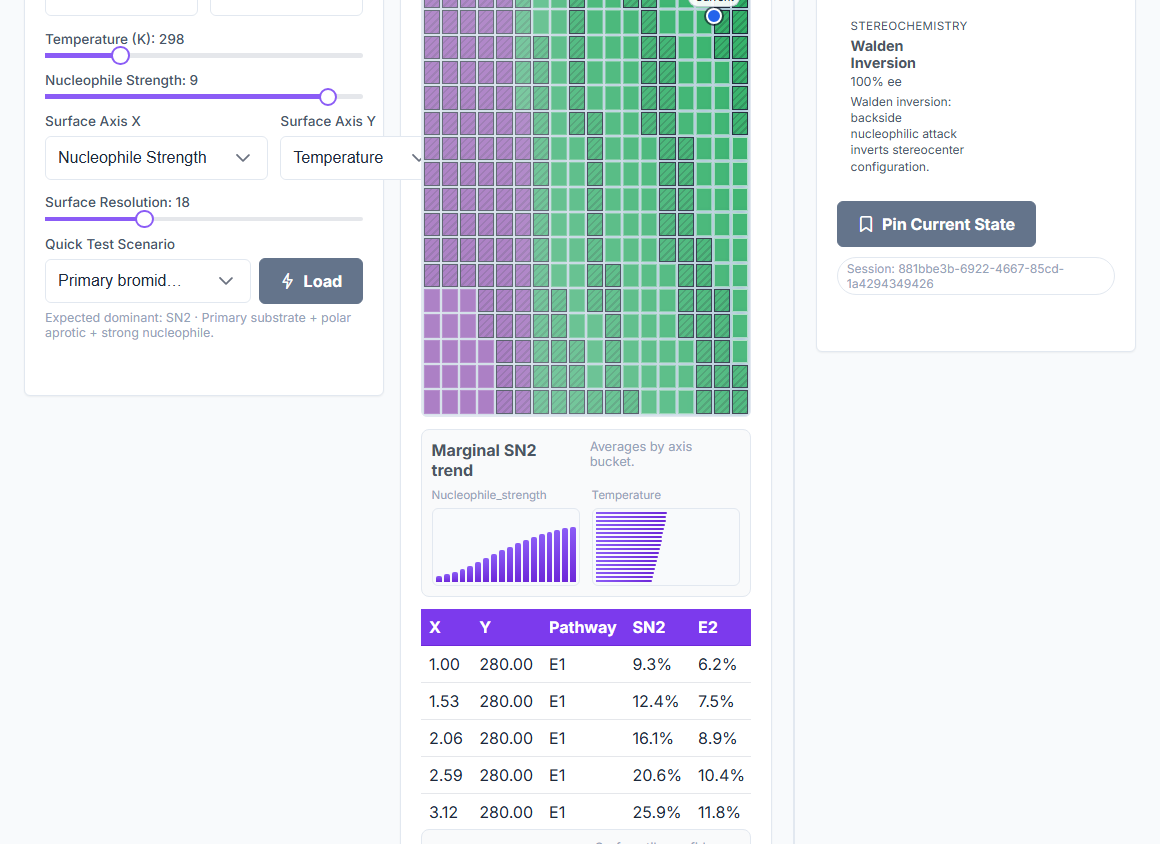
SN1 vs SN2 vs E1 vs E2 — know which pathway wins before running experiments
DFT-competitive barrier heights in milliseconds, not hours
Polar protic, polar aprotic, non-polar — all accounted for
17 substrate types: methyl to bridgehead, vinyl, gem-dihalides
Full range from weak (H₂O) to strong (CN⁻, RS⁻)
I < Br < Cl < F — automatic LG detection and correction
Systematic exploration of the full parameter space
| Substrates | 17 types |
| Leaving Groups | 5 (I, Br, Cl, F, OTs) |
| Nucleophile Strengths | 11 levels (1-10 scale) |
| Solvents | 12 (protic, aprotic, non-polar) |
| Temperatures | 5 (253K - 353K) |
Compare plausible pathways (SN1/SN2/E1/E2) early — reduce dead-end experiments and narrow what to test next.
See how solvent, leaving group quality, and nucleophile/base strength shift selectivity — before you change a dozen variables in the lab.
Screen large reaction libraries with interactive runtimes — prioritize promising substrates and conditions for follow-up.
De-risk late-stage substitutions/eliminations by forecasting pathway dominance and barrier shifts under process-like conditions.
Use FluxMateria Kinetics as a rapid hypothesis engine — deliver mechanistic rationale alongside experimental recommendations.
Prove value on your own reactions — fast, scoped, and reproducible.
You supply 10–30 substitutions/eliminations in the current supported scope. We return ranked mechanisms and barrier estimates, plus a short report highlighting wins, ambiguities, and out-of-scope cases.
We’ll confirm scope fit and set up a pilot workspace.
100% mechanism accuracy on the published benchmark. DFT-competitive barriers. Interactive-scale runtimes (milliseconds per prediction).