FLUXMATERIA — KINETICS

Mechanism discovery with 100% accuracy on the published benchmark.

Predict SN1/SN2/E1/E2/E1cb pathways with 100% accuracy on the 336-case benchmark. 7.4 kJ/mol barrier MAE. Interactive-scale runtimes (milliseconds) versus typical DFT (hours).

Schedule Demo See Full Benchmark

The Breakthrough

100%
Mechanism Accuracy
336/336 experimental cases
7.4
kJ/mol MAE
Barrier mean absolute error
~1 ms
Time per Prediction
Benchmark-scale runtime

No training data required. Deterministic physics engine — every prediction reproducible.

FluxMateria vs. Quantum Chemistry

Head-to-head comparison on mechanism prediction

Metric FluxMateria DFT (B3LYP) Winner
Mechanism Accuracy 100% 85-92% Comparable
Barrier MAE 7.4 kJ/mol 4-8 kJ/mol Comparable
Time per Prediction ~1 ms 1-4 hours FluxMateria
Physical Consistency 100% ~95-99% FluxMateria
Parameters Fitted 0 Many (functional-dependent) FluxMateria
View Full Methodology & 336 Test Cases →

Why This Matters

The landscape is either fast-but-crude or accurate-but-slow. FluxMateria is both.

Rule-Based Tools

"Primary → SN2, tertiary → SN1"

  • ~85% accuracy — fails on borderline cases
  • No barrier estimates
  • No E1cb, no rearrangements, no NGP
  • No temperature or solvent sensitivity

DFT / Quantum Chemistry

Gold-standard barriers, but at a cost

  • Hours to days per transition state search
  • Expert setup required (basis set, functional)
  • No automatic mechanism classification
  • Impractical for screening campaigns

FluxMateria Kinetics

DFT-grade accuracy at rule-based speed.

100% classification across 336 cases. 7.4 kJ/mol barrier MAE. 5 mechanisms. ~1 ms per prediction. Zero fitted parameters.

Capabilities

Every feature shown here is validated on the 336-case benchmark

🎯

5-Way Classification

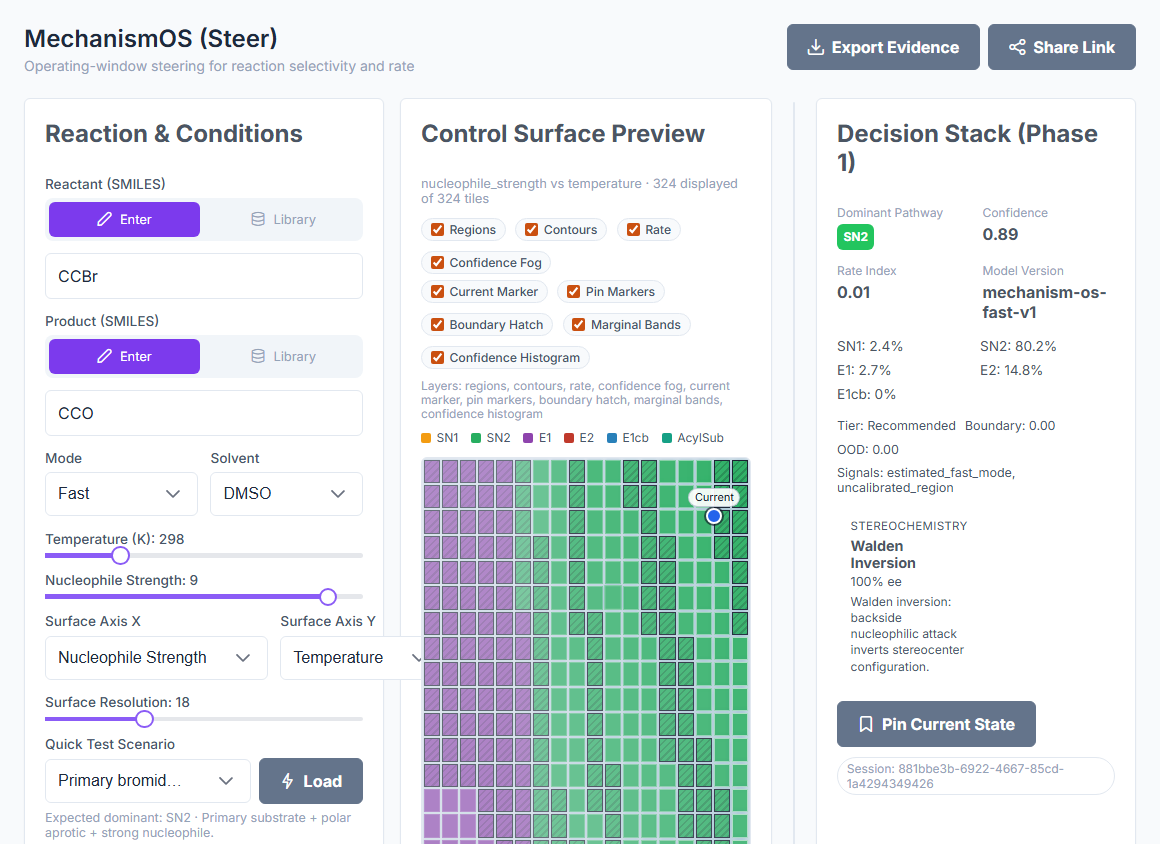
SN1, SN2, E1, E2, and E1cb — all five mechanisms from a single prediction call, with Boltzmann-weighted competition

DFT-Grade Barriers at 10⁶× Speed

7.4 kJ/mol MAE — inside the DFT accuracy window — in ~1 ms instead of hours. Enables real-time interactive exploration

🌡️

Temperature-Driven Switching

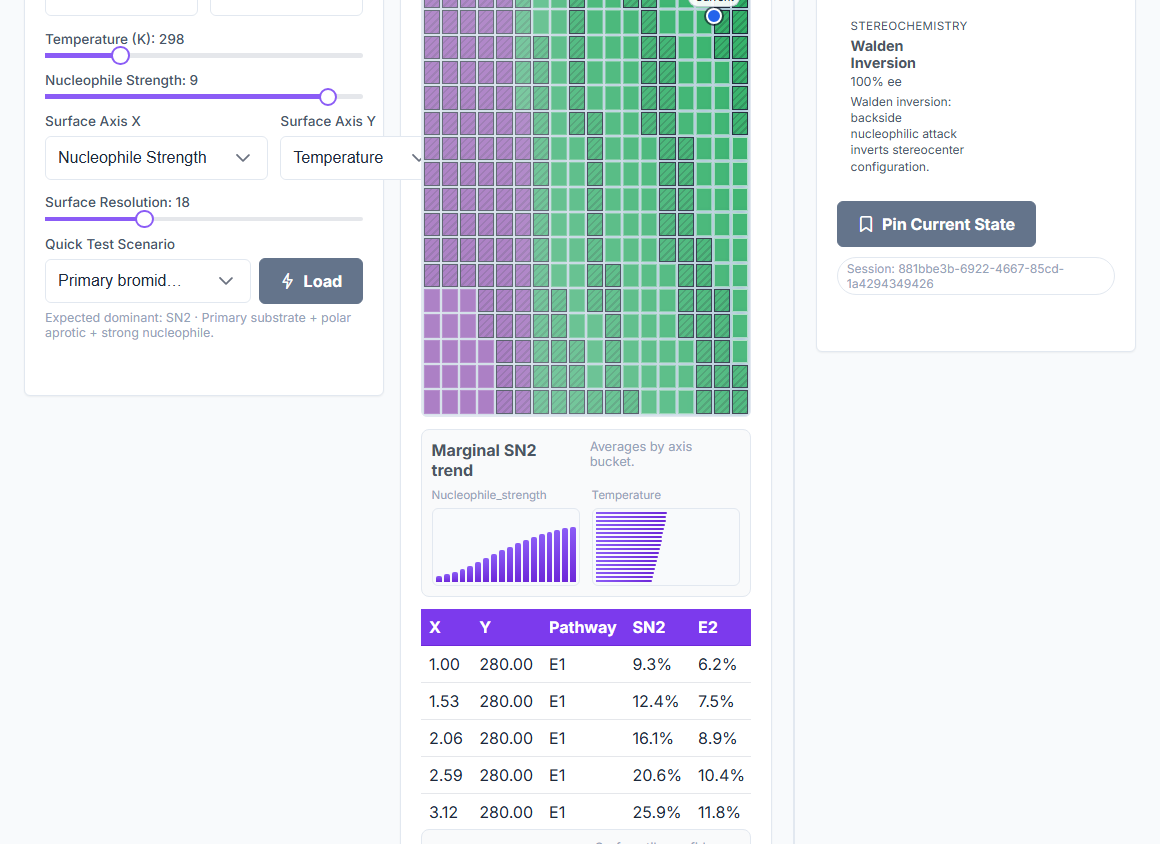
Predicts mechanism crossovers (SN1→E1, SN2→E2) as temperature changes — including the crossover point

🔀

Rearrangement Detection

Hydride shifts, methyl shifts, and ring expansions flagged automatically under SN1/E1 conditions via graph traversal

🔗

Neighboring Group Participation

Anchimeric assistance from S, N, and phenyl groups detected with rate enhancement estimates (episulfonium, aziridinium, phenonium)

🧬

Full Interpretability

Every kJ/mol traceable to a physical factor — nucleophilicity, steric strain, solvent stabilization. Not a black box

💧

16 Solvents

Water, ethanol, DMSO, DMF, acetone, TFE, t-BuOH, methanol, THF, and more — protic, aprotic, and non-polar

0️⃣

Zero Fitted Parameters

Derived entirely from first-principles physics. No training data, no ML weights, no empirical corrections.

Parameter Space Coverage

Conditions supported by the mechanism comparator

Mechanisms 5 (SN1, SN2, E1, E2, E1cb)
Substrate Types 7 (methyl, primary, secondary, tertiary, allylic, benzylic, vinyl)
Leaving Groups 7 (I, Br, Cl, F, OTs, OMs, OTf)
Nucleophile/Base Strengths Continuous (1-10 scale)
Solvents 16 (protic, aprotic, non-polar)
Temperatures Arbitrary (0-180°C validated, default 25°C)
Special Effects Rearrangements, NGP, EWG activation
Validated on: 336 experimental cases

Enterprise Applications

Route selection & troubleshooting

Compare plausible pathways (SN1/SN2/E1/E2) early — reduce dead-end experiments and narrow what to test next.

Condition sensitivity

See how solvent, leaving group quality, and nucleophile/base strength shift selectivity — before you change a dozen variables in the lab.

Mechanistic triage at scale

Screen large reaction libraries with interactive runtimes — prioritize promising substrates and conditions for follow-up.

Process development support

De-risk late-stage substitutions/eliminations by forecasting pathway dominance and barrier shifts under process-like conditions.

CRO & research workflows

Use FluxMateria Kinetics as a rapid hypothesis engine — deliver mechanistic rationale alongside experimental recommendations.

Pilot Evaluation

Prove value on your own reactions — fast, scoped, and reproducible.

30-day paid evaluation

You supply 10–30 substitutions/eliminations in the current supported scope. We return ranked mechanisms and barrier estimates, plus a short report highlighting wins, ambiguities, and out-of-scope cases.

  • Deliverables: predictions + rationale + summary report
  • Reproducible: inputs, settings, and outputs logged per case
  • Fast start: first results typically in days, not weeks

Request access

We’ll confirm scope fit and set up a pilot workspace.

Schedule Demo Request Pilot Access
Patent pending on core engines. NDA available for evaluations.

Accelerate your R&D pipeline

100% mechanism accuracy on the published 336-case benchmark. 7.4 kJ/mol barrier MAE. Interactive-scale runtimes (milliseconds per prediction).

Schedule Demo Request Pilot Access