๐ŸŽฏ FLUXMATERIA — PLATFORM

Stop searching.
Start specifying.

Define what you need — property ranges, hard constraints, tradeoffs. FluxMateria returns ranked candidates with satisfaction scores, rejection reasons, and the Pareto frontier when properties conflict. Works across drugs and materials.

Spec-driven Drugs & materials Rejection logging Pareto tradeoffs 6 presets
20
Searchable properties across drug and material specs
6
Preset specs (oral_drug, cns_drug, lead_like, and more)
2
Search domains — small-molecule libraries + crystal structures (CIF)
Per-candidate
Satisfaction score, failure reasons, and relaxation analysis
0
Training data required — same spec returns the same ranking every run
The breakthrough

Rejection is a first-class output.

Screening tools give you a ranked list and hide the losers. Inverse Search returns the full picture: which candidates satisfy the spec, which near-miss (and on which constraint), and what you would gain by relaxing any one criterion. The ones that fail teach you as much about the design space as the ones that pass — so your next spec is sharper, not just longer.

Capabilities

One spec language. Ranked candidates. Every rejection explained.

๐Ÿ“

Multi-property constraints

Set targets, ranges, and hard constraints across multiple properties in a single spec — no manual filtering loops.

๐Ÿ“Š

Candidate ranking

Satisfaction score per candidate against the full spec, not a single property. Ranks stay consistent across reruns.

๐Ÿ“ˆ

Pareto tradeoffs

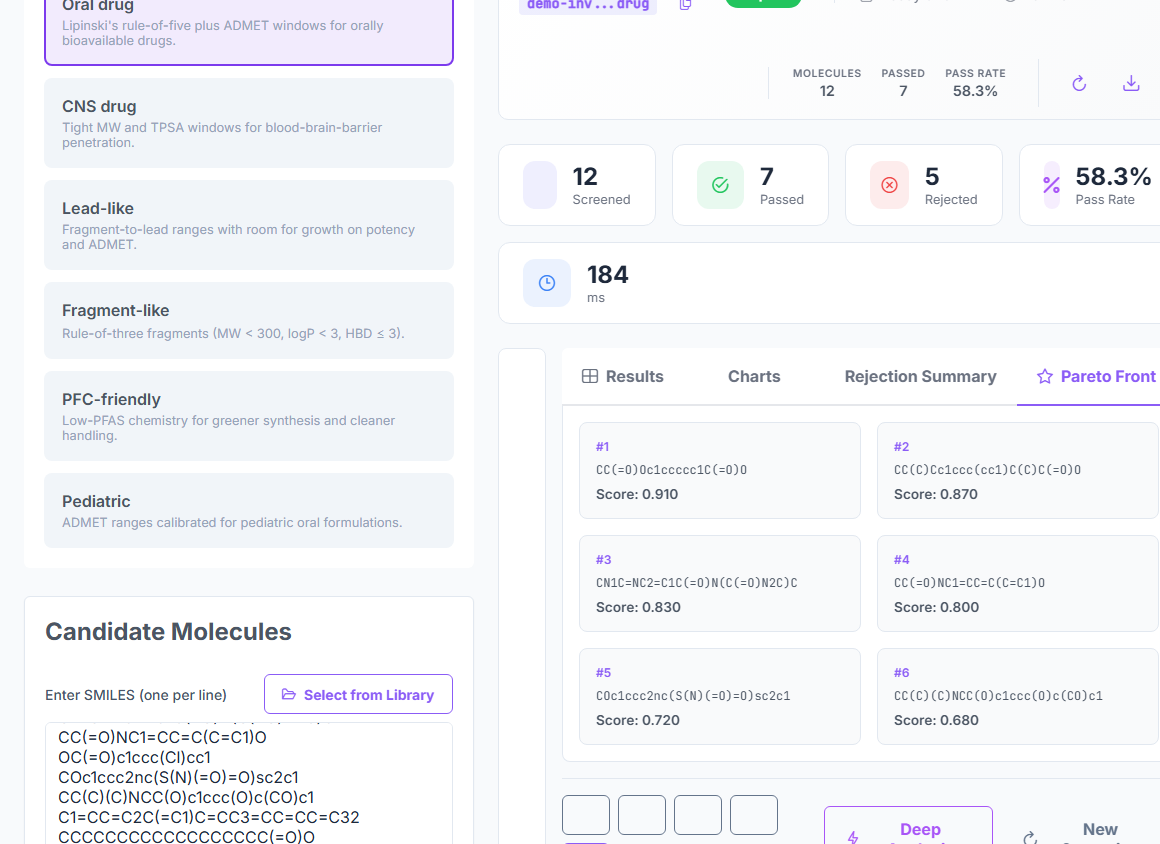
When properties conflict (potency vs selectivity, band gap vs stability), see the frontier instead of a forced winner.

๐Ÿ“

Rejection logging

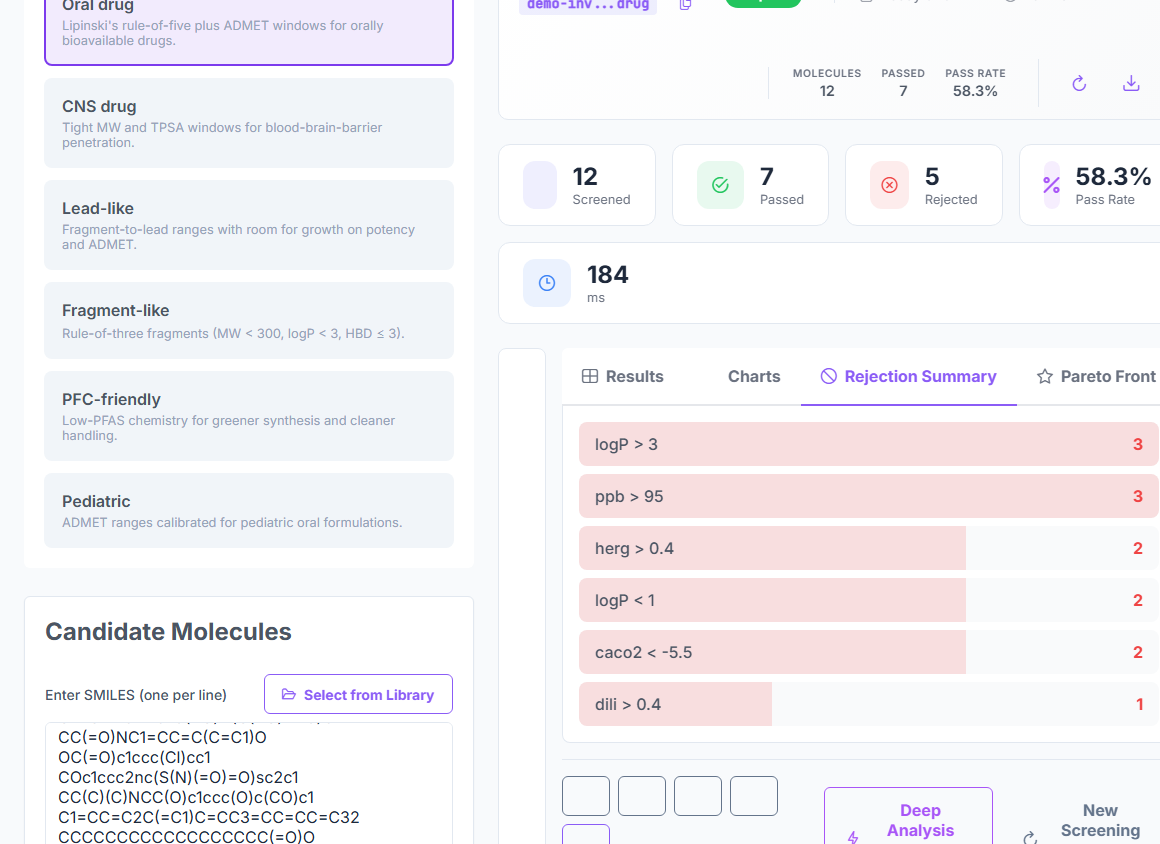
Every failing candidate comes with the constraint it missed and by how much. Audit-ready, explainable outputs.

๐Ÿ”„

Relaxation analysis

“If I soften logP by 0.5, how many more candidates pass?” Explicit tradeoff answers, per constraint.

๐Ÿงช

Drug & material presets

oral_drug, cns_drug, lead_like, fragment_like, pfc_friendly, and more — starting points you can edit.

๐Ÿ“

Bring your own library

Upload SMILES lists or CIF structures. Search against curated libraries or your in-house candidate set.

๐Ÿ“ค

Decision packet export

Shortlist, full rejection trail, and decision rationale exportable straight into Workspace.

The spec-driven pipeline

From constraint statement to exportable shortlist in one workflow.

1

Define spec

Write property targets, ranges, and hard constraints — start from a preset or build from scratch.

2

Validate

Spec is checked for conflicts, unreachable ranges, and missing required properties before search runs.

3

Search

FluxMateria evaluates the candidate space — uploaded library, curated set, or enumerated structures.

4

Review

Ranked candidates with per-constraint satisfaction, near-miss list, and explicit rejection reasons.

5

Analyze tradeoffs

Pareto frontier + relaxation analysis: see which constraints are binding and what softening them would unlock.

6

Export

Shortlist + full decision trail into Workspace. Every winner and every rejection is traceable and reproducible.

Why you can trust it

Deterministic, explainable, and auditable — by design.

0
Training data. The spec evaluates against first-principles property predictions — no model drift between runs.
Deterministic
Same spec, same library → identical ranking every run. No stochastic search, no random seeds to track.
Per-constraint
Every score is decomposable to the constraint that drove it. Rejection reasons are concrete, not “low confidence.”
6 presets
oral_drug, cns_drug, lead_like, fragment_like, pfc_friendly, and more — editable starting points, not black boxes.
Full trail
Spec, validation results, full candidate ranking, and rejection log exportable as one decision packet.
Workspace-ready
Every search is a versioned run. Replay, compare, or hand off the decision packet with the full history attached.

How FluxMateria compares

Head-to-head against the common ways of narrowing a candidate set.

MetricFluxMateriaClassical screeningGenerative modelsSpreadsheet filters
InputProperty specLarge libraryTraining setLibrary + rules
Multi-property constraintsNativeManual filtersSoft penaltiesHard cutoffs
Rejection reasonsPer constraintNot surfacedNot surfacedWhichever cut first
Pareto tradeoffsBuilt-inManualRareNot provided
Relaxation analysisBuilt-inManualN/AManual
Training dataNoneNoneThousands of labelsNone
DeterminismIdentical rerunsIdentical rerunsStochasticIdentical reruns
Decision packetOne exportAssembled by handNot providedNot provided

The key insight: Most tools answer “which of these is best?” — Inverse Search answers “which of these meets my spec, which don’t, and what would it cost to get more?” The difference shows up when the spec is tight, the library is expensive to screen, or the decision has to survive an audit.

Where Inverse Search wins

Decisions where “top of the list” isn’t the question.

Use case 1

Lead optimization

Target potency, selectivity, and ADMET ranges simultaneously. Get the candidates that hit all four — not just the best potency.

Use case 2

Materials screening

Band gap range, thermal stability threshold, cost ceiling — spec it, upload CIFs, get ranked compositions back.

Use case 3

Formulation development

Solubility window, stability band, excipient compatibility. See what’s achievable in your target space before you mix.

Use case 4

Research planning

Before synthesis, understand which constraints are binding. Know which criterion is killing your candidates before you start.

Use case 5

Portfolio triage

Re-rank an internal library against a new spec in minutes. Keep every rejection reason for the decision trail.

Use case 6

Go / no-go review

When the Pareto frontier shows no candidate meets the full spec, the answer is “relax X or kill the program” — explicitly.

Inverse Search in the product

Real captures from the live application. Click any image to zoom.

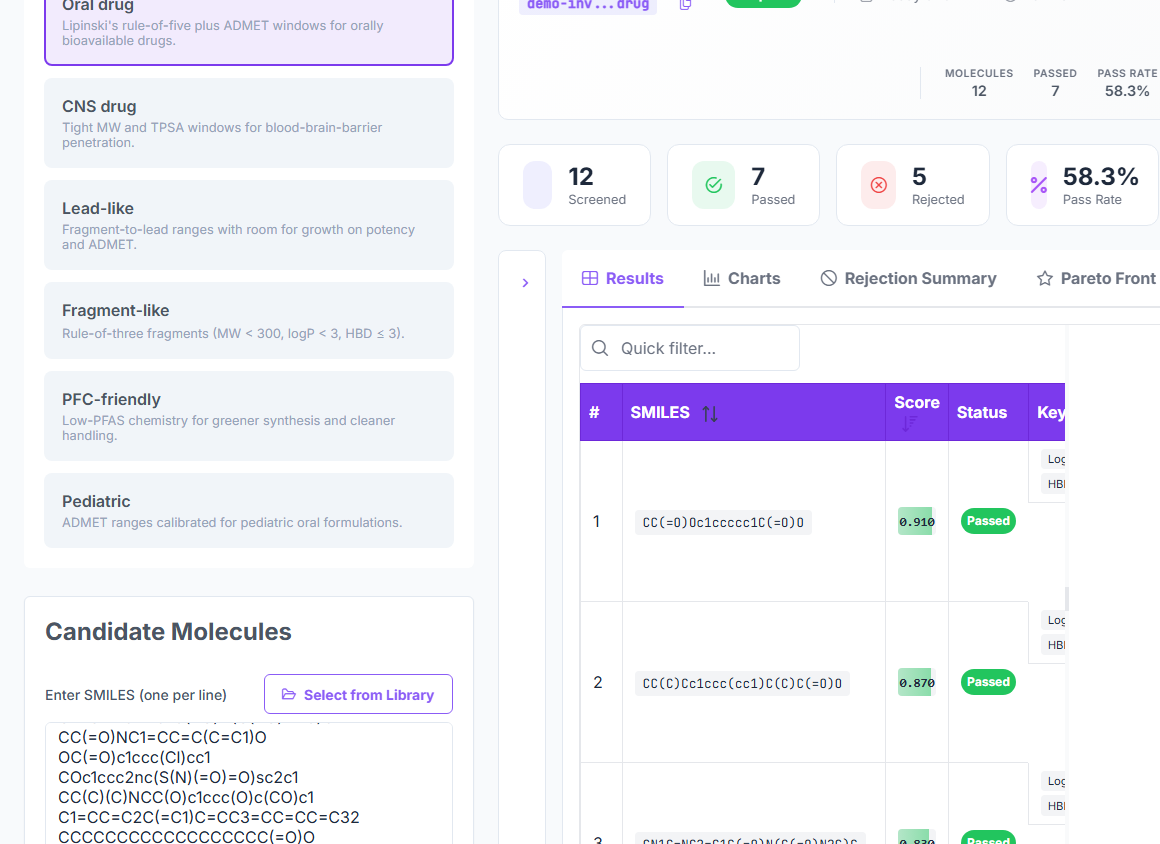
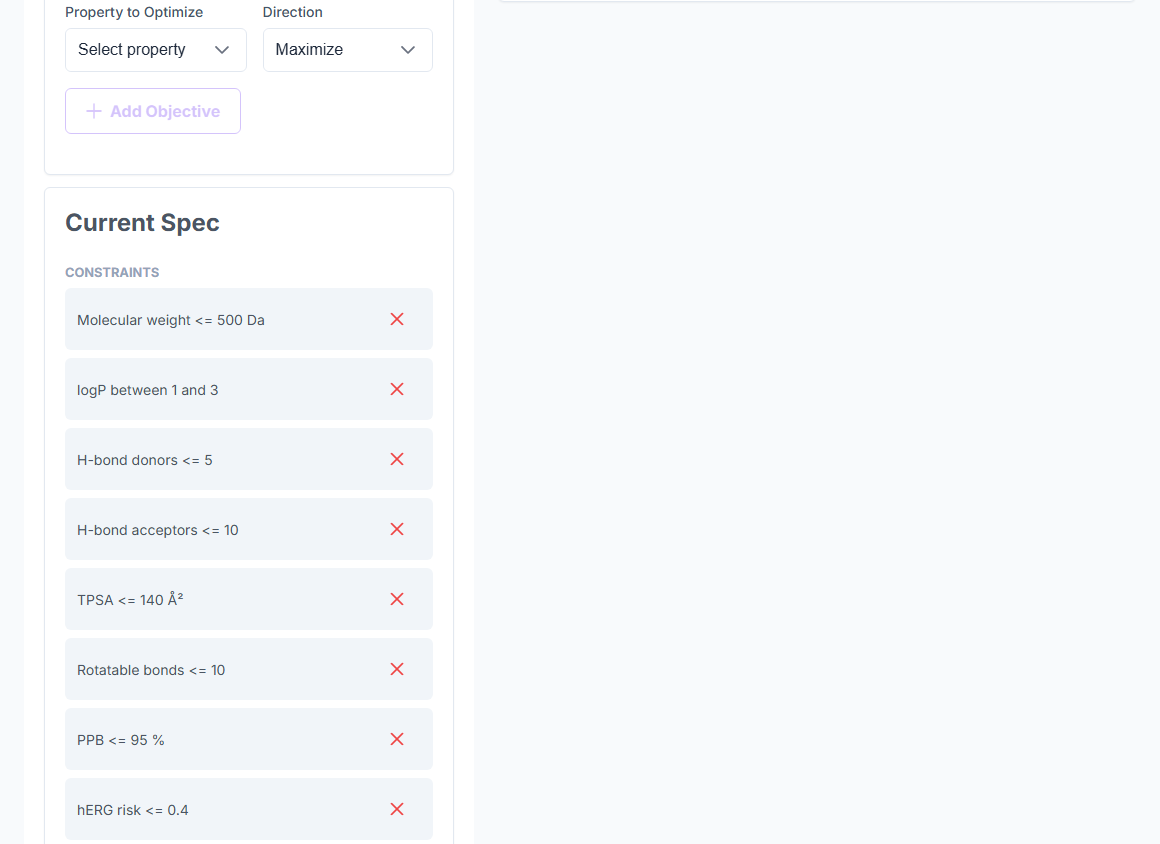
Spec editor with multi-property constraints
Spec editorProperty ranges, hard constraints, and preset selection — the starting point of every search.
Ranked candidates with satisfaction scores
Ranked resultsCandidates ordered by per-spec satisfaction, not a single property. Near-misses surfaced alongside full matches.
Pareto tradeoff visualization
Pareto frontierWhen properties conflict, the tradeoff space is explicit — not hidden inside a composite score.
Rejection log with per-constraint reasons
Rejection logEvery failing candidate comes with the constraint it missed and the gap — audit-ready, exportable.

Scope & Limitations

Strengths

  • Spec-first workflow covers 20 searchable properties across drug and material domains.
  • Rejection reasons are explicit per constraint — no black-box “low score” outputs.
  • Pareto frontier and relaxation analysis surface what a tight spec is actually costing you.
  • Deterministic: identical spec + identical library return identical ranking, every run.
  • Decision packet export straight to Workspace — versioned, replayable, audit-ready.

Known limitations

  • Accuracy is bounded by the underlying property modules — a loose ADMET or materials prediction shows up as a loose spec match.
  • Custom property integration (beyond the 20 shipped) is on the roadmap; current scope covers the common pharmaceutical and materials metrics.
  • Structural diversity filters are included but generative enumeration is out of scope — pair with Design Studio or Discovery to propose new candidates.
  • Inverse Search ranks and explains; synthesis feasibility and cost of acquisition live in Synthesis and the Workspace pricing ledger respectively.

Specify the answer. Let FluxMateria find it.

Pilot access includes Inverse Search, the full ADMET and Materials stacks, Design Studio, Discovery, and a Workspace seat for audit-ready runs.

Request Pilot Access →