๐Ÿงฌ FLUXMATERIA — LIFE SCIENCE

Mechanism of action & target prediction
from a SMILES, in milliseconds

FluxTarget predicts a molecule’s primary target, its mechanism (agonist, antagonist, inhibitor, modulator), the off-target polypharmacology panel, and the safety signals that come with it — all without a single trained parameter.

MoA prediction Target ID Off-target panel Safety signals No ML
94.2%
MoA accuracy, 120-compound ChEMBL + FDA validation
100%
Agonist + inhibitor calls correct
~1,000 / s
Predictions per second, single CPU
13 ms
Average latency per compound
0
Trained parameters
The breakthrough

Continuous efficacy from structure alone

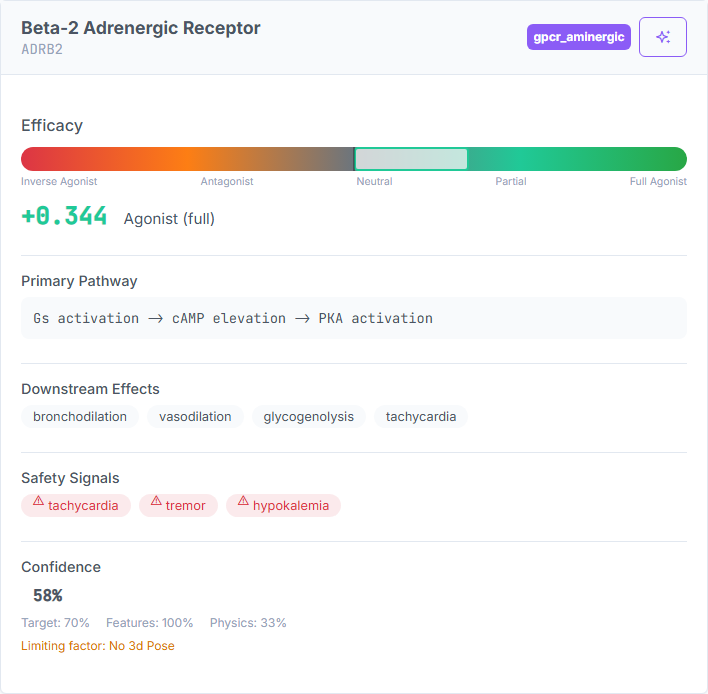
FluxTarget scores a molecule on a continuous scale from inverse agonist to full agonist — the same scale pharmacologists actually reason in — and returns the mechanism class, the off-target panel, and the safety signals in the same call. One SMILES in, one efficacy value out, ~13 ms later. And because the scoring is grounded in physics rather than trained on a target family, the prediction holds on unseen scaffolds.

What FluxTarget does

A single pipeline that covers target identification, mechanism, off-target, and safety.

๐ŸŽฏ

MoA predictor

One SMILES in, one efficacy value out on a continuous scale: inverse agonist, antagonist, partial or full agonist, or competitive inhibitor.

๐Ÿ—‚๏ธ

Polypharmacology screen

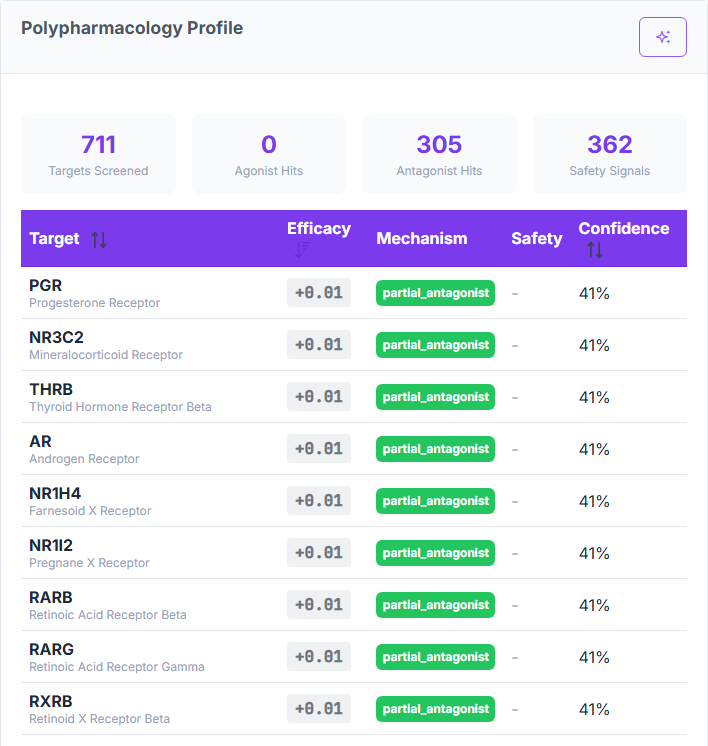
Single call returns the full off-target table: efficacy, mechanism, and confidence per target, plus aggregated safety signals. Surfaced in the Flux Pharmacology cascade as the Selectivity Panel (cross-class polypharmacology + safety) and the Repurposing Panel (~260-target screen for approved drugs and tool compounds).

๐Ÿงช

Binding prediction

Estimates pKi / pIC50 for a ligand against a curated target pocket, with a one-click handoff to ADMET and docking.

๐Ÿ”Ž

Target search

Search the curated target library by organism, gene, family, and essentiality. Every target carries its published context.

๐Ÿงฉ

Scaffold library

Browse chemical series linked to their known targets and mechanisms, then enumerate analogues directly into a pipeline.

๐Ÿงญ

Discovery Wizard

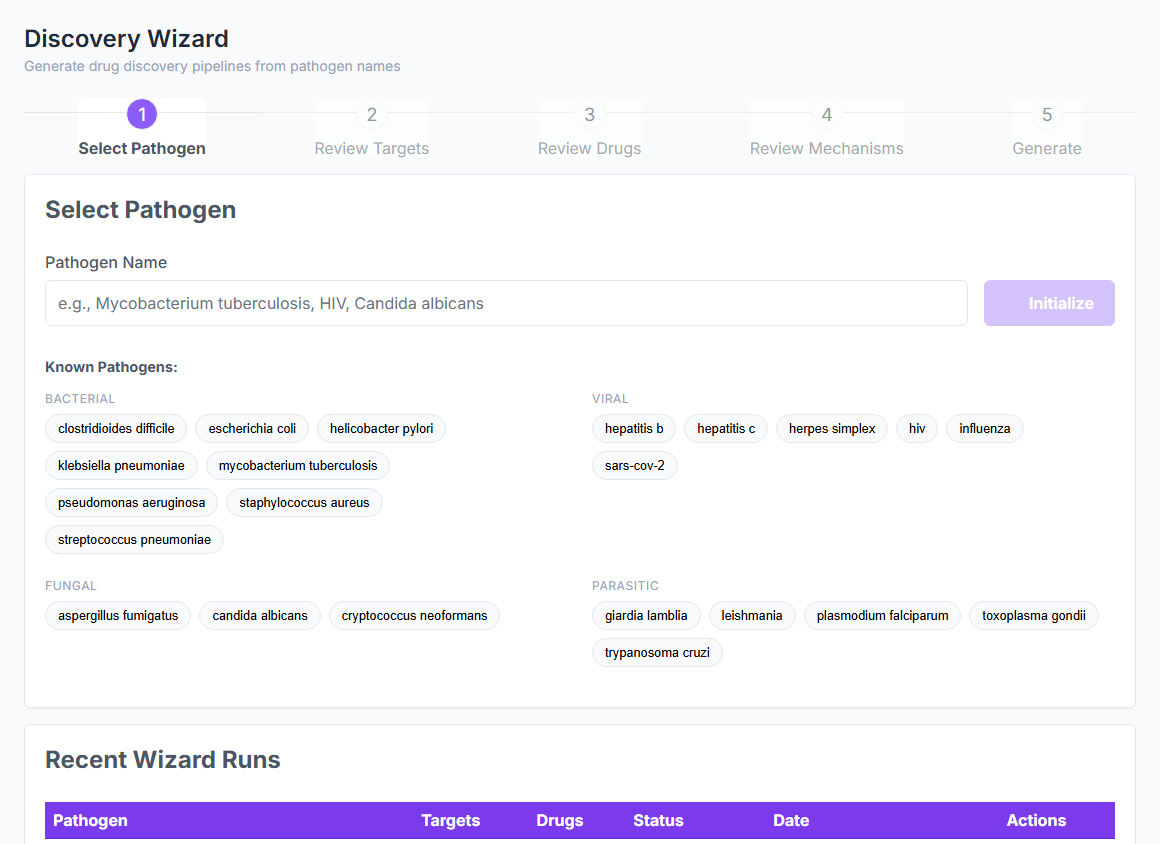
Five-step generator that takes a pathogen or target class and produces a full discovery configuration: targets, drugs, mechanisms, output paths.

โš ๏ธ

Safety signals

Cardiac, liver, CNS, and reproductive flags surface automatically, with the off-target hits that triggered them annotated.

๐Ÿ“

Calibrated confidence

Every call returns a confidence breakdown — target data quality, feature coverage, physics agreement — and the limiting factor.

How a prediction is built

From SMILES to efficacy + safety panel in milliseconds.

1

Read the molecule

Parse SMILES, enumerate tautomers and protonation states, extract the full pharmacophore — donors, acceptors, aromatic cores, ionizable groups, size.

2

Pick the target(s)

Single target supplied by the user, or the full curated target catalogue for a polypharmacology sweep.

3

Score the interaction

Project the pharmacophore onto the target’s binding-site family and return a continuous efficacy value plus a mechanism class.

4

Layer the safety panel

Aggregate off-target hits against known safety liabilities — cardiac, hepatic, CNS, reproductive — and annotate the contributing targets.

5

Calibrate & return

Compute confidence from target-data quality, feature coverage, and physics agreement; surface the limiting factor alongside the result.

Why you can trust it

Benchmarked on published ChEMBL mechanisms and iconic FDA drugs, not on internal metrics.

94.2%
Overall MoA accuracy across 120 compounds (combined ChEMBL + FDA validation set).
95%
Accuracy on the 100-compound external ChEMBL validation subset.
90%
Accuracy on the 20 iconic FDA drugs (diverse scaffolds, diverse targets).
100% · 17/17
Agonist calls correct across both datasets.
100% · 14/14
Competitive-inhibitor calls correct across both datasets.
92.1% · 82/89
Antagonist calls correct (the hardest class, by design).

How FluxMateria compares

Head-to-head against every major approach to mechanism-of-action prediction.

Metric FluxMateria Trained ML classifier Docking-only scoring Expert panel screen
External MoA accuracy 94.2% 70–85% Not applicable Assay-dependent
Training data required None Thousands per family Co-crystal + assay Not applicable
Latency per compound ~13 ms 1–100 ms (GPU) Seconds to minutes Days to weeks
Throughput (single CPU) ~1,000 / s GPU-bound <10 / hour Not applicable
Out-of-distribution behaviour Degrades gracefully Confidently wrong Pose-sensitive Reliable
Polypharmacology sweep Single call Model per target One dock per target Per-panel assay
Safety-signal panel Built-in Separate model Not provided Separate panel
Interpretability Confidence + limiting factor Opaque Pose-centric Assay readouts

The key insight: Trained classifiers and expert panels are accurate only where they have data; docking answers binding, not mechanism. FluxTarget returns mechanism, polypharmacology, and the safety panel in a single sub-second call, with calibrated confidence when the molecule sits outside the validation distribution. Read the 120-compound case study →

Where FluxTarget wins

Real drug-discovery workflows where physics-first, millisecond-per-prediction MoA changes the economics.

Use case 1

Hit-series triage

A new scaffold comes out of a primary screen. Run the polypharmacology sweep in a single call — mechanism, off-target table, and safety signals before the medicinal chemist leaves the bench.

Use case 2

Off-target & safety pre-review

Screen the lead against hERG, CYPs, the adrenergic family, and the CNS panel before committing to an expensive target-panel assay. Ship only the molecules that pass.

Use case 3

Target prioritisation

A new target lands on the roadmap. Run your in-house library against it in a batch, rank by predicted efficacy and confidence, and send the top ~50 molecules to biology.

Use case 4

Literature sanity check

A reviewer claims compound X is a full agonist at receptor Y. One-second cross-check on the continuous efficacy scale, with the pharmacophore overlap reported in the confidence breakdown.

Use case 5

Compliance & audit trail

Every prediction is deterministic and grounded in physics — no trained weights, no frozen snapshot to retrain. Regulators, IP reviewers, and internal QA can re-run any call and get the same answer.

Use case 6

Pathogen-to-pipeline

The Discovery Wizard turns a pathogen name into a drug-discovery configuration — essential targets, known drugs, scaffolds, mechanism choices — and hands off to Workspace for the next stage.

FluxTarget in the product

Real captures from the live application. Click any image to zoom.

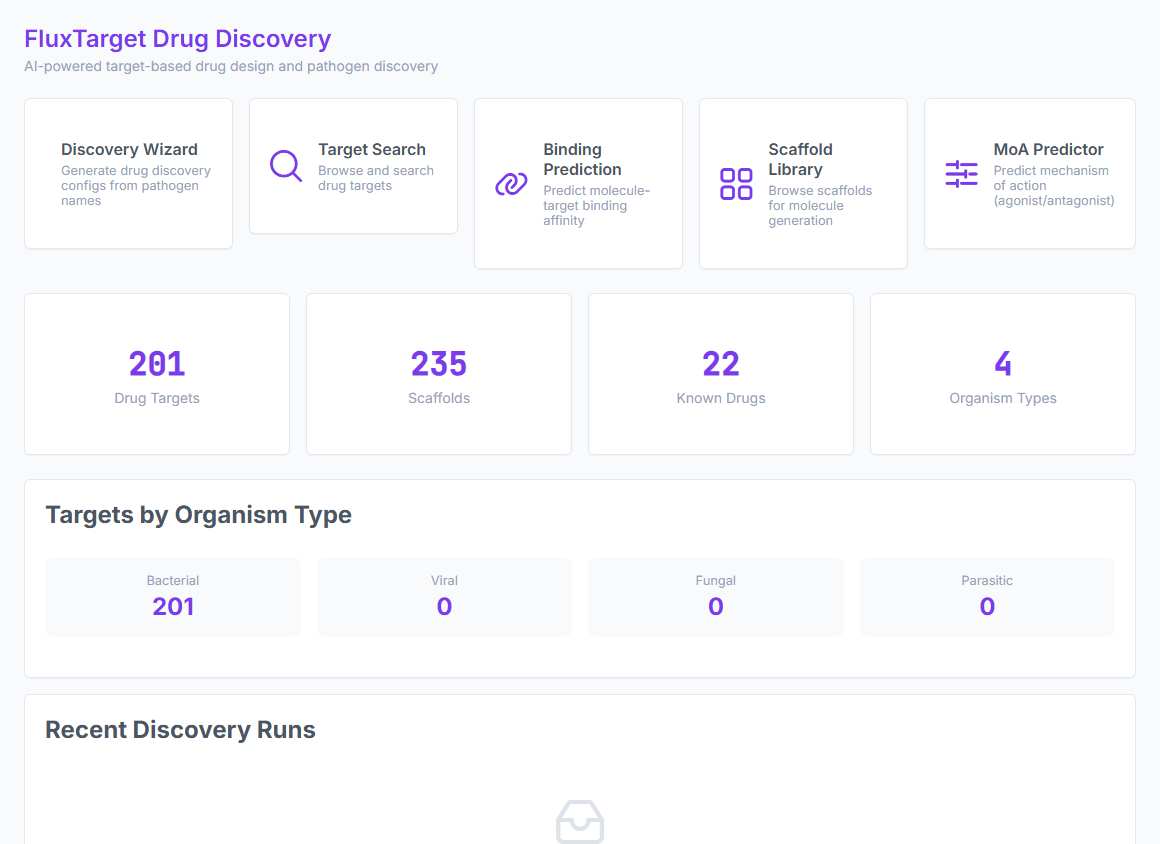
FluxTarget dashboard with tool cards, platform stats, and targets-by-organism table
Dashboard Entry point with MoA Predictor, Discovery Wizard, Target Search, Binding Prediction, and Scaffold Library.
MoA Predictor single-target result showing the efficacy gauge, primary pathway, downstream effects, safety signals, and confidence breakdown
MoA Predictor — single target Continuous efficacy gauge, pathway, downstream effects, safety signals, and the confidence breakdown for one SMILES against one target.
MoA Predictor polypharmacology view showing targets screened, agonist and antagonist hits, the target hits table, and aggregated safety signals
Polypharmacology sweep Summary cards, ranked target-hits table, and aggregated safety signals from a single call across the curated target catalogue.
Discovery Wizard five-step flow: select pathogen, review targets, review drugs, review mechanisms, generate configuration
Discovery Wizard Five-step flow from pathogen selection to a runnable discovery configuration — targets, drugs, and mechanism choices included.

Scope & Limitations

Strengths

  • GPCRs, nuclear receptors, kinases, ion channels, and enzymes covered by a single predictor.
  • Agonist / antagonist / inhibitor classification at 92–100% per class on the validation set.
  • One call returns both the primary mechanism and the off-target table — no model-per-family sprawl.
  • Confidence is calibrated, not invented: target-data quality, feature coverage, and physics agreement are all surfaced.
  • CPU-only, ~1,000 predictions per second — fits inside existing CI and triage loops.

Known limitations

  • Peptides and biologics are out of scope today — small molecules only.
  • Antagonist class sits at 92.1% and is the most error-prone; treat low-confidence antagonist calls as ambiguous.
  • Allosteric binders are flagged but not resolved to specific allosteric sites.
  • Epigenetic readers (BET, chromatin) are scheduled for the 2026 Q3 release.

Predict MoA on your next series

Bring FluxTarget into triage, off-target screening, or a pathogen-to-pipeline run. Pilot access includes the Discovery Wizard, the polypharmacology screen, and a Workspace seat.

Request Pilot Access →