โš›๏ธ FLUXMATERIA — CHEMISTRY

Marcus theory,
with first-principles tunneling

Electron-transfer rate constants that include the 2–3× quantum-tunneling enhancement classical Marcus misses. Through-bond and through-space decay constants within literature range. All three Marcus regimes (normal / activationless / inverted) validated. ~150 ms per donor-acceptor pair.

Marcus + tunneling All 3 regimes Parabola viz PCET-ready No ML
26 / 26
Validation tests passing across 5 categories
2–3×
Tunneling enhancement over classical Marcus
Literature
Through-bond & through-space decay match
~150 ms
Per donor-acceptor pair, full pipeline
0
Fitted parameters
The breakthrough

Tunneling-aware Marcus rates, without an empirical coupling.

Classical Marcus skips tunneling and underestimates rates. DFT-based electron-transfer needs a coupled quantum simulation and hours per pair. This module layers a first-principles quantum-tunneling correction onto the Marcus picture, picks up the 2–3× enhancement tunneling gives you in cold or narrow-barrier regimes, and delivers the full ΔG° + λ + HDA + rate breakdown in about 150 ms.

What Electron Transfer does

Every ingredient of a Marcus rate, including the one classical theory leaves out.

โšก

Marcus rate constants

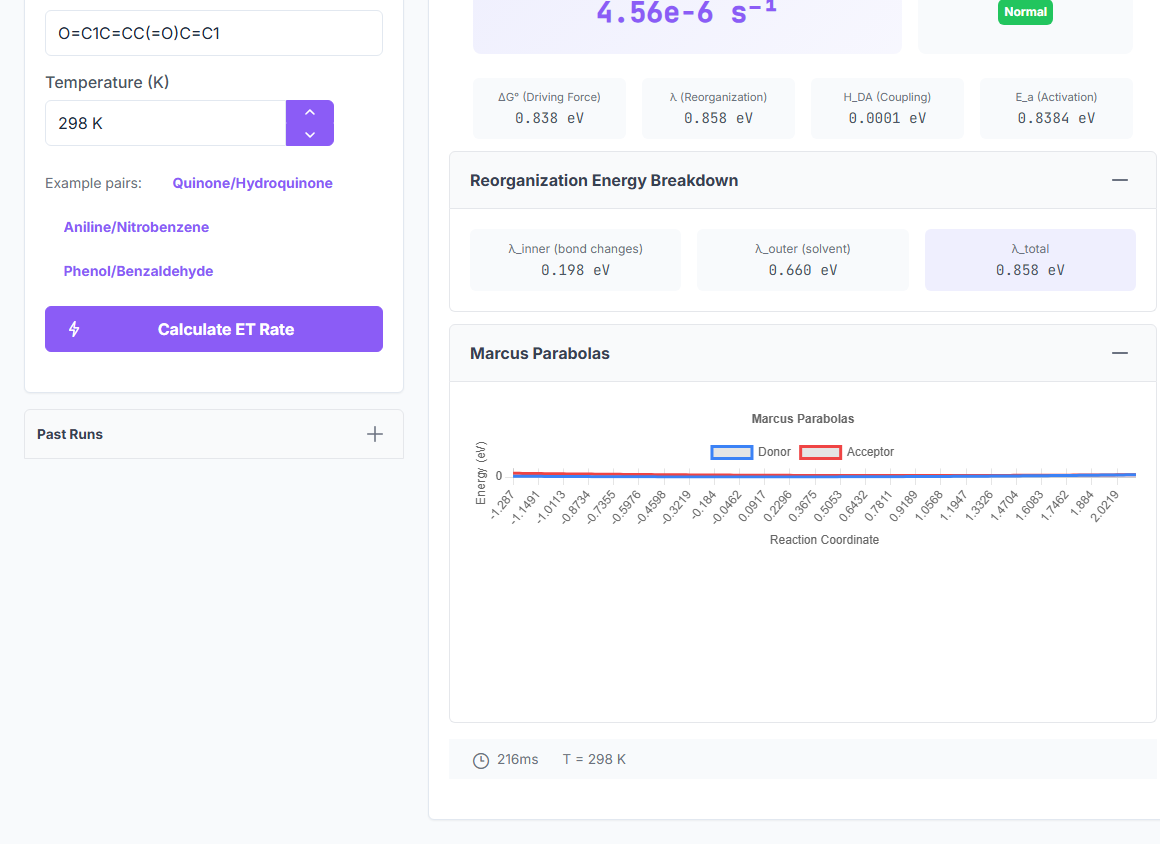
Full Marcus theory: driving force ΔG°, reorganisation energy λ, electronic coupling HDA, rate constant kET.

๐ŸŒŠ

Quantum tunneling κ

First-principles tunneling correction layered on top of classical Marcus. Gives the 2–3× enhancement needed in cold / narrow-barrier regimes.

๐Ÿ”—

Electronic coupling

Superexchange decay constants (through-bond + through-space) derived from first principles. No fitted coupling parameters.

๐ŸŽฏ

Regime classification

Automatic normal / activationless / inverted region detection. Colour-coded in the UI so the operating regime is immediately obvious.

๐Ÿ“Š

Marcus parabolas

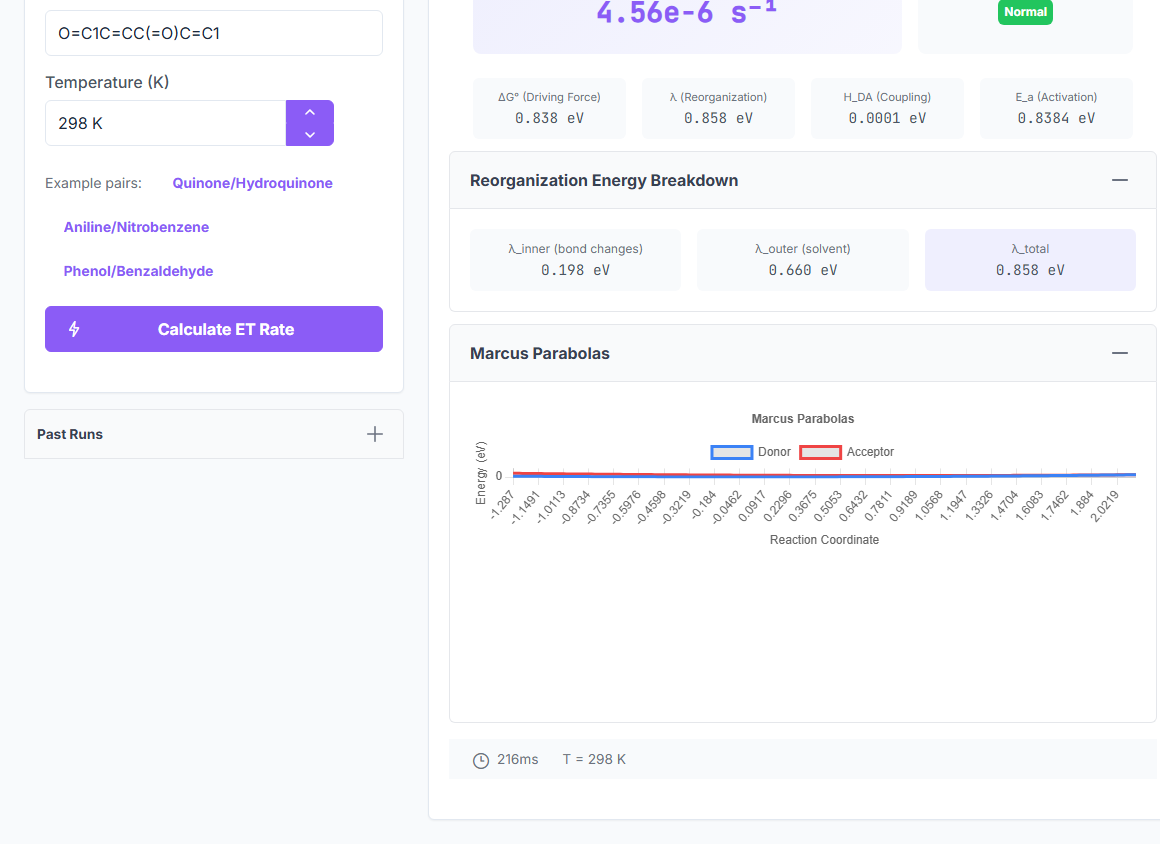
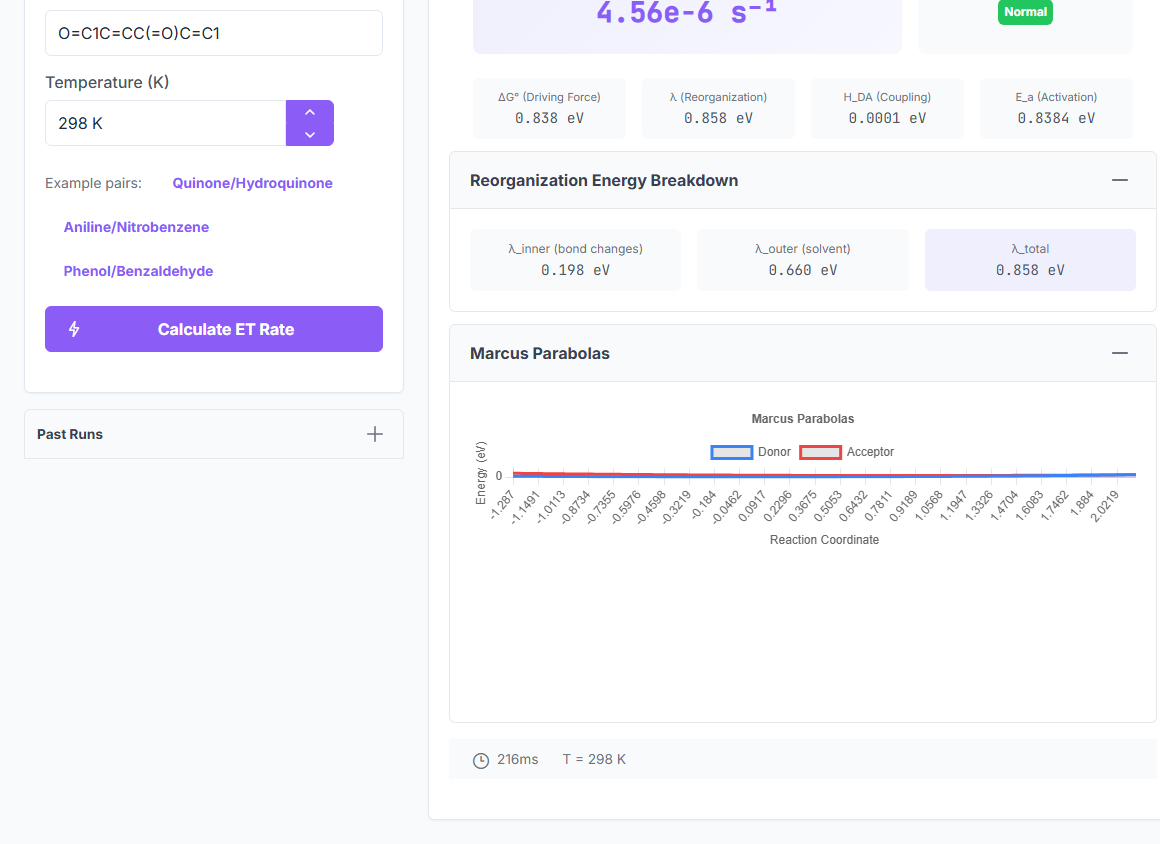
Interactive donor / acceptor parabola plot with the 100-point reaction coordinate, crossing-point highlighted.

๐Ÿงช

Reorganisation energy

Inner (bond distortion) + outer (solvent) decomposition from closed-form FLUX expressions. Both parts individually inspectable.

๐Ÿค

Proton-coupled ET

PCET-ready — the tunneling correction captures the regimes where proton-coupled transfer diverges from pure ET.

๐Ÿ“ค

Export & audit

CSV / JSON / XLSX / PDF with per-pair parabola, regime, and every contributing term. Reviewers re-run and get the same rate.

How a rate is computed

From donor + acceptor SMILES to Marcus rate with tunneling in one call.

1

Input

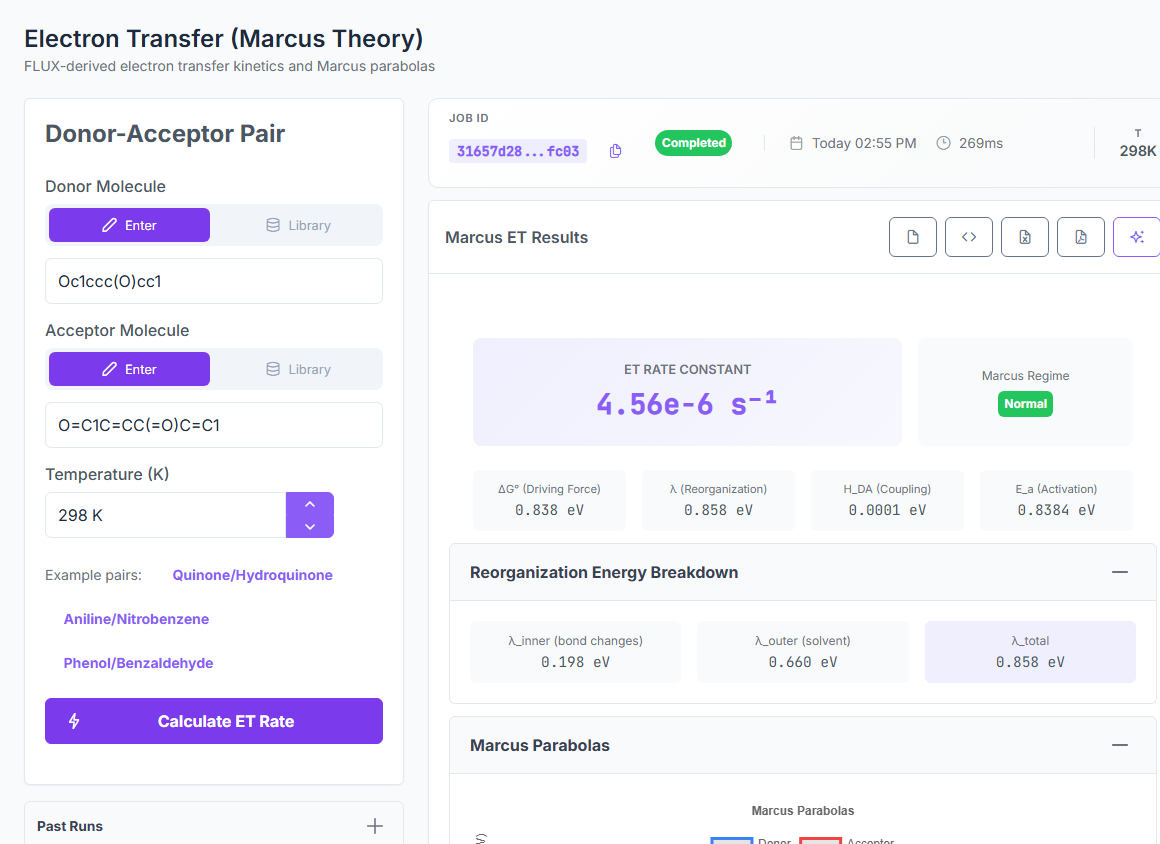
Donor + acceptor SMILES, solvent, temperature, donor-acceptor distance or bridge.

2

Orbitals

HOMO / LUMO energies for both donor and acceptor — deterministic, from the same orbital engine used in Spectroscopy.

3

Energetics

ΔG° driving force, inner + outer reorganisation energy λ, electronic coupling HDA from decay constants.

4

Rate

Classical Marcus kclassical, then FLUX tunneling correction κ. Total rate = κ · kclassical.

5

Classify

Normal / activationless / inverted regime flagged automatically based on the ΔG° vs λ relationship.

6

Visualise & export

Marcus parabolas rendered; per-pair CSV / JSON / XLSX / PDF export with every term itemised.

Why you can trust it

Validated against published decay constants, tunneling enhancements, and all three Marcus regimes.

26 / 26
Validation tests passing across 5 categories (Marcus regimes, decay constants, tunneling, parabola geometry, export integrity).
Through-bond β
Superexchange decay constant within published literature range across all validated donor-bridge-acceptor systems.
Through-space β
Distance decay constant within literature range for free-space ET — no refitting per system.
All 3
Marcus regimes — normal, activationless, inverted — reproduced correctly at the crossover points.
~150 ms
Per donor-acceptor pair on a single CPU. Batches of tens to hundreds of pairs in seconds.
0
Fitted parameters. Same donor + acceptor + solvent returns the same rate and regime, every run.

How FluxMateria compares

Head-to-head against the standard approaches to electron-transfer rates.

MetricFluxMateriaClassical MarcusDFT-based ETML surrogate
Tunneling correctionFirst-principles κNoVaries by methodUsually no
Runtime per pair~150 ms~150 ms (no tunneling)Hours to daysms–s
Decay-constant provenanceFirst-principlesEmpirical fitComputed (system-specific)Black box
Training dataNoneNoneNoneThousands of pairs
All three regimesYesYesYesDepends on set
Inner / outer λ decompositionBuilt-inManualBuilt-inOpaque
Parabola visualisationInteractiveStatic sketchPer-methodNot provided
AuditabilityClosed-form per termFormula + fitMethod traceOpaque

The key insight: Classical Marcus is fast but misses the 2–3× tunneling enhancement — critical in cold, narrow-barrier, or proton-coupled regimes. DFT-based ET captures the physics but takes hours per pair. FluxMateria adds the tunneling correction from first principles, keeps the runtime at ~150 ms, and audits every term. See the full benchmark →

Where Electron Transfer wins

Programs where the classical Marcus rate is wrong by 2–3×.

Use case 1

Battery electrolyte design

Electron-transfer rates between electrode and electrolyte species. Tunneling matters at low temperature — classical Marcus under-predicts systematically.

Use case 2

Photovoltaics & OSC

Screen donor-acceptor pairs for organic solar cells. Predict charge-separation rate + regime. Inverted-region emitters flagged automatically.

Use case 3

Catalyst cycle steps

Understand ET steps inside catalytic cycles. PCET-ready — the tunneling correction captures the regimes that matter for proton-coupled steps.

Use case 4

OLED emitter pairs

Evaluate charge-injection and recombination rates. Screen emitter / host combinations for inverted-region performance effects.

Use case 5

Biological ET

Model protein electron-transfer chains. Through-bond decay constant within literature range, so predicted rates slot into existing biochemistry models.

Use case 6

Teaching & intuition

Interactive Marcus parabola + regime classifier + tunneling contribution viewer. Grad-course explanations become concrete numbers.

Electron Transfer in the product

Real captures from the live application. Click any image to zoom.

Donor-acceptor input panel with SMILES, solvent, temperature
InputDonor + acceptor SMILES, solvent, temperature, distance or bridge. Single pair or batch.
Marcus rate breakdown with classical rate, tunneling factor, and total rate
Rate breakdownΔG° + λ + HDA + classical Marcus k + tunneling κ + total rate — every term inspectable.
Marcus donor-acceptor parabolas with crossing point highlighted
Marcus parabolasInteractive donor / acceptor parabolas with the crossing point, barrier, and 100-point reaction coordinate.
Regime classifier showing normal, activationless, and inverted zones
Regime classifierColour-coded normal / activationless / inverted regions with the pair placed at its computed position.

Scope & Limitations

Strengths

  • First-principles tunneling correction — the 2–3× enhancement classical Marcus misses.
  • Through-bond and through-space decay constants both within published literature range.
  • All three Marcus regimes (normal / activationless / inverted) validated and visualised.
  • ~150 ms per pair on a single CPU — fits inside interactive tools and batch pipelines.
  • Every term of the rate is a closed-form expression — audit-ready, re-runnable bit-for-bit.

Known limitations

  • Beta status — actively benchmarking PCET edge cases and multi-step ET chains.
  • Decay constants validated within the organic / photochemical / bio-ET parameter range; unusual metal-metal ET systems may need custom calibration.
  • Solvent treatment is implicit-continuum with outer-sphere λ; full explicit-solvent MD lives in MD & Free Energy.
  • Strongly coupled (HDA > kBT) adiabatic regimes are flagged but sit outside Marcus theory — use the Advanced Methods relativistic / correlation tools for those.

Compute an ET rate

Pilot access includes Electron Transfer, the Chemistry bond engine, Advanced Methods, MechanismOS, and a Workspace seat for audit-ready runs.

Request Pilot Access →