Docking, without force-field parameterisation
Pose and affinity for any ligand in any published pocket. Covalent warheads, metal-site geometry, bridging waters, kinetics, and flexible side-chain refinement — in one studio, no force field to fit.
FLUX Settling does not search a scoring function someone tuned — the ligand relaxes into the pocket's physical field until it stops moving, the way it would in solution. The field is derived from first-principles physics and textbook atomic data. Nothing in it was regressed against binding data, pose data, or any benchmark, and no reference structure is consulted at prediction time. Measured blind on PoseBusters-428 it places the correct pose first in 47.4% of cases — and, unusually, it also tells you when to trust that answer.
The standard blind pose-prediction set. Official scoring, all 428 complexes, no per-target tuning.
| Method | Top-1 | Top-5 | Top-10 | Fitted to data? |
|---|---|---|---|---|
| FluxMateria — FLUX Settling | 47.4% | 72.1% | 76.1% | No |
| AutoDock Vina | 60% | — | — | Force field fitted |
| GOLD | 58% | — | — | Force field fitted |
| DiffDock | 38% | — | — | Trained on the PDB |
Read this honestly: Vina and GOLD are more accurate at top-1, and we do not claim otherwise. They are also fitted to binding data, and DiffDock is trained on the PDB itself. FluxMateria is fitted to nothing — the same field that predicts a pose was derived without ever seeing one. That is the trade we are making, and it is the reason the method behaves predictably on chemistry no training set covered.
A per-case confidence, validated on held-out complexes the threshold was never tuned on.
| If you take the most confident… | Top-1 is correct |
|---|---|
| 20% of cases | 69.4% |
| 40% of cases | 66.7% |
| 50% of cases | 60.5% |
| every case (no filter) | 46.3% |
Why this matters more than the headline:
A method that is right half the time is hard to act on. A method that is right half the time and knows
which half is a triage tool. On the most confident 40% of targets the pose is correct two times in
three; everywhere else the module returns a short ranked set instead of a single answer, so you know when
to look at three poses rather than one. The threshold is set on one half of the benchmark and the accuracy
measured on the other — it is not tuned on the number it reports.
Note on the baseline: this table is computed over the held-out split, so its unfiltered rate
(46.3%) sits marginally below the 47.4% full-benchmark headline. Both are reported as measured; neither
is rounded toward the other.
One studio for pose, affinity, kinetics, and the chemistry that lives inside the pocket.
FLUX Settling — the ligand relaxes into the pocket's field, with a multi-conformer ensemble and flexible ligand torsions. Benchmarked blind at 47.4% top-1 on PoseBusters-428.
ΔG = ΔH − TΔS + ΔGsolv. Every term is reported — van der Waals, electrostatic, H-bond, desolvation, conformational entropy, translational / rotational penalty.
Hydrogen bonds, salt bridges, hydrophobic contacts, π-stacking, cation-π, halogen bonds — with geometric criteria and per-residue contributions.
Michael addition, acylation, disulfide, vinyl sulfone, epoxide chemistries. Returns bond energy plus the effective Ki.
Detects Zn, Fe, Mg, Cu, and other metal centres, identifies coordinating residues, and reports the coordination geometry.
Finds water-mediated hydrogen-bond bridges between ligand and pocket — the interactions structure-based tools often miss.
Rotamer-library sweep on residues within 5 Å of the ligand, re-scored per iteration. Rigid pocket by default, opt-in flexible.
kon, koff, and residence time from the activation-barrier estimate — useful for slow-off-rate drug design programs.
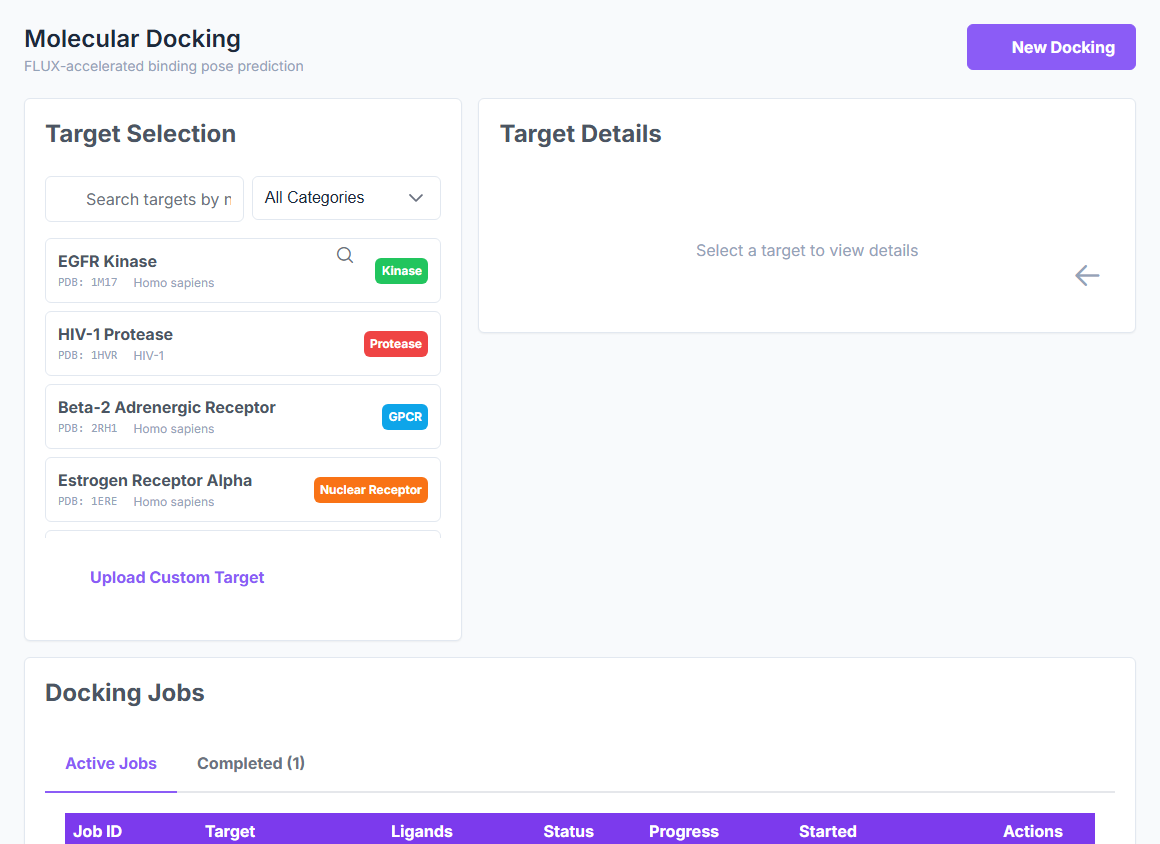
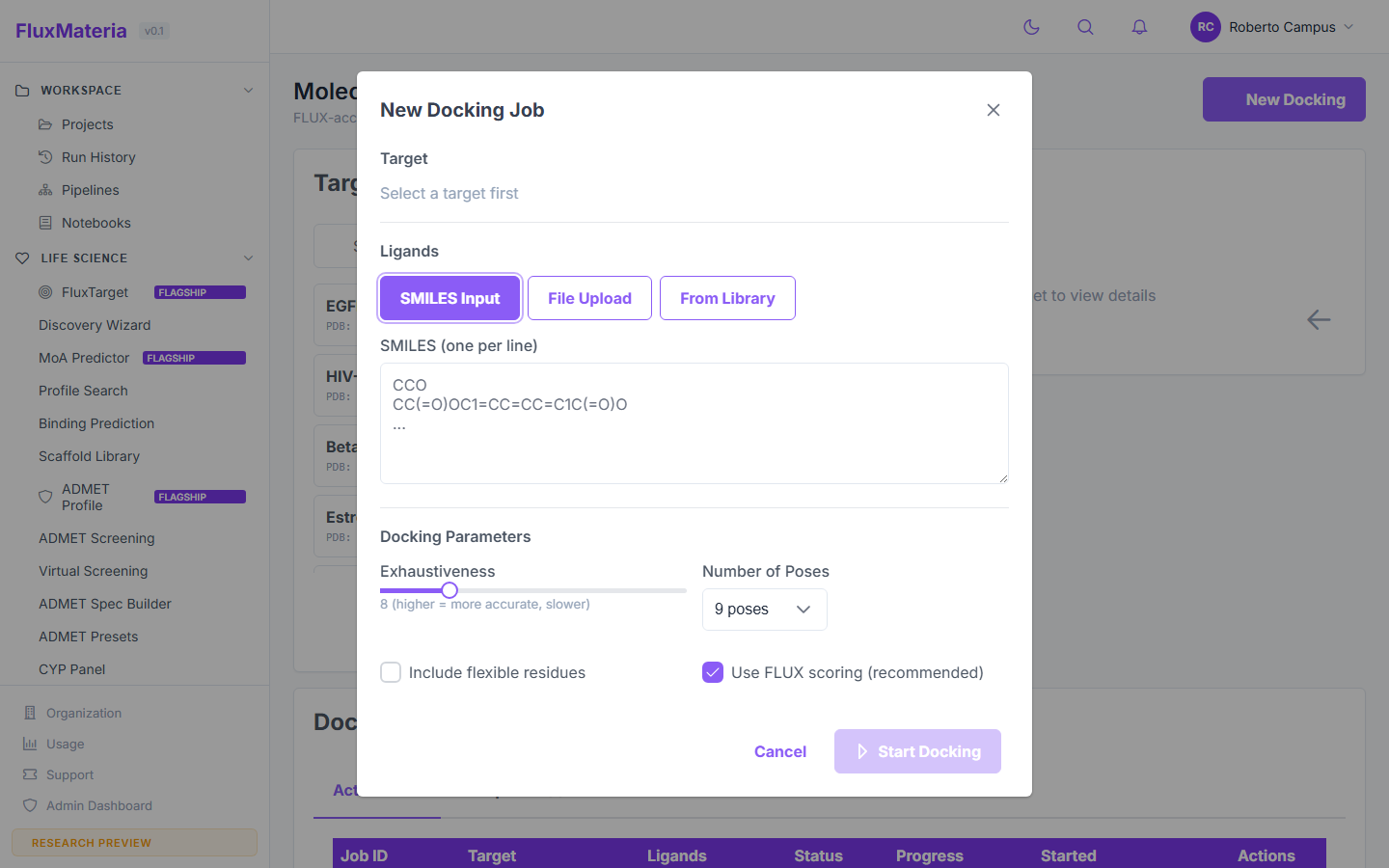
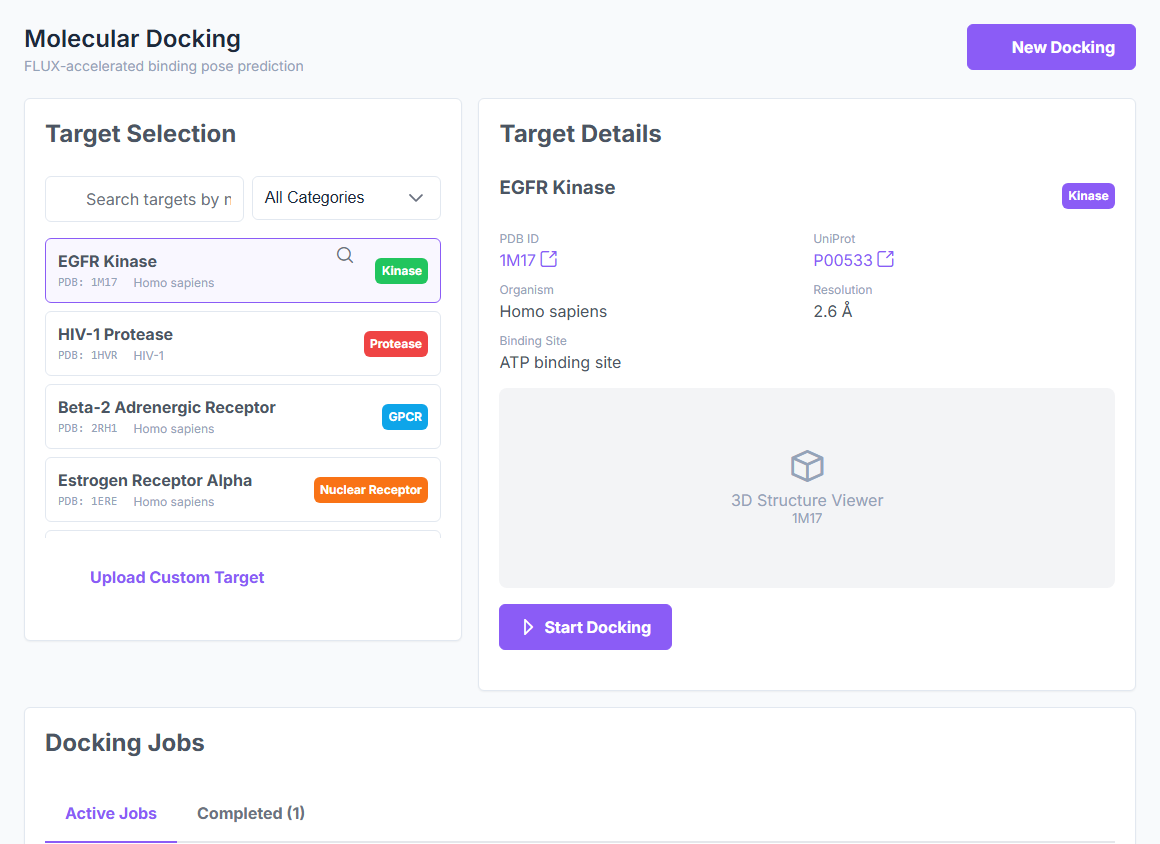
From a SMILES and a PDB to a ranked pose set in one workflow.
PDB in, grids out. Pre-compute the van der Waals, electrostatic, H-bond donor / acceptor, and desolvation grids around the binding site.
Single conformation from the SMILES, or a multi-conformer ensemble for flexible ligands ranked by score.
Each starting placement relaxes into the pocket's physical field — position, orientation and ligand torsions moving together — until it stops. No scoring function is searched; the pose is where the physics comes to rest.
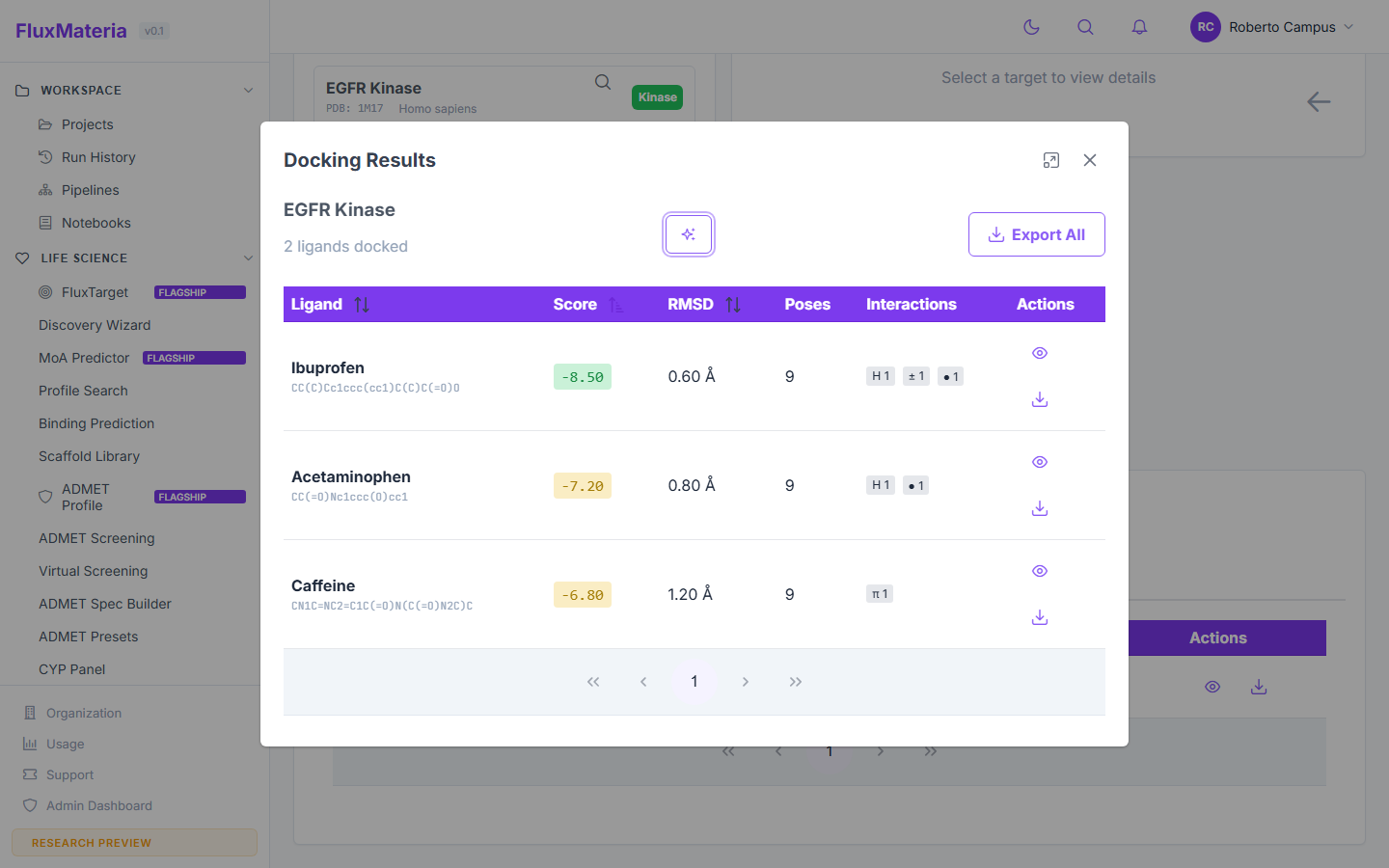
Distinct settled poses are ranked and de-duplicated, and the case is assigned a confidence so you know whether to act on the top pose or review the short list.
Hydrogen bonds, salt bridges, hydrophobic, π-stacking, cation-π, halogen bonds — per pose, with per-residue attribution.
Full ΔG breakdown plus kon / koff / residence time. Export CSV / JSON / PDB poses or hand off to Workspace.
Deterministic physics, auditable formulas, and honest scope.
Head-to-head against the common sources of docking poses and affinities.
| Metric | FluxMateria | AutoDock Vina | FEP / MM-PBSA | ML scoring |
|---|---|---|---|---|
| Training / fitting required | None | Force-field parameters | Force-field parameters | Thousands of poses |
| Blind PoseBusters top-1 | 47.4% | 60% | Not a pose method | Depends on input poses |
| Pose engine | Field settling | Iterated local search | Usually reuses pose | Rescoring only |
| Per-case confidence | Yes, validated | Not provided | Not provided | Score only |
| Interaction profile built-in | 6 types + metal + water | Limited | Limited | Not provided |
| Covalent warheads | 5 chemistries | Custom | Manual | Not provided |
| Kinetics (kon / koff) | Built-in | Not provided | Separate workflow | Not provided |
| Bridging waters | Detected automatically | No | Explicit modelling | No |
| Runtime per ligand | Sub-minute pose set | Sub-minute | Hours | Milliseconds (rescore) |
| Out-of-distribution behaviour | Degrades gracefully | Force-field-limited | Force-field-limited | Confidently wrong |
The key insight: Classic docking is fast but depends on hand-tuned force fields. Free-energy methods are accurate but take hours per ligand. ML rescoring is fast but only as good as the poses someone else generated — and as good as its training set, which is why it fails quietly on novel chemistry. FluxMateria lets the ligand settle into first-principles physics, profiles the full interaction pattern, and returns affinity + kinetics in one pass — with nothing fitted anywhere in the pipeline, and a confidence score telling you which answers to act on. See FluxTarget for the MoA context →
Workflows where the pocket chemistry is as important as the pose.
Michael acceptors, acyl fluorides, vinyl sulfones — pick the warhead, let the engine score pose and bond energy, rank by effective Ki.
Detects the metal site and reports coordination geometry, so ligands are evaluated in the chemistry that actually sits in the pocket.
Pockets where the crystal water is the key interaction. Bridging-water detection surfaces the ligands that keep it versus the ones that displace it.
kon / koff / residence time per pose, useful for the kinetics-driven discovery programs where slow-off-rate is the goal.
GPCRs and kinases with mobile side chains. 5 Å flexible refinement pass re-scores the top poses with the correct rotamers.
When FluxTarget flags an off-target of interest, open it in Docking to confirm the pose and affinity before chasing it into the lab.
Real captures from the live application. Click any image to zoom.


Pilot access includes Docking, FluxTarget, the ADMET suite, and a Workspace seat to keep every run auditable.