๐Ÿงฌ FLUXMATERIA — LIFE SCIENCE

Docking, without force-field parameterisation

Pose and affinity for any ligand in any published pocket. Covalent warheads, metal-site geometry, bridging waters, kinetics, and flexible side-chain refinement — in one studio, no force field to fit.

Pose & affinity Covalent warheads Metal sites Bridging waters Flexible residues
11
Docking API endpoints covering pose, affinity, kinetics, interactions
6
Interaction types profiled per pose
5
Covalent warhead chemistries supported
200 FU
Metered per docking run — predictable pricing
0
Force-field parameters fit
The breakthrough

Binding scored where the atoms actually are

The docking engine evaluates every pose on pre-computed physics grids — van der Waals, electrostatics, hydrogen bonding, desolvation — then optimises locally and clusters by RMSD. The same pass returns interaction type counts, affinity with a thermodynamic breakdown, and estimated kon / koff from the activation barrier. No force field to tune; same numbers on the same SMILES every time.

What Docking does

One studio for pose, affinity, kinetics, and the chemistry that lives inside the pocket.

๐ŸŽฏ

Pose prediction

Genetic search for global pose space plus local optimisation on the top candidates, clustered by RMSD. Multi-conformer ensemble option for flexible ligands.

๐Ÿ“

Affinity & breakdown

ΔG = ΔH − TΔS + ΔGsolv. Every term is reported — van der Waals, electrostatic, H-bond, desolvation, conformational entropy, translational / rotational penalty.

๐Ÿค

Interaction profile

Hydrogen bonds, salt bridges, hydrophobic contacts, π-stacking, cation-π, halogen bonds — with geometric criteria and per-residue contributions.

๐Ÿ”—

Covalent warheads

Michael addition, acylation, disulfide, vinyl sulfone, epoxide chemistries. Returns bond energy plus the effective Ki.

โš™๏ธ

Metal-site geometry

Detects Zn, Fe, Mg, Cu, and other metal centres, identifies coordinating residues, and reports the coordination geometry.

๐Ÿ’ง

Bridging waters

Finds water-mediated hydrogen-bond bridges between ligand and pocket — the interactions structure-based tools often miss.

๐Ÿงช

Flexible side-chain refinement

Rotamer-library sweep on residues within 5 Å of the ligand, re-scored per iteration. Rigid pocket by default, opt-in flexible.

โฑ๏ธ

Kinetics

kon, koff, and residence time from the activation-barrier estimate — useful for slow-off-rate drug design programmes.

How a docking job is built

From a SMILES and a PDB to a ranked pose set in one workflow.

1

Prepare receptor

PDB in, grids out. Pre-compute the van der Waals, electrostatic, H-bond donor / acceptor, and desolvation grids around the binding site.

2

Generate 3D ligand

Single conformation from the SMILES, or a multi-conformer ensemble for flexible ligands ranked by score.

3

Global pose search

Genetic search across the binding-box translation and orientation space. Scoring by trilinear interpolation on the pre-computed grids.

4

Local optimise & cluster

L-BFGS-B local optimisation on the top candidates. Hierarchical RMSD clustering returns one representative per mode.

5

Profile interactions

Hydrogen bonds, salt bridges, hydrophobic, π-stacking, cation-π, halogen bonds — per pose, with per-residue attribution.

6

Affinity & kinetics

Full ΔG breakdown plus kon / koff / residence time. Export CSV / JSON / PDB poses or hand off to Workspace.

Why you can trust it

Deterministic physics, auditable formulas, and honest scope.

Deterministic
Same ligand + pocket + seed returns the same pose set and the same ΔG, run after run.
Auditable
Every contribution to ΔG is reported — VDW, electrostatic, H-bond, desolvation, entropy terms. No black-box score.
Geometry-validated
H-bond and hydrophobic criteria match literature geometric ranges (2.8–3.0 Å / 155–165° / 3.4–4.0 Å).
6 chemistries
Covalent warhead coverage includes Michael, acylation, disulfide, vinyl sulfone, and epoxide.
5 Å flex
Flexible side-chain refinement on residues within 5 Å of the ligand, with up to three iterations.
0
Force-field parameters fit. No training data; no per-target re-parameterisation.

How FluxMateria compares

Head-to-head against the common sources of docking poses and affinities.

MetricFluxMateriaAutoDock VinaFEP / MM-PBSAML scoring
Training / fitting requiredNoneForce-field parametersForce-field parametersThousands of poses
Pose searchGenetic + L-BFGS-BIterated local searchUsually reuses poseRescoring only
Interaction profile built-in6 types + metal + waterLimitedLimitedNot provided
Covalent warheads5 chemistriesCustomManualNot provided
Kinetics (kon / koff)Built-inNot providedSeparate workflowNot provided
Bridging watersDetected automaticallyNoExplicit modellingNo
Runtime per ligandSub-minute pose setSub-minuteHoursMilliseconds (rescore)
Out-of-distribution behaviourDegrades gracefullyForce-field-limitedForce-field-limitedConfidently wrong

The key insight: Classic docking is fast but depends on hand-tuned force fields. Free-energy methods are accurate but take hours per ligand. ML rescoring is fast but only as good as the poses someone else generated. FluxMateria docks on first-principles physics grids, profiles the full interaction pattern, and returns affinity + kinetics in one pass — without a force-field fit anywhere in the pipeline. See FluxTarget for the MoA context →

Where Docking wins

Workflows where the pocket chemistry is as important as the pose.

Use case 1

Covalent warhead triage

Michael acceptors, acyl fluorides, vinyl sulfones — pick the warhead, let the engine score pose and bond energy, rank by effective Ki.

Use case 2

Metalloenzyme inhibitor design

Detects the metal site and reports coordination geometry, so ligands are evaluated in the chemistry that actually sits in the pocket.

Use case 3

Water-bridge-sensitive series

Pockets where the crystal water is the key interaction. Bridging-water detection surfaces the ligands that keep it versus the ones that displace it.

Use case 4

Off-rate programmes

kon / koff / residence time per pose, useful for the kinetics-driven discovery programmes where slow-off-rate is the goal.

Use case 5

Flexible-pocket challenges

GPCRs and kinases with mobile side chains. 5 Å flexible refinement pass re-scores the top poses with the correct rotamers.

Use case 6

FluxTarget hand-off

When FluxTarget flags an off-target of interest, open it in Docking to confirm the pose and affinity before chasing it into the lab.

Docking in the product

Real captures from the live application. Click any image to zoom.

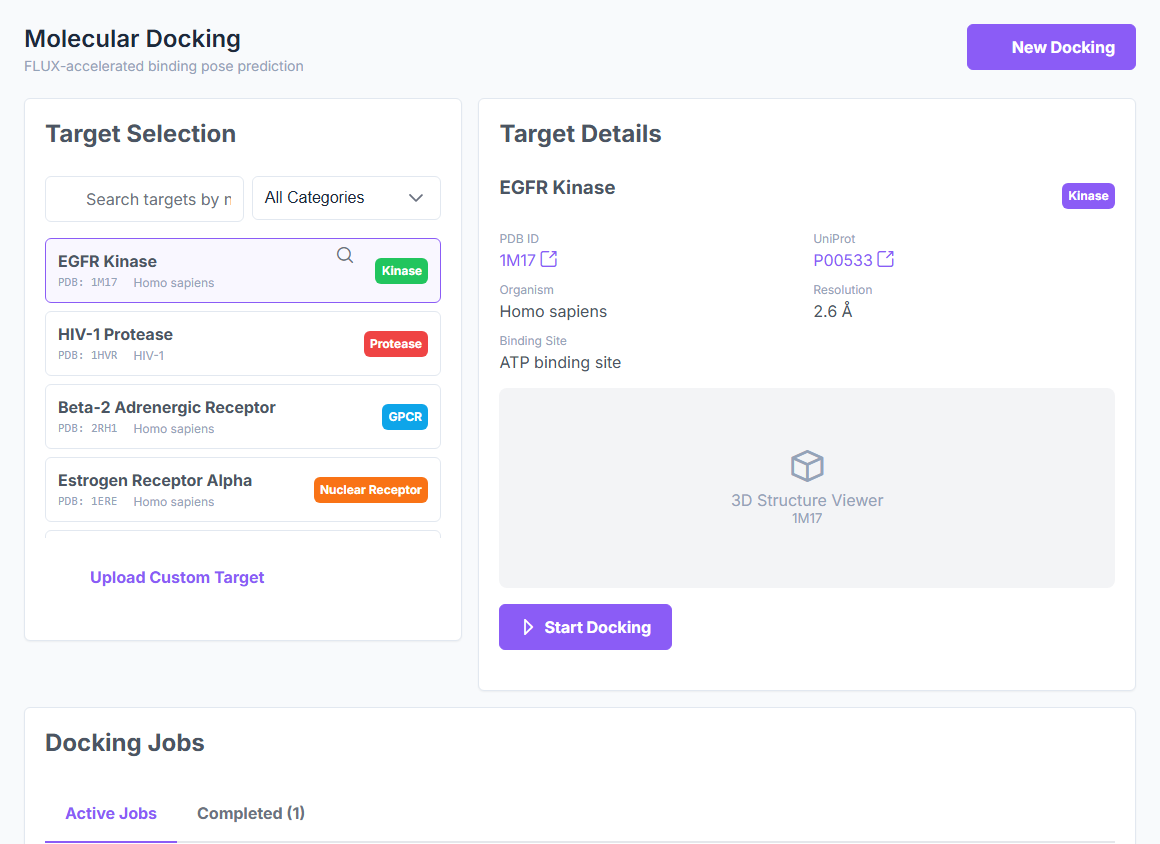
Target selection panel with search and filter-by-category
Target selectionSearch and filter the curated pocket library, preview PDB metadata and binding-site residues.
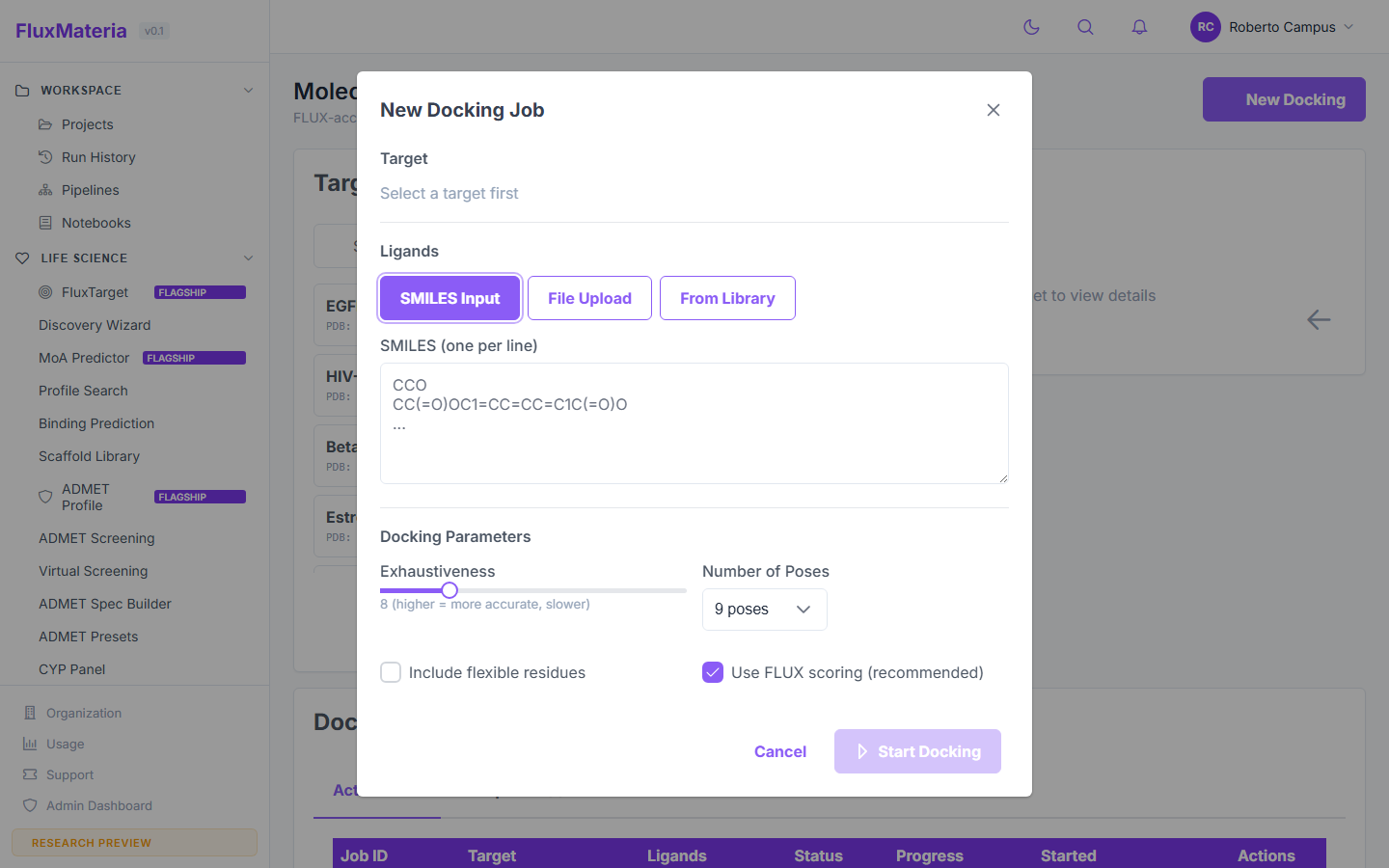
New docking dialog with ligand entry, exhaustiveness, pose count, and flexible residue toggle
New jobSMILES / SDF / CSV ligand entry, exhaustiveness slider, pose count, and flexible-residue toggle.
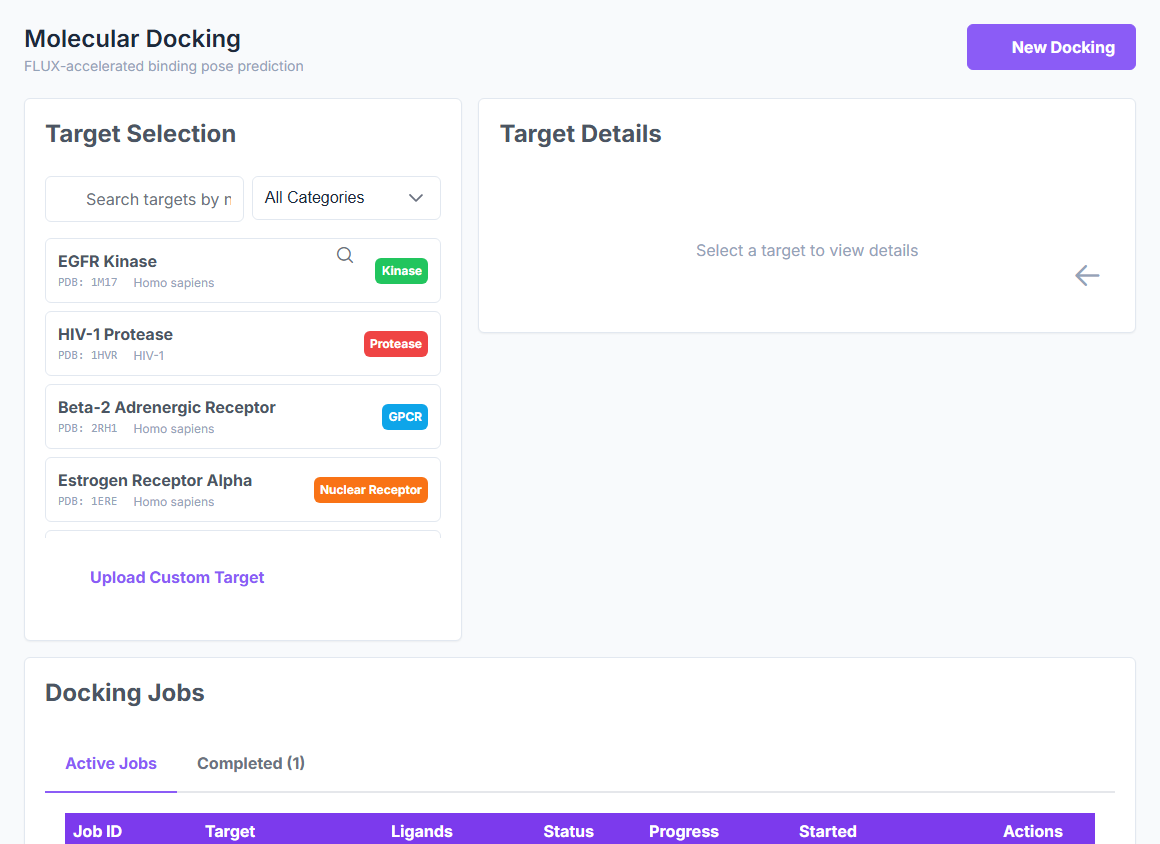
Active jobs table with status, progress bar, cancel button
JobsActive and completed docking jobs with status, progress, best-score badge, and cancel / view / download actions.
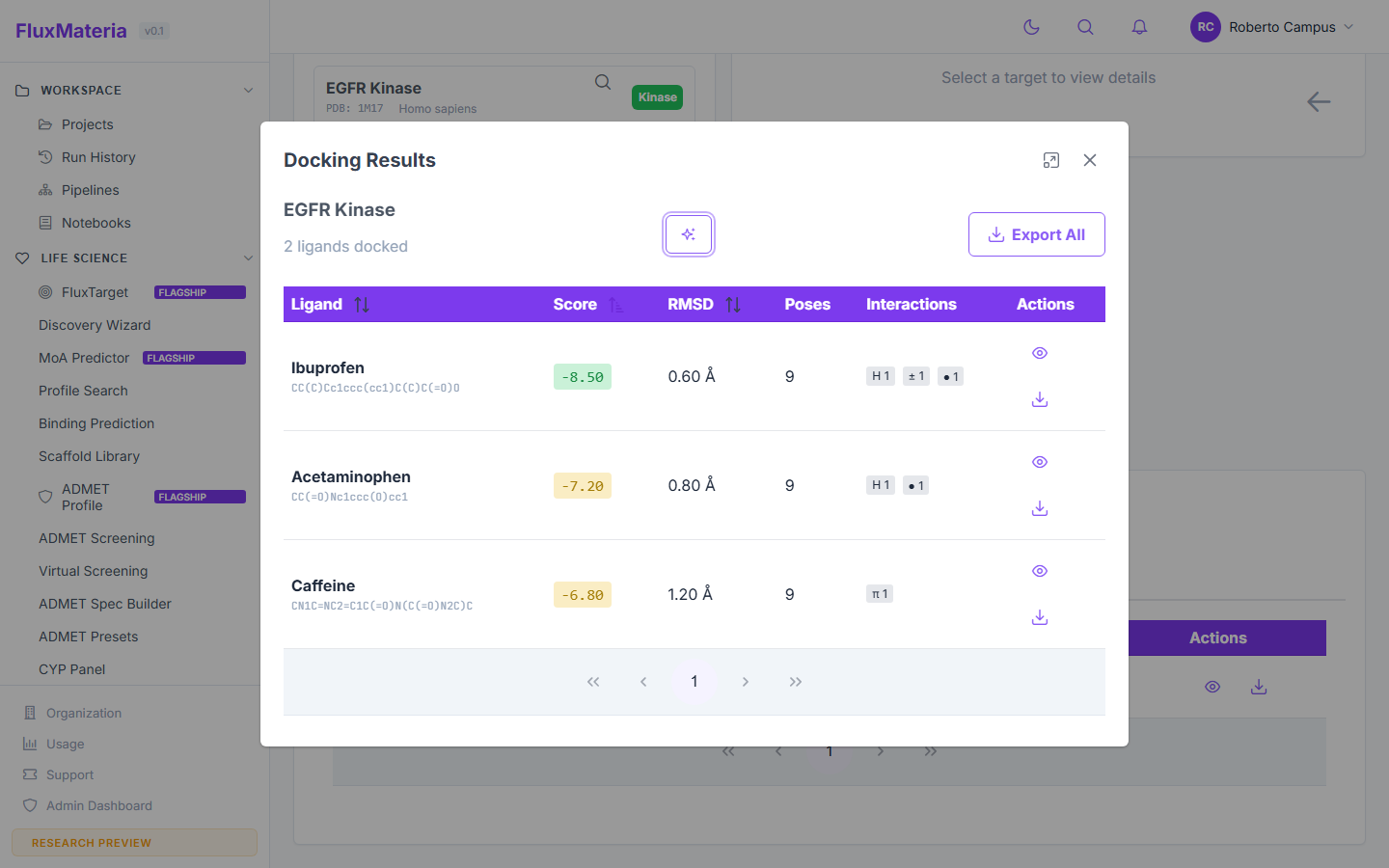
Results dialog with ligand rows, score, RMSD, interaction summary icons
ResultsLigand rows with score, RMSD, pose count, and interaction-summary badges (H / hydrophobic / π / salt / halogen).

Scope & Limitations

Strengths

  • Physics grids + genetic search + local optimisation — no force-field parameterisation required.
  • Covalent warheads, metal sites, and bridging waters are first-class features, not plug-ins.
  • Full ΔG breakdown + kinetics from one pass, deterministic and re-runnable.
  • Interaction profile reports every contact with geometric criteria matching literature.

Known limitations

  • External benchmark validation (PDBbind rank order, DUD-E enrichment) is scheduled for publication; internal tests cover physics and geometry only.
  • Rigid pocket is the default; the flexible-refinement pass is opt-in and capped at three iterations within 5 Å.
  • Large induced-fit motions and full-protein dynamics belong in the MD module, not here.
  • Peptide / macrocycle docking works best when paired with an explicit multi-conformer seed rather than a single SMILES.

Dock your next series

Pilot access includes Docking, FluxTarget, the ADMET suite, and a Workspace seat to keep every run auditable.

Request Pilot Access →