๐Ÿ”ฌ FLUXMATERIA — MATERIALS

Design a material to spec,
in a second

Write the constraints, pick a target profile, and the Design Studio generates a ranked shortlist of inorganic candidates — each with FLUX-derived properties, lineage, and a two-tier validation path that ends at a GPU lattice dynamics pass.

Constraint DSL Target-profile presets Two-tier validation Lineage + trace No ML
313
Curated materials at 100% match across 14 families
1.17%
Core-property MAPE on the family-holdout test
< 1 ms
Per-candidate engine prediction (Tier 1)
6
Target-profile presets, plus custom specs
0
Trained parameters
The breakthrough

Realtime generative design that actually returns real candidates

You write the spec — band gap range, thermal behaviour, hardness floor, element scope — and the Studio generates, scores, repairs, and ranks candidate compositions in one click. Every candidate comes with its predicted properties, its lineage, and a validation channel: a fast engine pass for all of them and an optional GPU lattice dynamics pass for the top-N.

What the Design Studio does

Every control a materials scientist needs to take a spec from sketch to shortlist.

๐Ÿ“œ

Constraint DSL

Hard constraints reject violators; soft constraints apply weighted penalties. Standard operators against band gap, bulk modulus, θD, κ, hardness, density, formation energy.

๐ŸŽฏ

Target-profile presets

Semiconductor, narrow- and wide-gap, room-temp superconductor, thermoelectric, ultra-hard, battery cathode, LED emitter — one-click starting points.

๐Ÿงช

Element-scope rules

Allowed / required / excluded element lists, maximum elements per formula, stoichiometry bounds, charge neutrality, oxidation plausibility.

โšก

Tier-1 engine validation

Every candidate passes through the materials engine: band gap, effective mass, dielectric, bulk modulus, θD, density — sub-millisecond per prediction.

๐Ÿ’Ž

Tier-2 GPU lattice validation

Top-N candidates pass through a GPU lattice dynamics stage that flags synthetically unstable structures before you commit synthesis time.

๐Ÿงญ

Pareto front ranking

Multi-objective search returns the Pareto-optimal set alongside the fitness-ranked list. Choose by fitness or by dominance.

๐Ÿงฌ

Lineage & pipeline trace

Each candidate carries parent IDs, the operator that produced it, the repair origin, the generation pass, and per-stage timings.

๐Ÿ“ค

Export & interpret

CSV, Excel, JSON, and PDF export. AI interpretation generates a reviewer-ready narrative explaining why each candidate survived.

How a design run is built

From constraints to a GPU-validated shortlist in a single click.

1

Configure

Pick a target preset, tune constraints and objectives, set population and time budget, declare element scope and plausibility gates.

2

Generate

Adaptive generation pipeline: database-seed injection, guided search, repair fork for near-misses, mutation and crossover on elite candidates.

3

Filter & score

Hard constraints reject; soft constraints apply weighted penalties; objective function ranks the survivors and populates the Pareto front.

4

Tier-1 validate

Full materials-engine pass on every candidate: band gap, effective mass, dielectric, bulk modulus, Debye temperature, density — sub-ms each.

5

Tier-2 validate

Top-N candidates pass through a GPU lattice dynamics stage for phonon stability and refined bulk / Debye properties. Drift vs engine is reported.

6

Report

Ranked results table with lineage, pipeline trace, operator-survival summary, and one-click export (CSV / JSON / Excel / PDF) or AI narrative.

Why you can trust it

Benchmarked on published materials, not on internal metrics.

313
Curated materials at 100% match across III-V, II-VI, TMDs, chalcopyrites, perovskites, oxides, halides, nitrides, and thermoelectrics.
1.17%
Core-property MAPE (Test A) — family-holdout validation, 797 property points across 19 folds.
1.38%
Core-property MAPE (Test B) — interaction-holdout validation, 821 property points across 15 folds.
0.237 eV
Band-gap MAE across 1,048 materials — the public benchmark, computed without fitting.
< 1 ms
Tier-1 engine runtime per candidate. Tier-2 GPU lattice runs in ~200 ms per candidate.
0
Trained parameters. Every run is deterministic and reproducible by composition alone.

How FluxMateria compares

Head-to-head against the usual approaches to materials generative design.

Metric FluxMateria DFT generative ML surrogate High-throughput lookup
Tier-1 latency < 1 ms Minutes to hours 1–100 ms < 1 ms (lookup)
Training data None None Thousands per family Data is the tool
Spec DSL Hard + soft Per-run Ad-hoc None
Predicts new materials Yes Yes (slow) Within distribution No
Phonon-stability gate Built-in Separate job Not provided Not provided
Out-of-distribution Degrades gracefully Unchanged Confidently wrong Miss
Pareto front Built-in Rare Rare No
Lineage & trace Full audit log Usually Opaque Pointer to dataset

The key insight: DFT generative design is honest but too slow for a live UI; ML surrogates are fast but blind outside their training set; lookup catalogues are instant but only show what already exists. The Design Studio gives you all three: realtime predictions on unseen compositions, a built-in phonon-stability gate, and a full audit trail of how each candidate was generated. See the full materials benchmark →

Where the Design Studio wins

Design problems where a realtime, phonon-gated search changes what’s tractable.

Use case 1

Wide-gap TCO design

Target gap > 3 eV, low work function, earth-abundant element scope. Returns a Pareto front across the oxide / halide / nitride families in a single pass.

Use case 2

Battery cathode short-list

Element-restricted (Li, Co, Ni, Mn, O, Fe, P), density < 6 g/cm3, gap < 4 eV. Dozens of stoichiometries ranked in seconds.

Use case 3

DFT budget allocation

Generate and Tier-1-validate thousands of candidates in seconds, Tier-2 the top five on the GPU, spend DFT cycles only on the survivors.

Use case 4

Feasibility sanity check

A collaborator proposes a novel perovskite. Drop the composition in, read the Tier-1 properties and the Tier-2 phonon-stability flag before the next meeting.

Use case 5

Thermoelectric discovery

Narrow gap (0.1–1.0 eV) with low lattice thermal conductivity. The ZT-relevant composite objective ranks candidates without having to compute ZT directly.

Use case 6

Compliance & audit trail

Every candidate carries lineage and pipeline trace. Reviewers, regulators, and IP counsel can re-run the same spec and get a bit-identical ranked list.

Design Studio in the product

Real captures from the live application. Click any image to zoom.

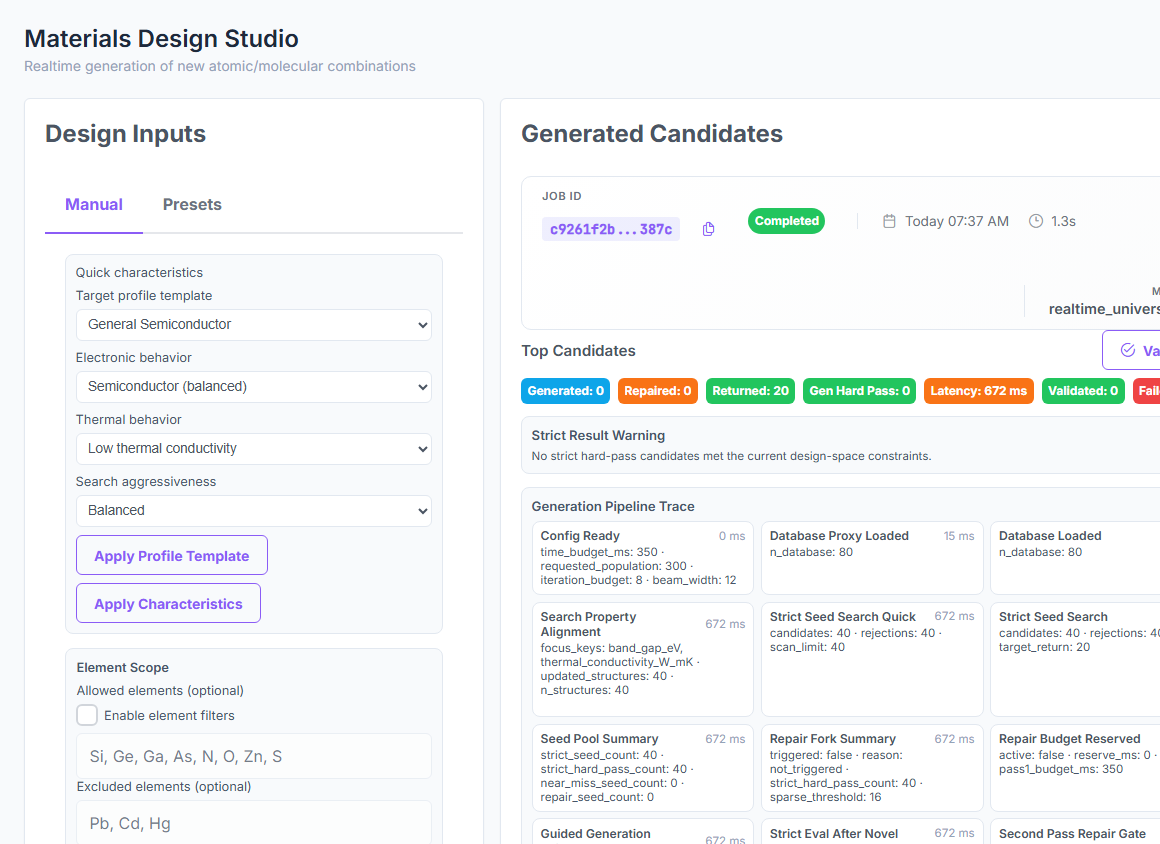
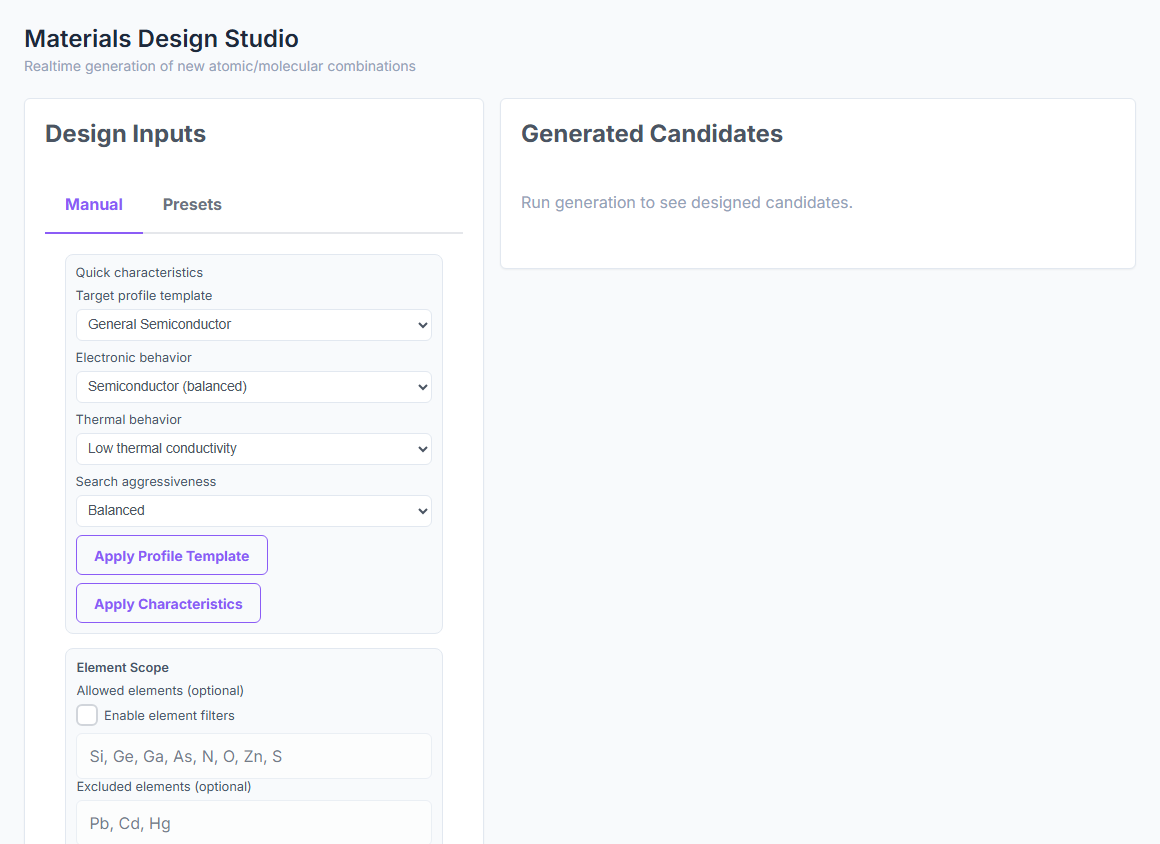
Design Inputs card with target preset, electronic behaviour, element scope, and performance constraints
Design inputs Target preset, electronic / thermal behaviour, element scope, and performance constraints on one panel.
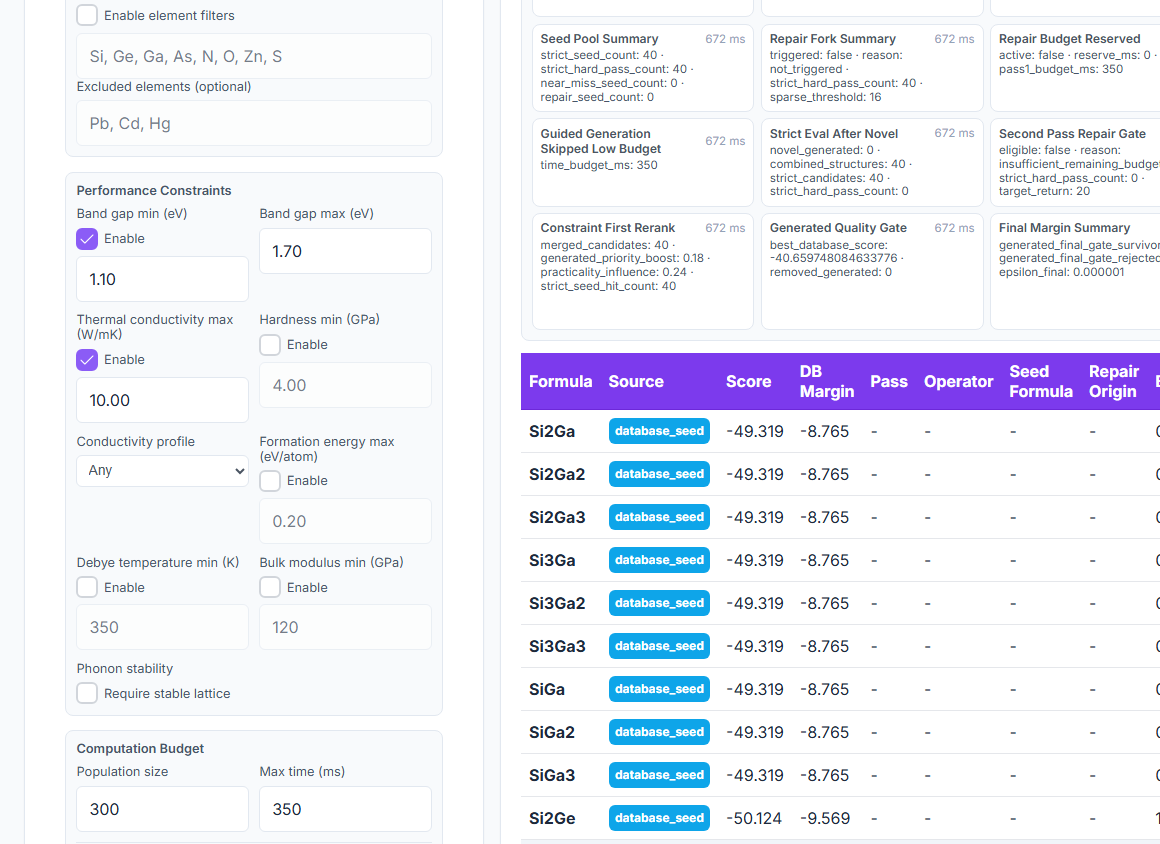
Generated candidates table with formula, score, band gap, thermal conductivity, validation status
Generated candidates Ranked shortlist with Tier-1 properties, source flag, DB margin, operator, and validation status.
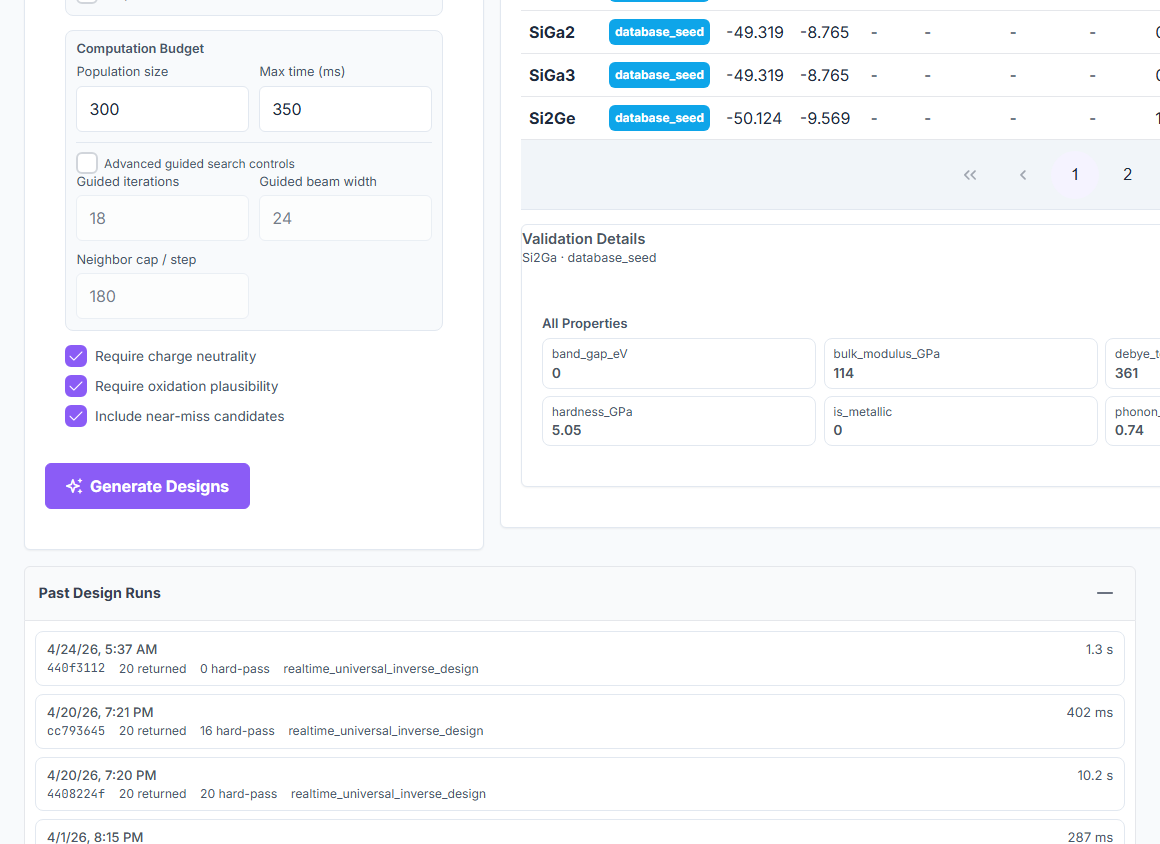
Pipeline trace showing per-stage timings and operator survival summary
Pipeline trace Per-stage timings, operator-survival summary, and the hard / soft gate statistics for the run.
GPU lattice validation report showing phonon stability and refined properties
Tier-2 GPU validation Phonon-stability flag, refined bulk and Debye properties, engine-vs-GPU drift for the top candidates.

Scope & Limitations

Strengths

  • Two-tier validation path: fast engine on every candidate, GPU lattice dynamics on the finalists.
  • Constraint DSL supports hard and soft gates with standard operators against every exposed property.
  • 313-material curated seed database warms every population with high-quality baselines.
  • Pareto front and fitness-ranked list both returned; choose your selection mode per run.
  • Lineage, operator-survival, and per-stage timings are logged for every candidate — audit-ready.

Known limitations

  • Organic semiconductors, amorphous solids, and MOFs are outside the current structure library.
  • Charge-neutrality and oxidation-plausibility gates are strict; unusual but real oxidation states can be rejected.
  • Tier-2 GPU validation adds latency; skip it for exploratory runs and re-enable for the final shortlist.
  • Magnetic ordering comes from the Curie module, not this one — link out for ferromagnets and antiferromagnets.

Design your next material

Pilot access includes the full Design Studio workflow, the 313-material curated database, Tier-2 GPU validation, and a Workspace seat to keep every run auditable.

Request Pilot Access →