FLUXMATERIA — CHEMISTRY

Every bond, from first principles.

Bond lengths and bond dissociation energies for 64 elements. 1,361 validated observables. First principles, not fits. Sub-millisecond per query.

Request Access ← Back to Modules

Capabilities

📏

Bond lengths

453 validated bonds: single, double, triple, aromatic. 0.079% mean error vs experimental data.

Bond dissociation energies

908 validated BDEs across singles, doubles, and triples. 0.289% mean error. 870/906 within 1%.

🧪

Reaction enthalpies

Hess’s law from BDE differences. Coverage for transition metal, p-block, and s-block bonds.

🔍

Batch screening

Query thousands of bonds per second. Export full catalogs. 2,080 element pairs computable.

🎯

3D structure support

Bond lengths feed directly into molecular geometry construction for 3D visualization.

📊

Full audit trail

Every prediction includes the computed value, experimental reference, error percentage, and data provenance.

How FluxMateria compares

Head-to-head against every major approach to bond properties

Metric FluxMateria DFT (B3LYP) CCSD(T) Empirical Tables
Bond length error 0.079% 1–3% ~0.5% 0% (where listed)
Bond energy error 0.289% 3–10% 1–3% 0% (where listed)
Speed per bond <1 ms Minutes to hours Hours to days <1 ms (lookup)
Validated coverage 1,361 observables Typically <50 per study <20 per study ~300 (fixed catalog)
Predict new bonds 2,080 pairs, instant Hours per bond Days per bond Not possible
Trend analysis Yes (continuous model) Yes (re-run series) Yes (re-run series) No (discrete values)
Physical model First-principles (0 fitted) First-principles First-principles None (raw data)

The key insight: Empirical tables are exact but frozen — they cannot predict unmeasured bonds or reveal trends. DFT and CCSD(T) can predict anything but cost hours to days per bond. FluxMateria combines first-principles accuracy with lookup speed across 2,080 element pairs. See full benchmark data →

At a glance

453
Validated bond lengths
391 single + 62 multiple
908
Validated bond energies
Singles + doubles + triples
64
Elements covered
p-block + d-block + s-block
0
Fitted parameters
Pure first principles

Typical workflow

1

Query

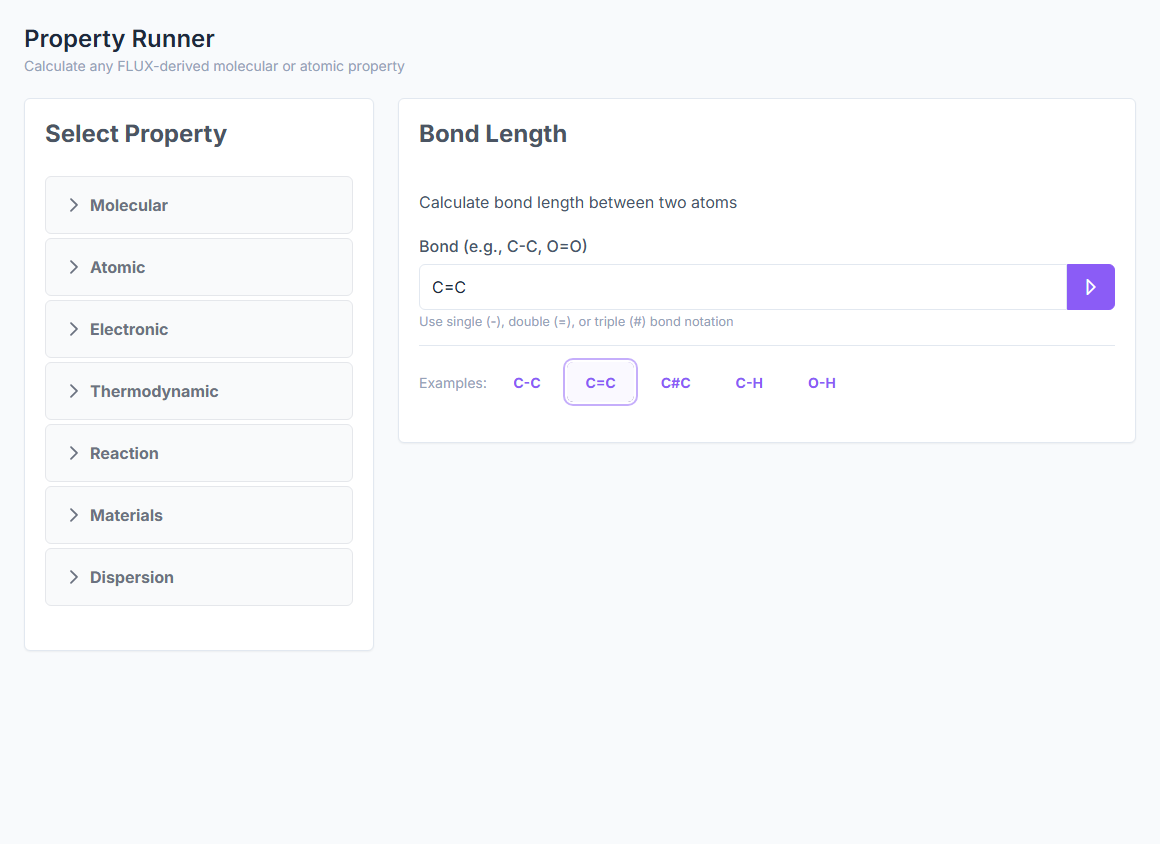
Enter a bond type (e.g. C–H, Fe=O, N#N) or element pair

2

Compute

Engine returns length (pm) and energy (eV) with experimental reference

3

Compare

See FLUX prediction vs experimental value with error percentage

4

Export

Download full catalogs or feed into downstream modules

Feeds into other modules

Bond data is foundational — it powers multiple downstream capabilities.

⚗️ Mechanism Discovery

Activation barriers computed from BDE differences. 908 bonds provide comprehensive coverage for Hess’s law calculations.

🧪 Synthesis Planning

Route planning uses FLUX-derived barriers. Bond energies determine thermodynamic feasibility of disconnections.

📐 3D Structure

Molecular geometry construction uses engine bond lengths as primary source. Covers aromatic, double, and triple bonds.

📈 Spectroscopy

IR and Raman predictions require accurate bond force constants, derived from bond length and energy curves.

Try the bond engines

Query any bond. See the prediction. Compare against experiment.

View Benchmarks Request Access