FLUXMATERIA — BIOTARGET

Drug discovery that thinks in program constraints.

BioTarget screens binding across pathogen, human off-target, and microbiome panels — then fuses results with FluxMateria ADMET to produce a de-risked shortlist and a test plan.

Request Pilot Access ← Back to Modules
10,065 targets CASF-2016 validated Multi-panel selectivity Integrated ADMET

Capabilities

Not just a docking score — a program-aware decision bundle.

🎯

Targeted efficacy scoring

Rank compounds by predicted binding strength across 10,065 targets spanning 5 biological kingdoms. Full GPU physics simulation: 3D conformer generation, pose search, 14+ interaction energy modules — all from SMILES input alone.

🧷

Human off-target triage

Counter-screen across safety-critical human targets to catch liabilities early.

🦠

Microbiome impact lens

Estimate collateral binding across gut-relevant targets to reduce disruption risk.

📏

Selectivity + TI metrics

Therapeutic-index style margins (pathogen vs human) with explainable ranking. 5,000+ predictions/sec (~300,000x faster than conventional docking).

💊

Built-in ADMET fusion

One-run developability gating (hERG/CYP/solubility/permeability, etc.) via FluxMateria ADMET.

🧪

Auto test plan

Suggested counter-screens and confirmatory assays based on your top-ranked risks.

Inputs & outputs

Inputs

Ligands: SMILES / SDF / library CSV
Targets: curated panel or your own structures (pilot-supported)
Program config: pathogen vs human vs microbiome weighting, penalties, thresholds

Outputs

Ranked shortlist: efficacy + selectivity + ADMET-weighted score
Risk map: top off-targets + gut-risk drivers + ADMET flags
Decision artifacts: CSV exports + reproducible report bundle (for audit + handoff)
Next experiments: counter-screen recommendations and confirmation steps

Typical workflow

Designed for rapid iteration — not one-off scoring.

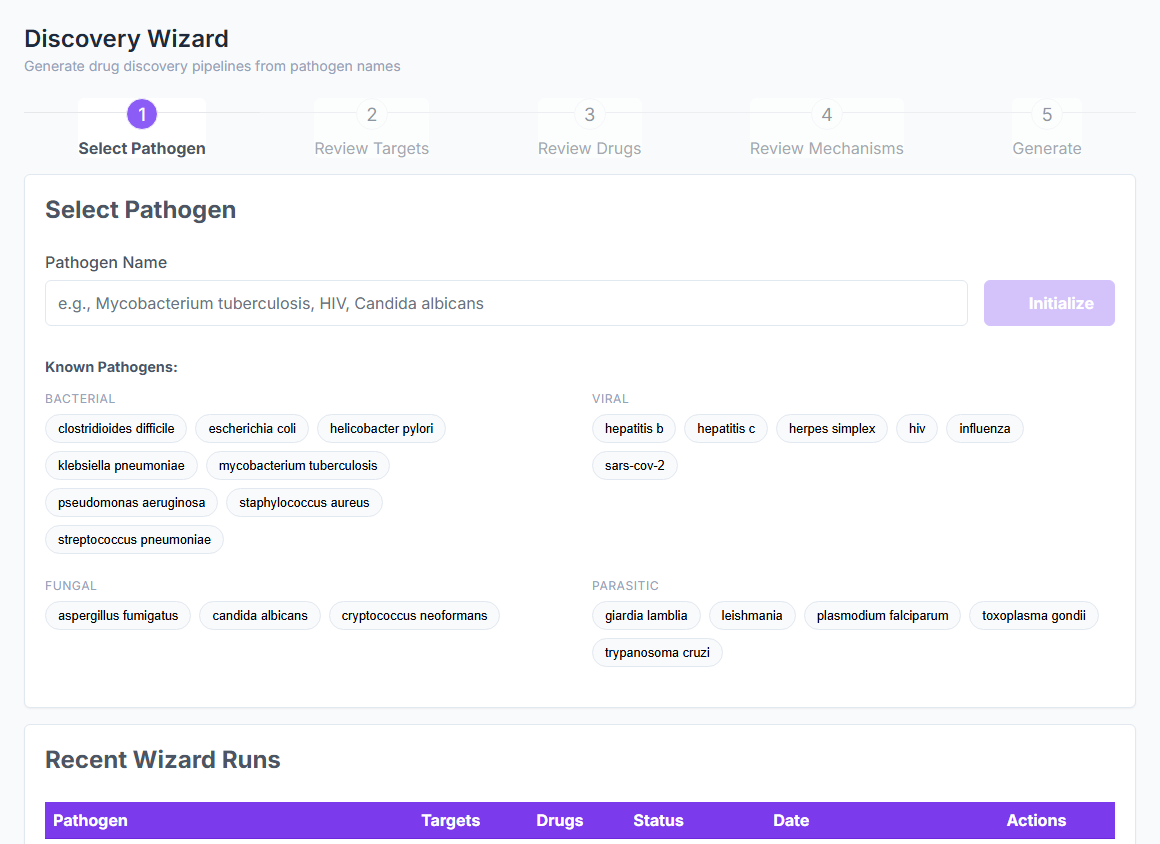
1) Define the program

Select pathogen target(s), choose counter-screen panels, set thresholds and penalties.

2) Screen the library

Run multi-target scoring and generate per-panel summaries (pathogen / human / microbiome).

3) Fuse ADMET

Automatically gate by developability: remove “potent but undruggable” candidates early.

4) Export + test

Ship a de-risked shortlist plus recommended assays to validate potency and liabilities.

Where BioTarget fits

🧫

Antibiotic discovery

Efficacy vs pathogen + safety vs human + microbiome-aware selection in one report.

🧬

Antiviral / antiparasitic

Rapid counter-screening to reduce host liabilities while maintaining target engagement.

🧠

Host-targeted therapy

Optimize selectivity within human target families and de-risk early ADMET failure modes.

🔁

Lead optimization

Iterate: modify scaffold → rerun panels → see what risk moved (and why).

Benchmarks

Validated against published benchmarks (CASF-2016, ChEMBL).

Binding Affinity — CASF-2016
Validated
0.537
Pearson r
1.90
MAE (pKi)
33%
Within 1.0 pKi
62%
Within 2.0 pKi
270 CASF-2016 complexes (Su et al. 2019) · Bias = -0.03 pKi
Input: SMILES + target name only (no 3D co-crystal structure required)
Every energy term deterministic and auditable
Not a direct comparison. All other methods require a 3D co-crystal structure and most require large training datasets (19K+ complexes). FluxTarget uses only SMILES + target name — no 3D structure, no training data.
Method r Required Input Training Data
DEEP LEARNING + 3D STRUCTURE + LARGE TRAINING SETS
graphDelta (GNN)0.873D co-crystal19K+ complexes
GNINA (CNN)0.823D co-crystal19K+ complexes
CLASSICAL SCORING + 3D STRUCTURE
RF-Score v30.723D co-crystal4K+ complexes
Glide SP0.653D co-crystalEmpirical (fitted)
AutoDock Vina0.60–0.703D co-crystalEmpirical (fitted)
NO 3D STRUCTURE · NO TRAINING DATA
FluxTarget v6.6b0.537SMILES + target nameNone (physics-only)
Per-complex results (270 complexes, CSV) Download ↓
Mechanism of Action (MoA)
Validated
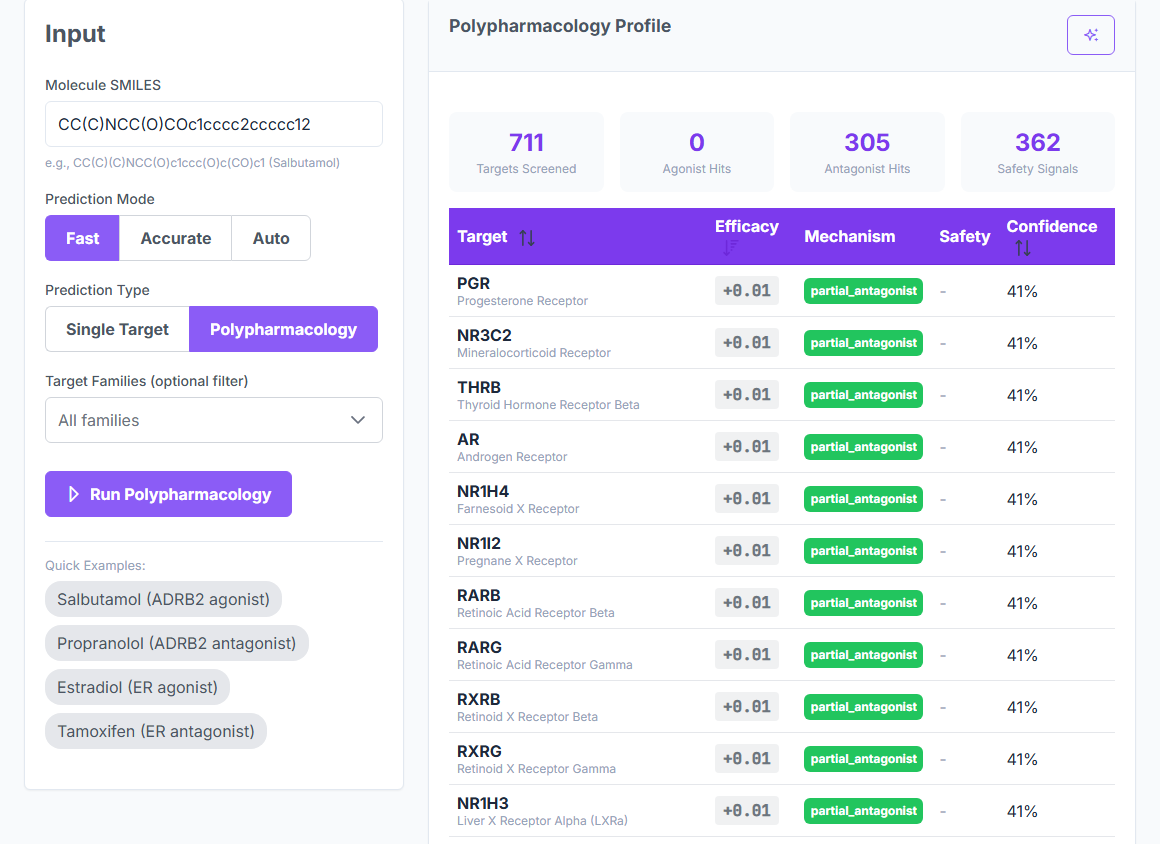
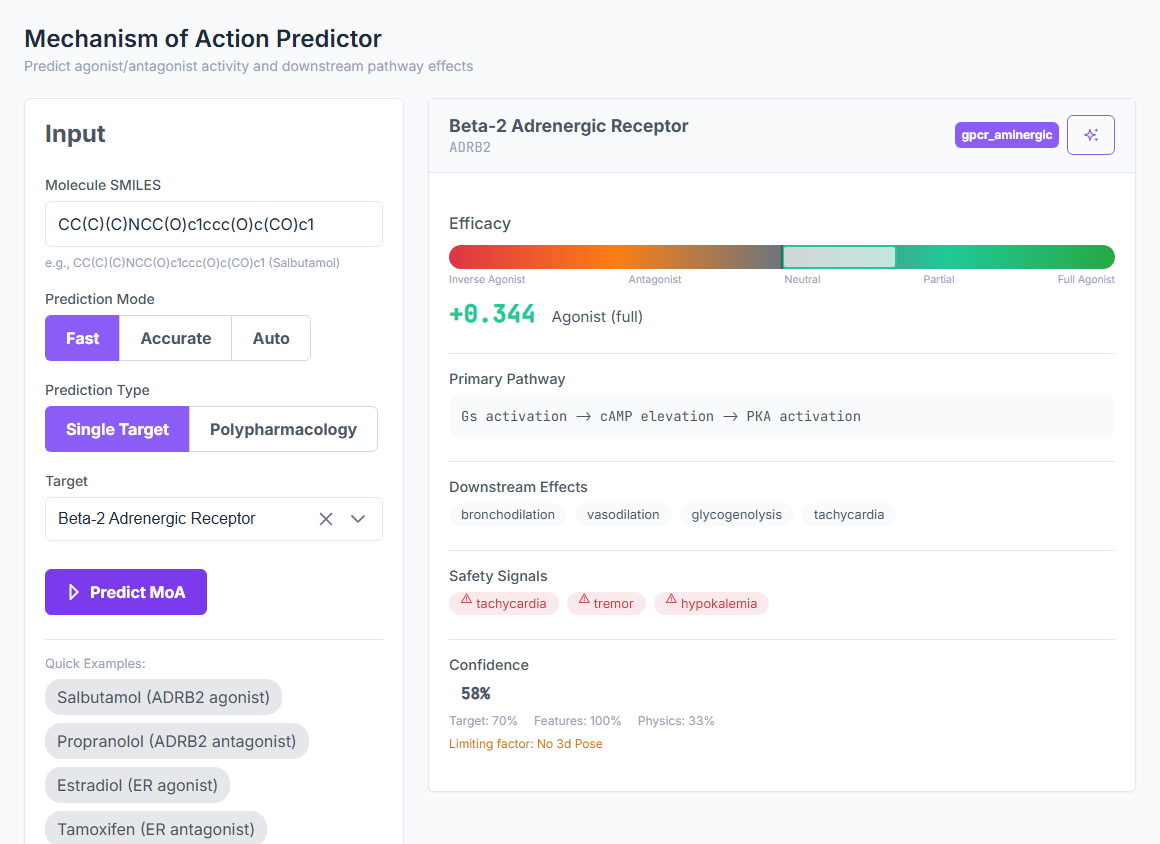
91% accuracy on ChEMBL validation set · Agonist/antagonist/inhibitor classification · No ML
Target Identification
Validated
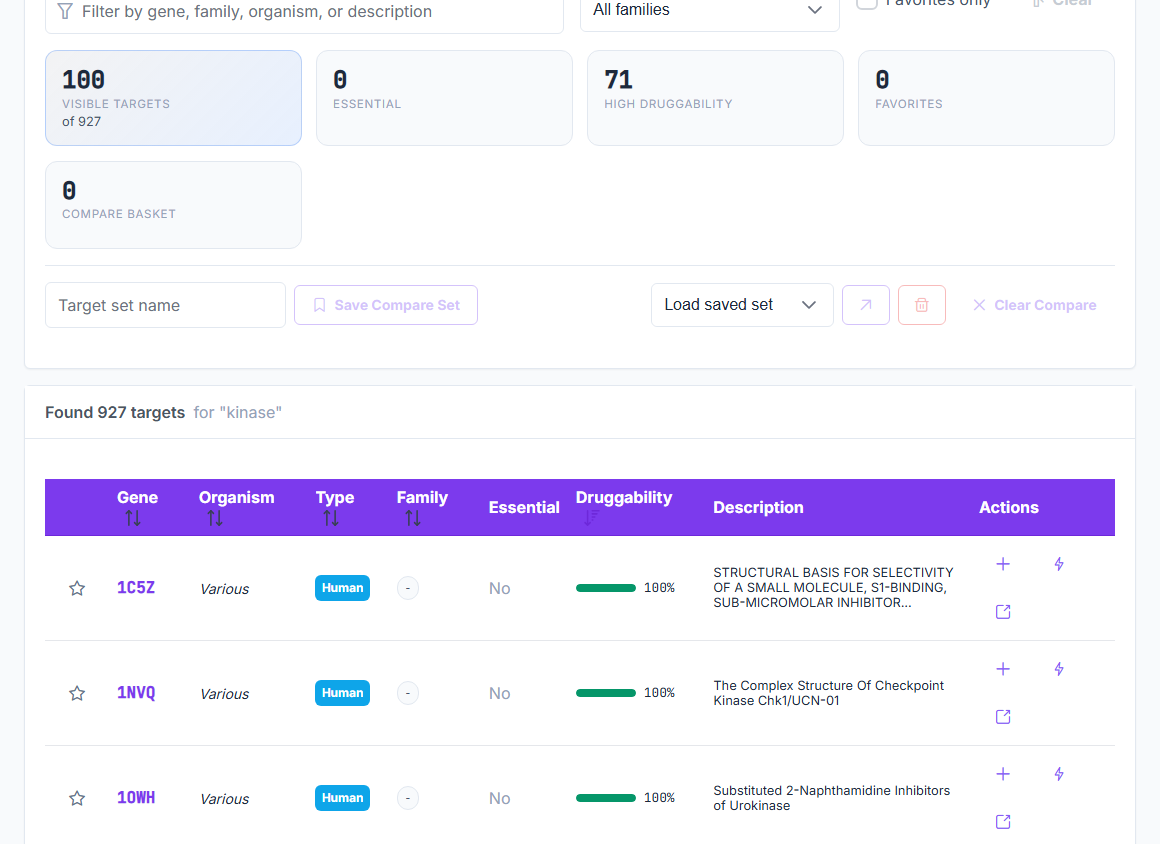
AUC = 0.980 · 10,065 targets across 5 kingdoms · Physics-only scoring

Why these numbers matter more than they look

FluxTarget solves a fundamentally harder problem than any method it's compared against.

What every other method receives
  • Experimentally solved 3D co-crystal structure (X-ray / cryo-EM)
  • Exact ligand pose already bound in the protein pocket
  • Protein conformation already adapted to the ligand
  • Water network and binding-site geometry pre-resolved
What FluxTarget receives
  • 1. A SMILES string (flat molecular formula)
  • 2. A target protein name
  • That's it. No 3D structure. No binding pose. No training data.
FluxTarget builds everything from scratch
1
Builds 3D ligand
RDKit conformer generation + MMFF optimization
2
Loads 3D protein
PDB structure parsing + pocket analysis (GPU ray-casting)
3
Docks on GPU
14+ physics modules on CUDA (VDW, H-bond, electrostatics...)
4
Predicts affinity
Full energy decomposition → pKi (deterministic physics)

FluxTarget performs a complete computational docking simulation — conformer generation, pose search, and physics-based scoring — entirely from first principles. Every other CASF-2016 method skips the first three steps because it starts with the experimentally solved answer.

🔬

Beta status

BioTarget is available via pilot access. We're actively expanding panels, workflows, and published validations.

Included in pilot access

  • Multi-panel scoring (pathogen / human / microbiome)
  • Therapeutic-index style ranking and explainable risk map
  • ADMET fusion and developability gating (via FluxMateria ADMET)
  • Exportable reports (CSV + narrative summary)
  • CASF-2016 validated binding affinity scoring (r = 0.537, 270 complexes)

Near-term roadmap

  • Expanded curated panels (per indication / target family)
  • Partner-assisted PDB ingestion + standardized target prep
  • Induced-fit / ensemble handling (planned)
  • Kinetics / mechanism discovery integration for program-level hypotheses (planned)
Note: BioTarget pilot access is structured and data-driven; we publish benchmarks as they pass our validation criteria.

Want BioTarget on your program?

Bring a target + a small compound set (or a library). We’ll run an evaluation and return a structured shortlist and risk map.

Request Pilot Access See Demos