โš›๏ธ FLUXMATERIA — CHEMISTRY

Every molecular property
from a single SMILES

Advanced Methods is the universal calculator. One request returns structural descriptors, drug-likeness, electronic properties, and reactivity indices — all from first-principles physics, all with zero fitted parameters.

Structural Drug-likeness Electronic Reactivity Batch of 100
5,956
First-principles formulas across 75 JSON layers
0.079%
Bond-length MAPE across 453 validated bonds
0.289%
Bond-energy MAPE across 908 validated BDEs
100
Molecules per batch request
0
Trained parameters
The breakthrough

One physics engine, every molecular property

You drop in a SMILES and Advanced Methods returns a full property card in one request: molecular weight and formula, donors and acceptors and TPSA, HOMO / LUMO / band gap, hardness and electrophilicity. Same engine, same axiom, same sub-millisecond runtime whether you ask for the structural descriptors alone or the entire reactivity profile.

What Advanced Methods computes

Four property panels, one request, one JSON payload.

๐Ÿงฑ

Structural descriptors

Molecular weight, exact mass, Hill formula, atom and heavy-atom counts, rotatable bonds.

๐Ÿ’Š

Drug-likeness

logP, TPSA, hydrogen-bond donors and acceptors, molar refractivity, polarizability — the Ro5 stack in one call.

โšก

Electronic properties

HOMO, LUMO, band gap, dipole moment — the orbital and polarity headlines needed for mechanism and reactivity work.

๐ŸŽฏ

Reactivity indices

Chemical hardness, softness, electronegativity, electrophilicity — the conceptual-DFT indices, from the same pass.

๐Ÿ“ฆ

Batch mode

Up to 100 molecules per request. Error-tracked per row, counters for total / success / failed, results indexed back to the input.

๐Ÿงช

Example molecules

Aspirin, caffeine, glucose, benzene one-click-loaded for live demos and unit-test scaffolding.

๐Ÿ“ค

Export & interpret

CSV, Excel, JSON, PDF out of the box. AI interpretation generates a reviewer-ready narrative around the numbers.

๐Ÿ“’

Workspace history

Every run is logged to Workspace with the exact input, the exact output, and the engine version — re-runnable bit-for-bit.

How a property request is handled

From SMILES to a full property card in one API call.

1

Input

Single SMILES or batch (up to 100 rows, one per line). Canonicalised and validated before anything else runs.

2

Structural

Molecular weight, exact mass, Hill formula, atom / heavy-atom / rotatable-bond counts — the ground-truth descriptors.

3

Drug-likeness

logP, TPSA, HBD, HBA, molar refractivity, and polarizability come from the universal property engine.

4

Electronic & reactivity

HOMO / LUMO / band gap / dipole, then hardness / softness / electronegativity / electrophilicity — same pass, same engine.

5

Return

Single JSON with the method label, a computation-time stamp, and — on batch — per-row success / error tracking.

Why you can trust it

Benchmarked against published experimental data, not internal metrics.

5,956
First-principles formulas across 75 JSON layers — the same engine every request uses.
0.079%
Bond-length MAPE on 453 validated bonds across 64 elements (Chemistry benchmark).
0.289%
Bond-energy MAPE on 908 validated bond dissociation energies across 64 elements.
1,361
Total validated observables across bond lengths, angles, and energies.
< 1 ms
Per-property engine runtime on a single CPU — interactive-scale.
0
Trained parameters. Every value is reproducible from the input SMILES alone.

How FluxMateria compares

Head-to-head against the usual sources of molecular properties.

Metric FluxMateria DFT (B3LYP) ML property model Rules / lookup
Bond-length error 0.079% 1–3% Depends on set 0% (where listed)
Bond-energy error 0.289% 3–10% Depends on set 0% (where listed)
Latency per property < 1 ms Minutes to hours 1–100 ms < 1 ms (lookup)
Training data required None None Thousands per property Data is the tool
Predicts unseen molecules Yes Yes (slow) Within distribution No
Single-call multi-property Yes (4 panels) One job per property One model per property Usually
Deterministic Yes Yes No (seed / version) Yes
Auditable formulas All 5,956 traceable Method trace Opaque Dataset pointer

The key insight: DFT is honest but too slow for an interactive calculator; ML models are fast but only within the distribution they were trained on; lookup tables are exact but frozen. Advanced Methods combines first-principles accuracy with lookup-scale latency, across every molecule, every property, every call. See the chemistry benchmark →

Where Advanced Methods wins

Real chemistry workflows where one call beats five tools stitched together.

Use case 1

Ro5 triage at scale

Batch of 100 SMILES in, Ro5 descriptors out — MW, logP, HBD, HBA, TPSA, rotatable bonds — in a single second.

Use case 2

Reactivity triage

Hardness, softness, electronegativity, and electrophilicity in the same request. Prioritise electrophilic warheads without a second tool.

Use case 3

Mechanism prep

HOMO, LUMO, and dipole for the reactants and transition-state candidates — feeds MechanismOS with the right electronics in one call.

Use case 4

Spec verification

Check a supplier structure against internal Ro5 + reactivity spec in seconds; flag violators before they hit the assay queue.

Use case 5

Teaching & intuition

Students swap a substituent and see TPSA, logP, HOMO, and electrophilicity all move at once. Conceptual-DFT intuition from tangible numbers.

Use case 6

Audit & reproducibility

Every run is deterministic and logged to Workspace with the input SMILES, output JSON, and engine version stamp. Reviewers re-run the exact same call.

Advanced Methods in the product

Real captures from the live application. Click any image to zoom.

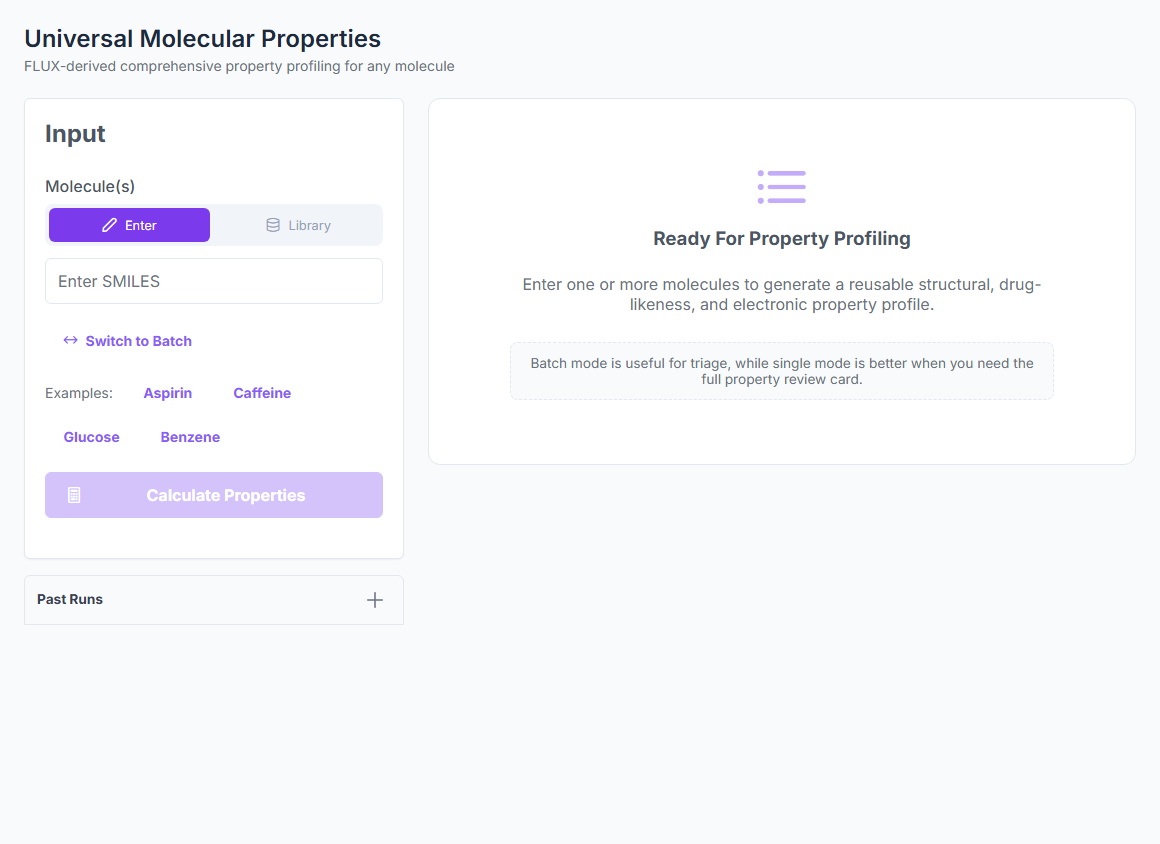
Universal properties input card with SMILES field, batch toggle, and example molecule chips
Input SMILES entry with single / batch toggle and one-click example molecules.
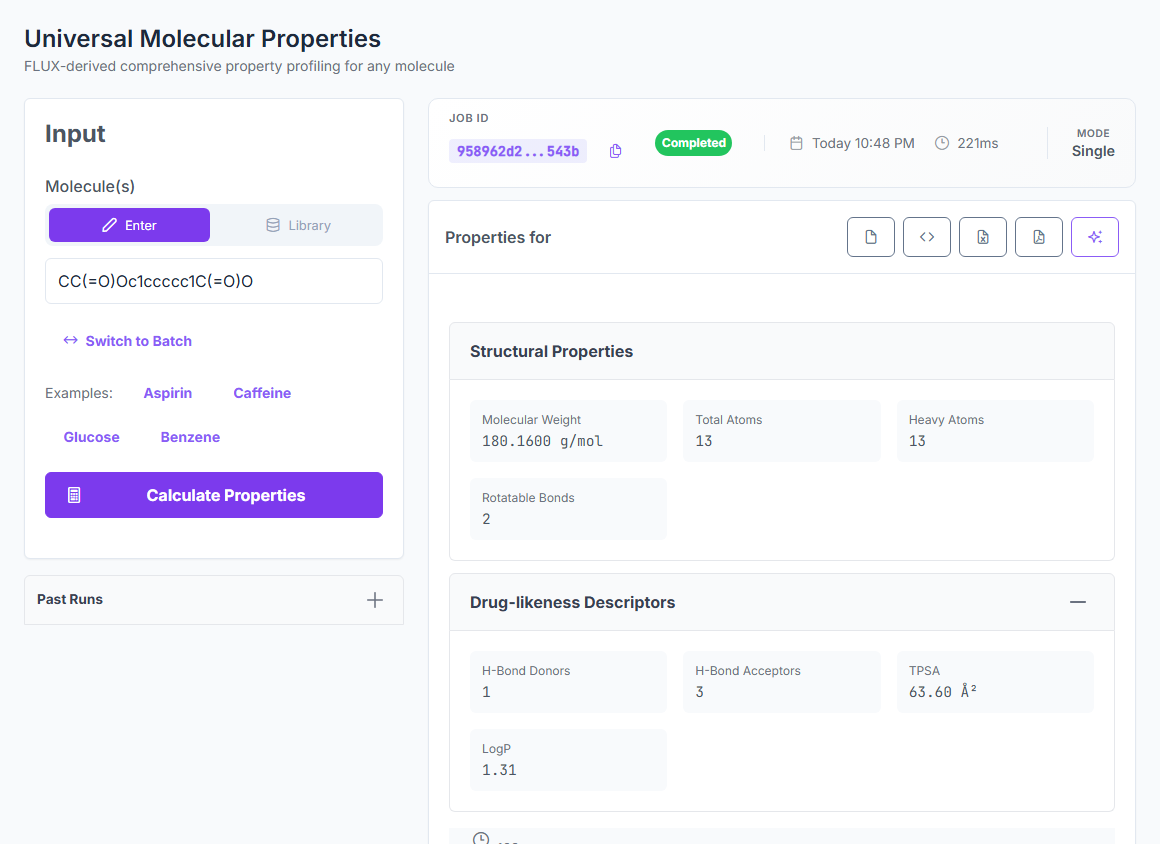
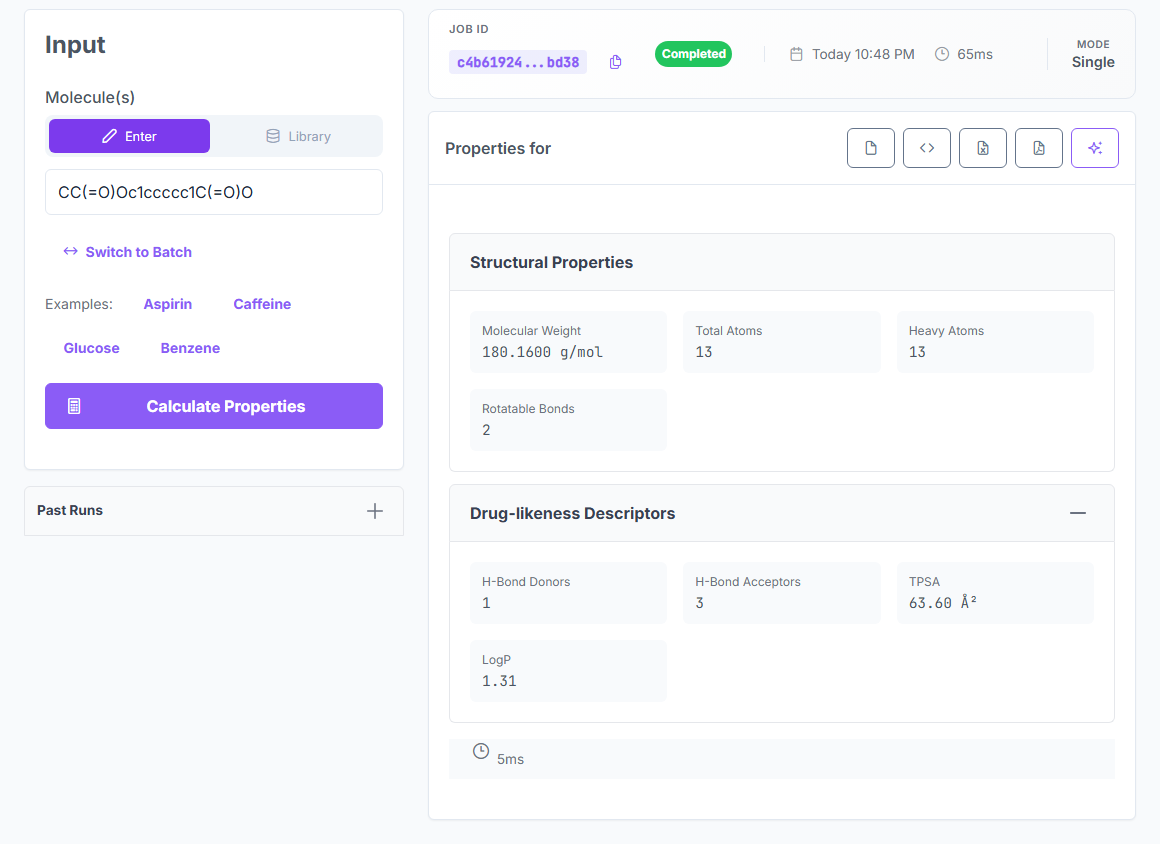
Structural and drug-likeness result panel with MW, formula, TPSA, logP
Structural & drug-likeness MW, formula, heavy-atom count, TPSA, logP, HBD, HBA, polarizability — all in one panel.
Electronic properties panel with HOMO, LUMO, band gap, dipole moment
Electronic & reactivity HOMO / LUMO / band gap / dipole alongside hardness, softness, electronegativity, and electrophilicity.
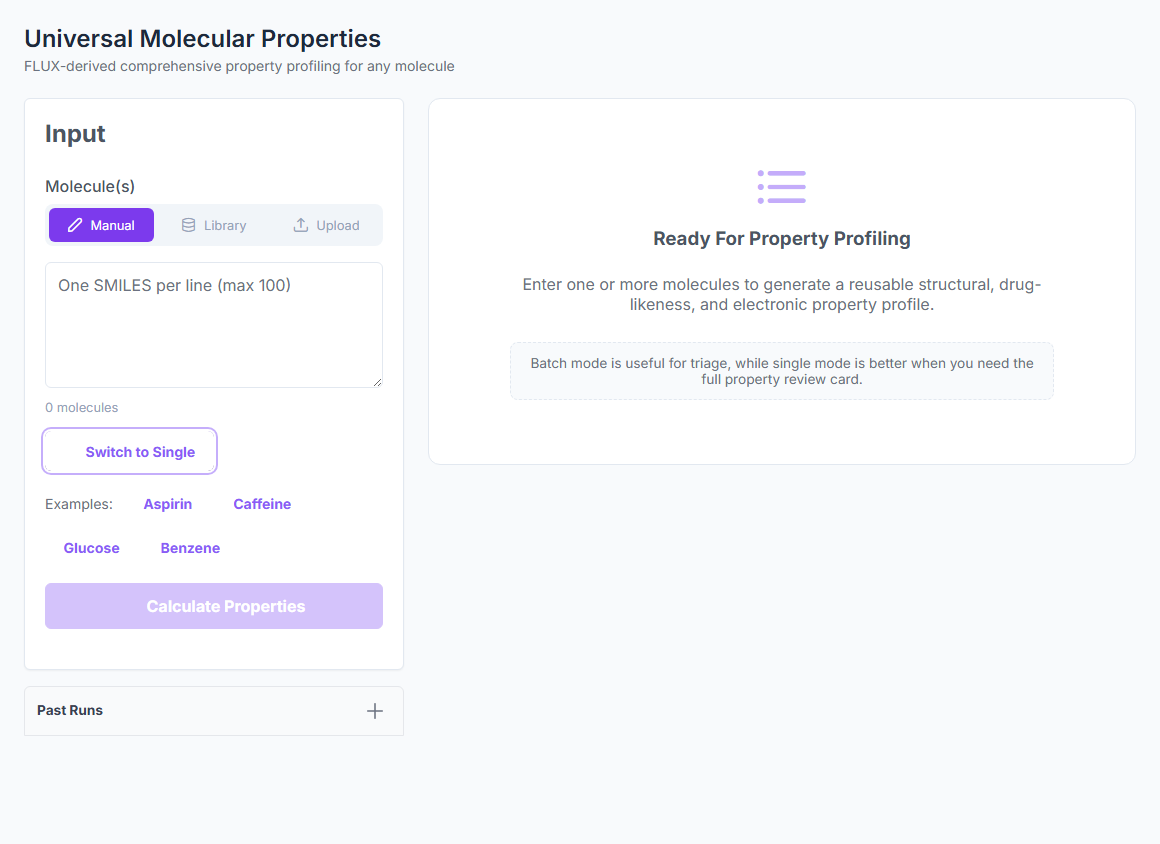
Batch result table with per-row properties, error tracking, and export controls
Batch mode Up to 100 molecules per request, per-row success tracking, export to CSV / Excel / JSON / PDF.

Scope & Limitations

Strengths

  • Four property panels in a single request, sub-millisecond each, deterministic every run.
  • Batch mode up to 100 SMILES per request with per-row success tracking.
  • Full export suite (CSV, Excel, JSON, PDF) and AI interpretation out of the box.
  • Every run logged to Workspace with inputs, outputs, and engine version — re-runnable bit-for-bit.
  • Shared engine with the Chemistry and ADMET modules; numbers match across the product.

Known limitations

  • For solvation free energy, trajectory sampling, or pKa use the dedicated peer modules (MD, Solvation, pKa).
  • Large peptides and biologics are outside the scope of this single-shot calculator.
  • Batch is capped at 100 molecules per request; the Workspace pipeline handles larger libraries.
  • Coupled multi-molecule properties (intermolecular dispersion, binding) live in Solvation and Docking, not here.

Profile your next molecule

Pilot access includes Advanced Methods, batch mode, every peer Advanced calculator (MD, pKa, dispersion, solvation, relativistic, excited states), and a Workspace seat.

Request Pilot Access →