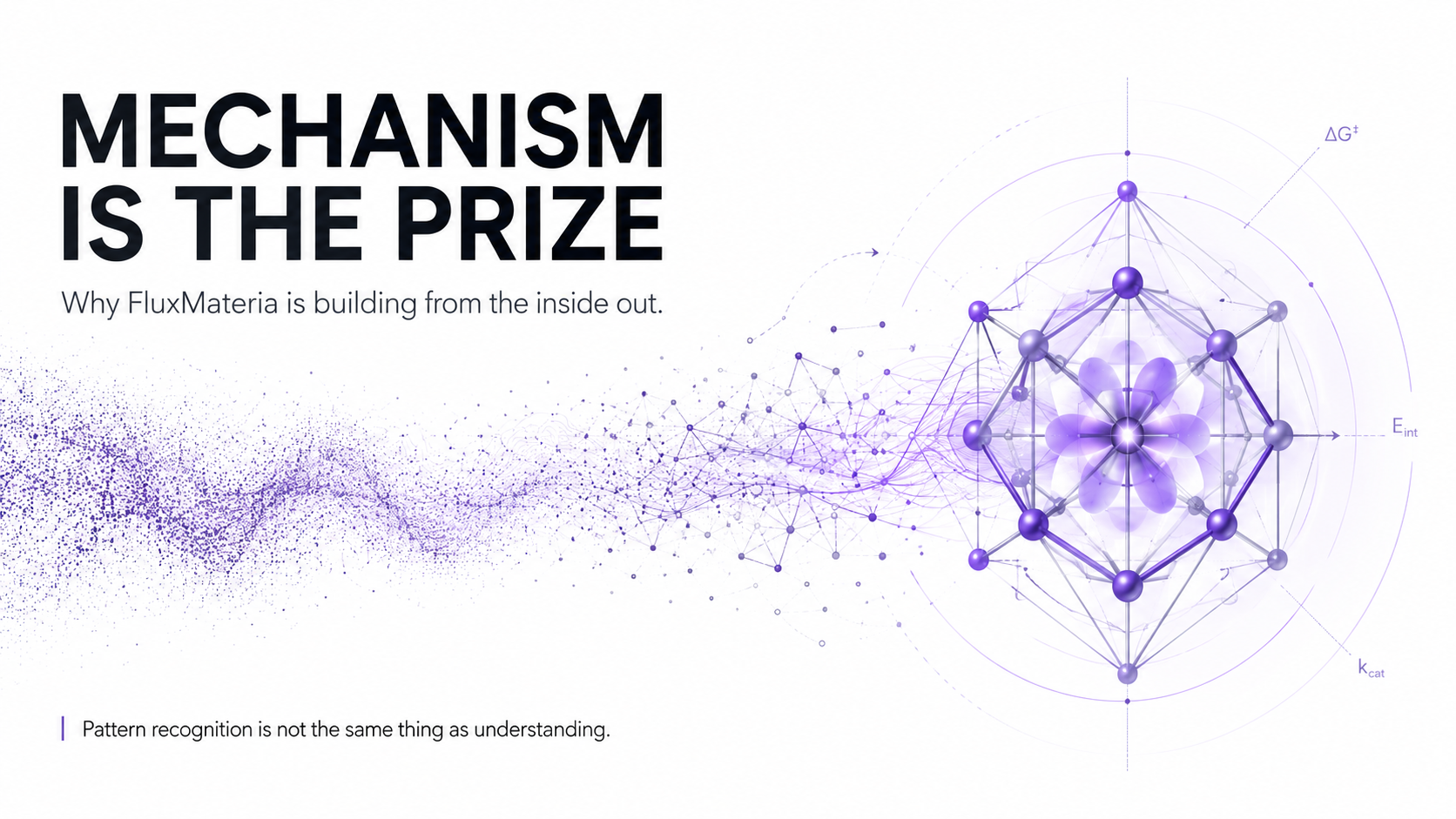
Mechanism Is the Prize: Why FluxMateria Is Building from the Inside Out
Modern computational science is betting heavily on scale: more data, more parameters, more GPUs. FluxMateria is following a different path — using physics-native computation to move closer to the mechanisms beneath chemistry, materials, and life sciences.
There is a quiet assumption underneath much of modern computational science:
If we scale the models enough, the truth will eventually emerge.
More data. More parameters. More GPUs. More pattern recognition.
And sometimes, that works beautifully.
Large-scale models have transformed what software can do. They can classify, generate, approximate, interpolate, and reveal patterns across domains where humans once had to search manually. In life sciences, chemistry, and materials research, data-driven methods have already become essential tools.
But pattern recognition is not the same thing as understanding.
A model can learn what tends to happen without knowing why it happens. It can predict an outcome without grasping the physical mechanism underneath it.
And in matter R&D, that distinction matters.
The limits of outside-in prediction
Most computational workflows approach matter from the outside in.
They begin with examples: known molecules, known materials, known targets, known measurements, known assay results, known crystal structures, known failed candidates, known successful compounds.
From there, models attempt to infer patterns.
This can be powerful when the new candidate resembles the old data. It can work well when the chemical space is familiar, when the domain is densely sampled, and when the question being asked is close to questions the model has already seen.
But the hardest problems in science are not always the ones with the most data.
Often, they are the places where the data runs out.
Novel compounds.
New materials.
Unseen targets.
Unexpected mechanisms.
Functional shifts.
Edge cases where correlation becomes fragile.
In these regimes, a model trained only to recognize precedent can become less reliable precisely when the problem becomes most important.
The question changes from:
What has happened before?
to:
What does this physical structure imply?
That is a different kind of question.
Why mechanism matters
A mechanism is not just a prediction.
It is a reason.
In chemistry, a mechanism explains why a reaction proceeds through one pathway instead of another.
In materials science, a mechanism explains why a composition produces a particular band gap, conductivity, thermal response, or mechanical property.
In life sciences, a mechanism explains why a molecule binds, why it misses, why it becomes toxic, why it shifts conformation, why it affects one target and not another.
Mechanism is what allows science to move from observation to understanding.
It is also what allows prediction to become useful when precedent is weak.
A purely pattern-based system may say:
“This candidate looks like others that worked.”
A mechanism-aware system asks:
“What does the geometry, energetics, and physical interaction structure say this candidate should do?”
Those are not the same thing.
The first is recognition. The second is reasoning.
Physics as a route back to causality
FluxMateria was built around a simple conviction:
Matter should be computed from the inside out.
That means starting from structure, physical constraints, interaction geometry, energetic relationships, and mechanism — not only from historical data.
Our goal is not to replace science with larger black boxes.
It is to make computation more physically intelligible.
In practical terms, this means building tools that can help answer questions like:
What properties does this structure imply?
Why does this mechanism dominate?
Where is the energetic bottleneck?
What makes this molecule developable or risky?
Why does this material behave differently from nearby compositions?
What should be tested next, and why?
The “why” matters.
Not because every computational result needs a philosophical explanation, but because R&D decisions are expensive. A team deciding whether to synthesize, screen, assay, optimize, patent, or abandon a candidate needs more than a score.
They need a reason to trust the signal. They need a way to interrogate it. They need to know whether the prediction is grounded in the physical structure of the system, or merely in resemblance to prior examples.
Where data-driven systems become fragile
Data-driven models are strongest where the data is rich, clean, and representative.
But matter R&D often violates all three assumptions.
Experimental datasets can be noisy. Assays vary. Negative results are underreported. Proprietary data is siloed. Chemical and materials spaces are effectively enormous. Biological systems are context-dependent. A model may perform well on a benchmark and still struggle when asked to reason beyond its training distribution.
That does not make data-driven methods useless.
Far from it.
But it does mean that pattern recognition alone is not enough.
The future of computational science should not be a choice between physics and AI, or between mechanism and scale.
The real frontier is integration — but integration must have a foundation.
Without mechanism, scale can produce confidence without understanding.
With mechanism, computation can become a tool for discovery rather than only approximation.
The FluxMateria approach
FluxMateria is a physics-native computation platform for chemistry, materials, and life-science R&D.
The core idea is simple:
Structure in. Physical signal out.
Instead of treating each domain as a separate modeling problem, FluxMateria approaches molecules, materials, reactions, spectra, ADMET behavior, target engagement, and developability as related expressions of physical structure.
That does not mean every problem is solved.
It does not mean every prediction should be trusted blindly.
It means the platform is designed around a different center of gravity.
Not “how much prior data can we memorize?”
But:
What does the physical system itself imply?
That shift changes the role of computation.
It turns computation from a filter into an investigative instrument.
It allows teams to screen earlier, reason faster, and reserve slower or more expensive methods — DFT, docking, molecular dynamics, synthesis, assays, and experimental validation — for candidates with stronger mechanistic signals.
From prediction to understanding
A prediction tells you what may happen.
A mechanism tells you why it may happen.
An explanation tells you what to do next.
This is why mechanism matters commercially as well as scientifically.
In early-stage discovery, teams are not just trying to label candidates. They are trying to decide where to spend attention, money, time, and experimental capacity.
A black-box score may help rank options.
A mechanism-aware signal can help shape strategy.
It can suggest which substitutions matter, which properties are coupled, which tradeoffs are real, which failures are structural, and which candidates deserve deeper investigation.
That is where computational science becomes more than acceleration.
It becomes leverage.
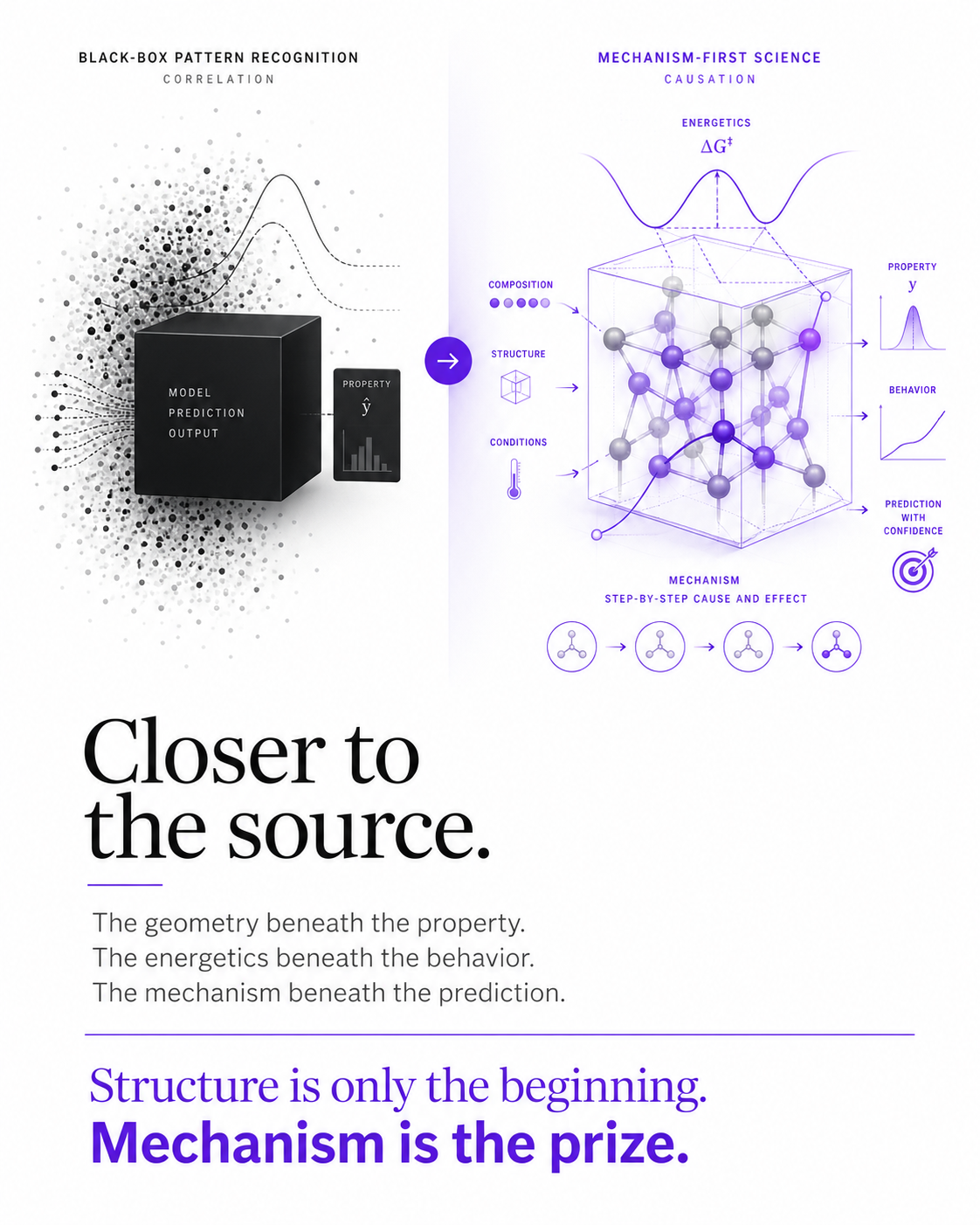
Closer to the source
Much of the industry is racing to approximate matter from the outside in.
More data. Bigger models. More compute.
FluxMateria is following another path.
Closer to the source.
The geometry beneath the property.
The energetics beneath the behavior.
The mechanism beneath the prediction.
This is not the loudest path.
It is not the most fashionable one.
But if the goal is to understand matter — not just classify it, not just imitate known outcomes, not just reproduce the past — then mechanism is the path that matters.
Structure is only the beginning.
Mechanism is the prize.
Explore FluxMateria
FluxMateria helps R&D teams compute broadly before they simulate deeply — across chemistry, materials, and life sciences.
Run more ideas earlier. Understand why candidates move forward. Reserve expensive validation for the strongest signals.